The Fractured
Mask
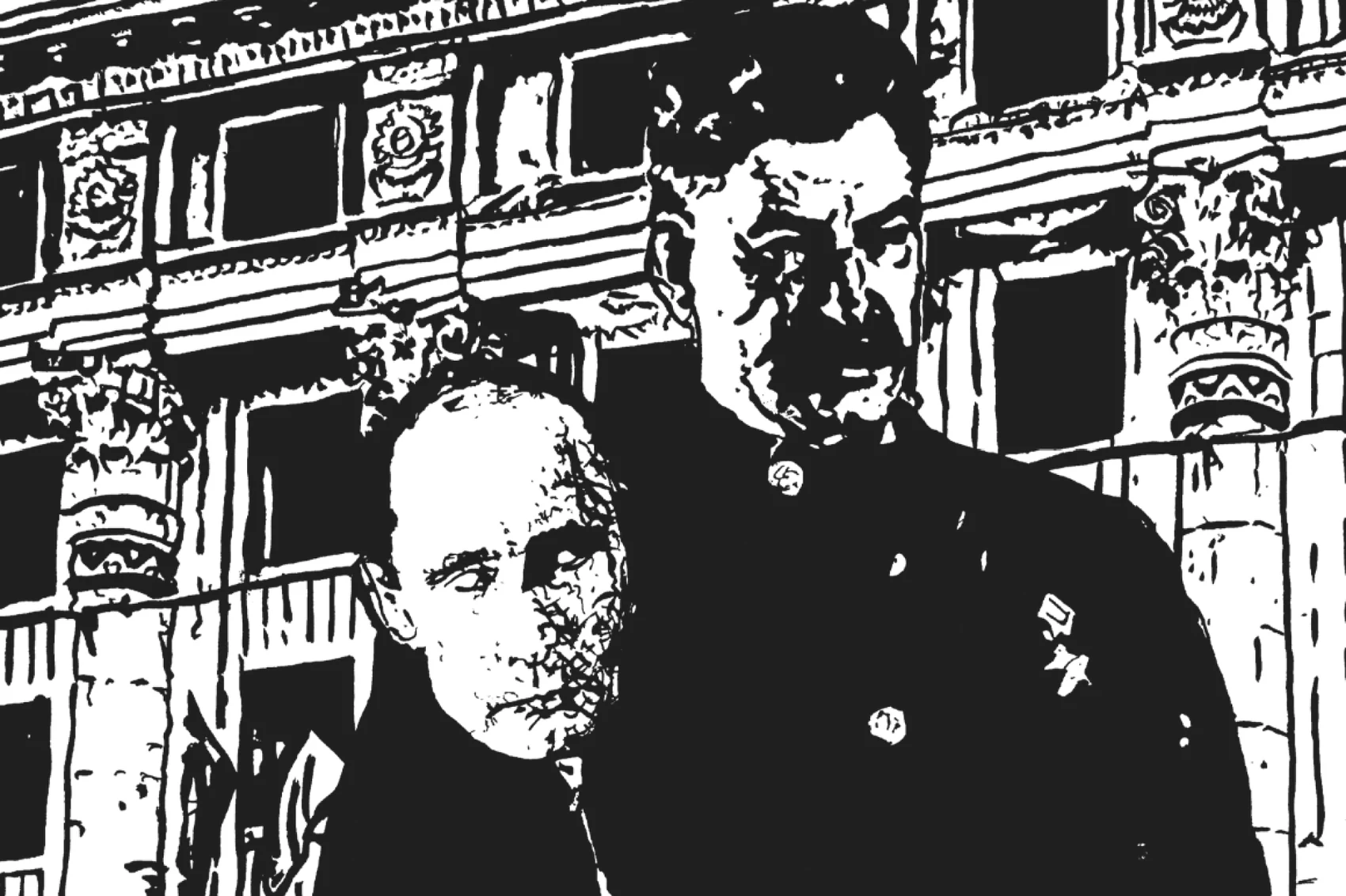
Two political faces occupy the centre of a city that has already been struck. One is carried by the other; the face in front seems to break apart.
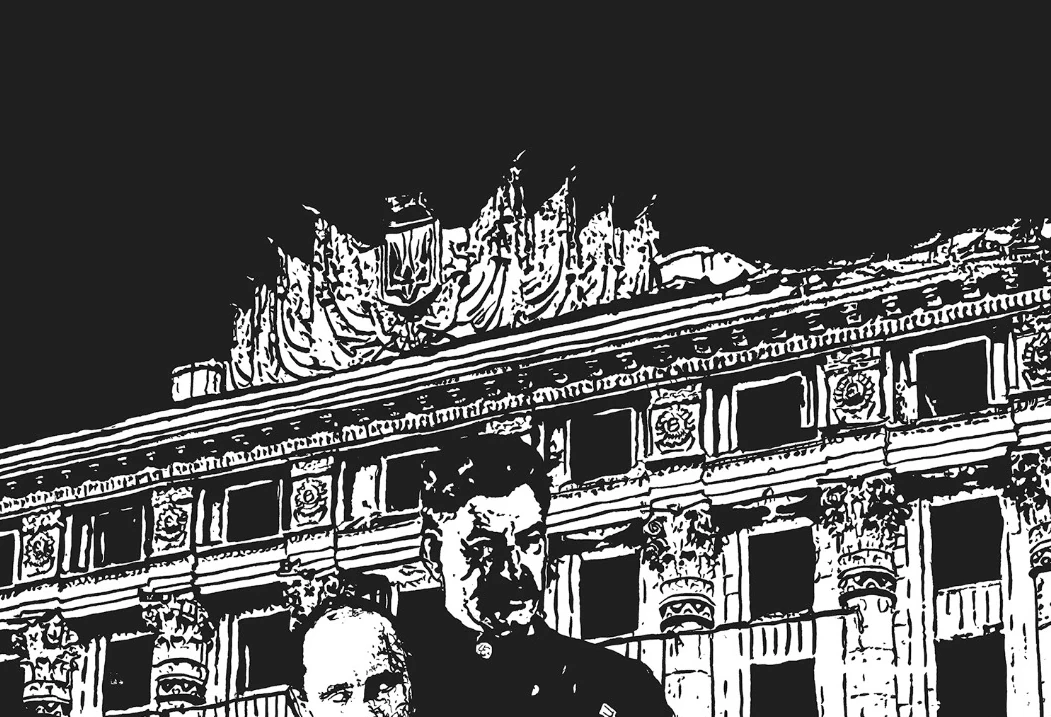
The drawing was made in the first year of Russia’s full-scale invasion of Ukraine. Behind the figures stands the damaged Kharkiv Regional State Administration on Freedom Square, its windows emptied by blast and fire. Above the façade, the Ukrainian trident remains visible.
The title turns the human face into an object of political performance. A mask can imitate, conceal or inherit. Here it is fractured: the image asks whether a later system of power can present itself as new while repeating older methods of coercion, denial and destruction.
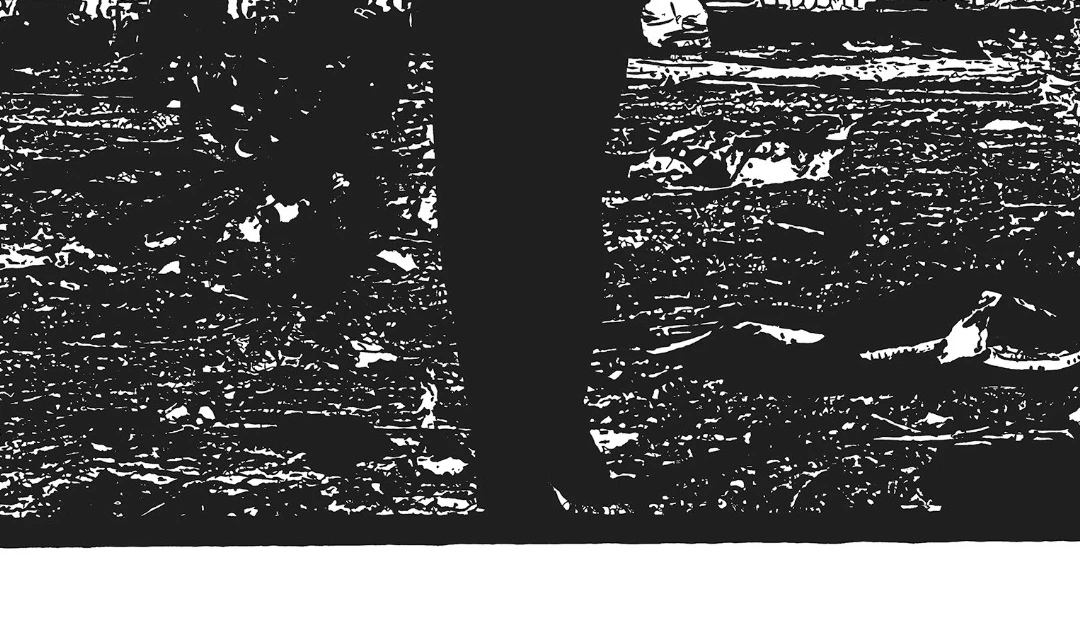
A face, a façade, a field of debris
The composition makes political power and damaged architecture inseparable. The figures do not stand before a neutral cityscape: the broken building is part of their meaning.
Kharkiv, 1 March 2022
On 1 March 2022, only days after the full-scale invasion began, a Russian missile struck Freedom Square in central Kharkiv and severely damaged the Regional State Administration building. The attack became one of the defining early images of the war: a monumental civic building blasted open in the centre of Ukraine’s second-largest city.
Read full historical context
Kharkiv, 1 March 2022
On 1 March 2022, only days after the full-scale invasion began, a Russian missile struck Freedom Square in central Kharkiv and severely damaged the Regional State Administration building. The attack became one of the defining early images of the war: a monumental civic building blasted open in the centre of Ukraine’s second-largest city.
The building itself adds another historical layer. Erected in the Soviet period and completed in 1954, it belongs to the monumental architecture of the post-war USSR. In independent Ukraine it continued to serve regional government, its Soviet political function replaced while the architecture remained. In the drawing, the Ukrainian coat of arms crowns a façade inherited from another state.
Stalin, famine and the politics of memory
The older history invoked by the work is the catastrophe of 1932–33. Forced collectivisation, grain requisitions, punitive measures and restrictions on movement contributed to a famine that killed millions across the Soviet Union and struck Soviet Ukraine with exceptional severity. Ukrainians commonly refer to this famine as the Holodomor.
The question of intention has generated a long historical debate. Ukraine and many states now recognise the Holodomor as genocide; other scholars and governments distinguish between a deliberately intensified famine in Ukraine and a broader Soviet famine that also devastated Kazakhstan and other regions. What is not in serious dispute is the central responsibility of Stalinist policy for the catastrophe, or the Soviet state’s efforts to conceal and deny it.
The comparison in the drawing
The work does not claim that the Soviet 1930s and the Russian invasion of 2022 are identical historical events. Its comparison is about political method. In a later description of the drawing, Alexandre Mitchell characterised it as a contrast between Stalin’s established brutality and the war in Ukraine under Vladimir Putin: two forms of violence joined by deception and destruction.
That distinction matters. Historical analogy becomes unhelpful when it erases differences. Here the visual device is narrower: one figure appears through another as a fractured mask, asking how authoritarian power uses inherited narratives, controlled information and the language of historical destiny to legitimise present violence.
Violence
The drawing begins from an actual damaged city. Political analogy is grounded in the material consequences of war.
Denial
The Holodomor was concealed by the Soviet state; the contemporary war has likewise been accompanied by systematic propaganda and competing narratives about responsibility.
Inheritance
The mask suggests continuity without identity: a later regime can draw on older symbols, myths and habits of power without simply reproducing the past.
Kharkiv as more than a backdrop
Kharkiv’s architectural heritage has suffered repeatedly since February 2022. The Regional State Administration on Freedom Square is only one highly visible example. Cultural-heritage organisations have continued to document damage to historic buildings across the city and region.
This gives the architecture in The Fractured Mask a double function. It records a particular moment in 2022, but it also belongs to a much larger story about what happens to cities when war attacks not only people and infrastructure, but the material evidence through which a place remembers itself.
Why a fractured mask?
A mask usually offers a complete surface. This one does not. Its fragmentation prevents the foreground face from becoming a stable portrait and turns it instead into something provisional — a political identity that is visibly constructed.
The figure behind remains more solid. The visual effect is not simple resemblance but dependence: the present seems to borrow a shape from the past.
The fracture is therefore the critical space in the drawing. It is where historical comparison becomes visible without becoming equivalence.
Exhibition history
View exhibition history
Exhibition history
- European Jewish Community Centre, Brussels8 December 2023 – 15 January 2024 · original drawing
- Full Circle, Brussels3 February – 25 April 2024 · original drawing
- Teloglion Fine Arts Foundation, Thessaloniki8 October – 10 November 2024 · original drawing
- European Parliament, Brussels30 September 2025 · Members’ Salon · lithograph
Lithograph · 2024
A signed and numbered hand-printed lithographic edition was produced in 2024 by Bruno Robbe from the 2022 drawing.
€250 · Brussels hand delivery by appointment · Elsewhere in Belgium & EU: €15 packaging/shipping · EU delivery only
Buy this lithographBrussels hand delivery · €250Kharkiv, Holodomor and historical analogy
View sources & further reading
Kharkiv, Holodomor and historical analogy
- Smithsonian Cultural Rescue Initiative et al., Rapid Site Report: Freedom Square, Kharkiv, Ukraine, in March 2022, documenting damage to Freedom Square and the Regional State Administration. Read report.
- Ukrainian Institute, “Freedom Square (Maidan Svobody),” on the square, the Regional State Administration and the 2022 attack. Read online.
- Anne Applebaum, Red Famine: Stalin’s War on Ukraine, 2017.
- Andrea Graziosi, “Les famines soviétiques de 1931–1933 et le Holodomor ukrainien,” Cahiers du monde russe 46/3, 2005.
- UK House of Commons Library, “Ukrainian Holodomor and the war in Ukraine,” on collectivisation, famine, genocide recognition and the continuing historical debate. Read briefing.
- UNESCO, ongoing verified assessment of cultural sites damaged in Ukraine. Damage assessment.
- Alexandre Mitchell, speech at the European Parliament, 30 September 2025, describing the work as a contrast between Stalinist brutality and the war in Ukraine under Putin. Speech PDF.