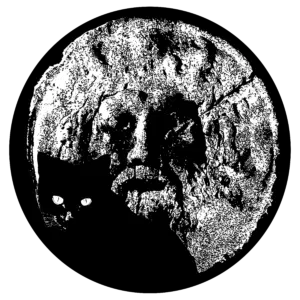
Dante sotto
la città
Florence does not stand behind Dante. It grows out of him.
The poet’s face is fused with the dome and fabric of Santa Maria del Fiore. The city occupies the upper part of the head; the face emerges beneath it, partly absorbed into the same black field. Portrait and architecture are no longer separate subjects.
The image is deliberately impossible in historical terms. Dante died in 1321. Brunelleschi’s dome was begun almost a century later, in 1420, and completed in 1436. This is therefore not Dante’s Florence reconstructed. It is the Florence that came after him, placed retrospectively upon the poet whose language became inseparable from the city’s cultural identity.
One face, two centuries
The drawing works by refusing a clean boundary between person and place. The dome crowns Dante, but it also replaces part of his head; the city becomes both memory and mask.
Painting the darkness around the image
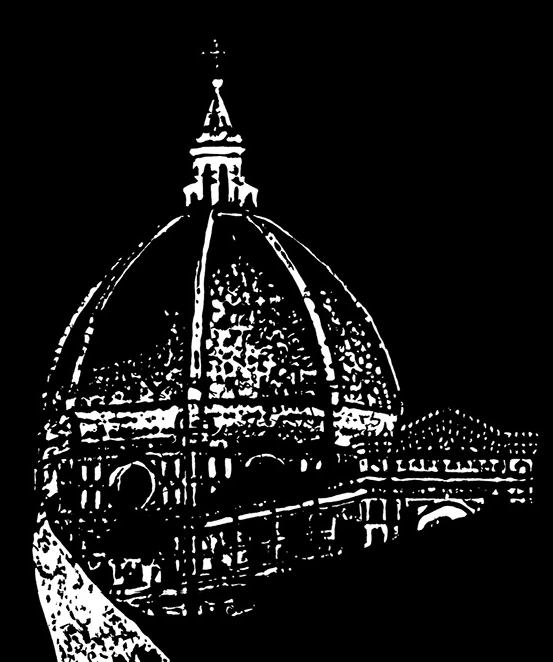
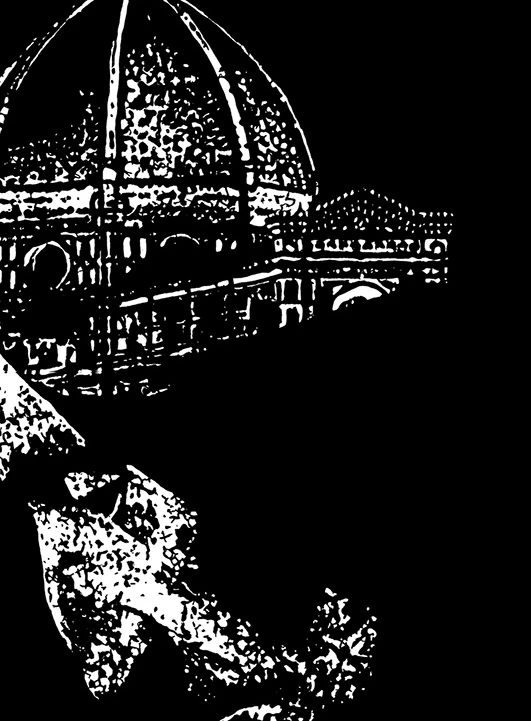
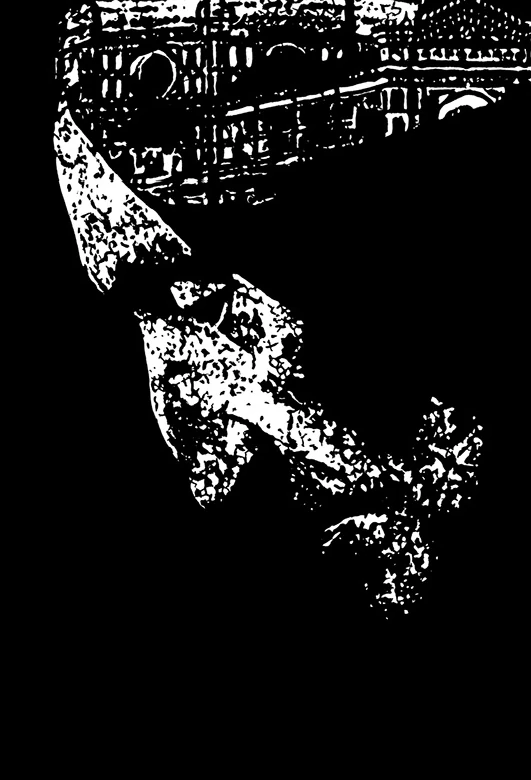
The surviving work-in-progress photograph makes the technique unusually clear. The drawing is painted in black ink, not in white. The luminous architecture and face are the paper left uncovered as the black field advances around them.
View process & sketches
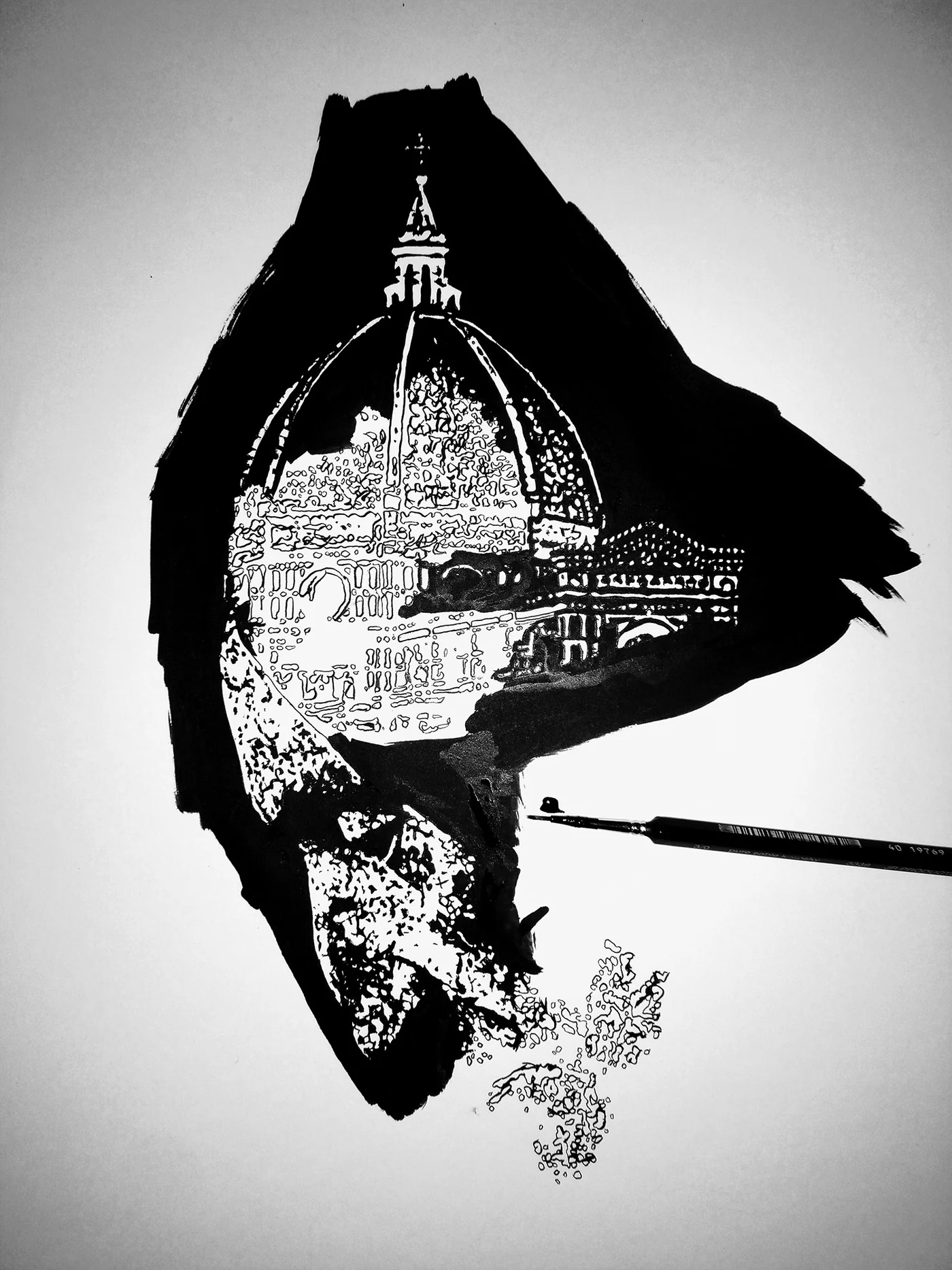
Painting the darkness around the image
The surviving work-in-progress photograph makes the technique unusually clear. The drawing is painted in black ink, not in white. The luminous architecture and face are the paper left uncovered as the black field advances around them.
This reverses the normal logic of drawing. Instead of adding highlights to darkness, the image is excavated from it. Details appear because they have not been painted over.
That process suits the subject. Dante and Florence seem less constructed than uncovered — as though one had been buried inside the other.
Dante’s Florence — and Florence after Dante
Dante Alighieri was born in Florence in 1265 and spent the first part of his life there before political conflict forced him into exile in 1302. He died in Ravenna in 1321 and never returned to the city that later made him one of its most powerful cultural symbols.
Read full historical context
Dante’s Florence — and Florence after Dante
Dante Alighieri was born in Florence in 1265 and spent the first part of his life there before political conflict forced him into exile in 1302. He died in Ravenna in 1321 and never returned to the city that later made him one of its most powerful cultural symbols.
The face we think we know
The portrait used in the drawing derives from the so-called death mask associated with Dante and preserved in Florence’s Palazzo Vecchio. It is a compelling object, but not a direct cast taken from the dead poet’s face. Nineteenth- and twentieth-century study rejected it as a genuine death impression; it may preserve, at a greater distance, the features of an older portrait tradition.
That uncertainty is useful rather than inconvenient for the drawing. Dante’s face has itself become a construction of memory: repeated in monuments, paintings, books and tourist imagery until an uncertain likeness acquires the authority of recognition.
A city Dante never saw
Santa Maria del Fiore was already under construction during Dante’s lifetime: its first stone was laid in 1296. But the dome that now defines Florence’s skyline belongs to the fifteenth century. Filippo Brunelleschi began its construction in 1420; the cathedral was consecrated with the dome closed in 1436.
Placing that dome on Dante’s head therefore collapses time. The poet is crowned by a Renaissance city that did not yet exist in this form when he died.
1321
Dante dies in Ravenna, still in exile from Florence.
1420–1436
Brunelleschi’s dome is built and becomes the defining visual symbol of Florence.
Language as another monument
Dante’s importance to Italian is sometimes compressed into the phrase “father of the Italian language.” The history is more complex, but the association is justified by scale. The Commedia demonstrated the extraordinary expressive range of the vernacular, and Dante’s work, together with that of Petrarch and Boccaccio, gave Florentine Tuscan a literary prestige that profoundly shaped the later national language.
In this sense, the drawing brings together two monuments to Florence: one built in brick, the other built in language.
Sotto la città
The Italian title can be read literally: Dante is “under the city.” But the relationship is not one of simple burial. Florence rests on him while also entering him.
The city has appropriated the exile it once expelled. Dante is everywhere in Florence today — in monuments, museum displays, street names and cultural memory — although his body remains in Ravenna.
The drawing holds that contradiction without resolving it: the absent citizen has become one of the city’s most permanent presences.
Exhibition history
View exhibition history
Exhibition history
- Full Circle, Brussels3 February – 25 April 2024 · original drawing
- Teloglion Fine Arts Foundation, Thessaloniki8 October – 10 November 2024 · lithograph
- Musée BIBLE+ORIENT, University of Fribourg25 March – 25 December 2025 · lithograph
Lithograph · 2023
A signed and numbered hand-printed lithographic edition was produced in 2023 by Bruno Robbe from the 2022 drawing.
€250 · Brussels hand delivery by appointment · Elsewhere in Belgium & EU: €15 packaging/shipping · EU delivery only
Buy this lithographBrussels hand delivery · €250Dante, language and Florence
View sources & further reading
Dante, language and Florence
- Zygmunt G. Barański & Simon Gilson (eds), The Cambridge Companion to Dante’s ‘Commedia’, Cambridge University Press, 2018.
- Guy P. Raffa, The Complete Danteworlds: A Reader’s Guide to the Divine Comedy, University of Chicago Press, 2009.
- Treccani, Enciclopedia dell’Italiano, on Dante, the early Tuscan vernacular and the later literary prestige of Florentine. Read online.
- Opera di Santa Maria del Fiore, official history of Brunelleschi’s dome and the cathedral complex. Official site.
- Regione Emilia-Romagna / Museo Dante, catalogue record on the so-called Dante mask and the rejection of its identification as a genuine death cast. Catalogue record.