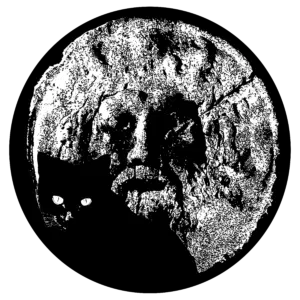
The Lost Children:
Franco’s Spain
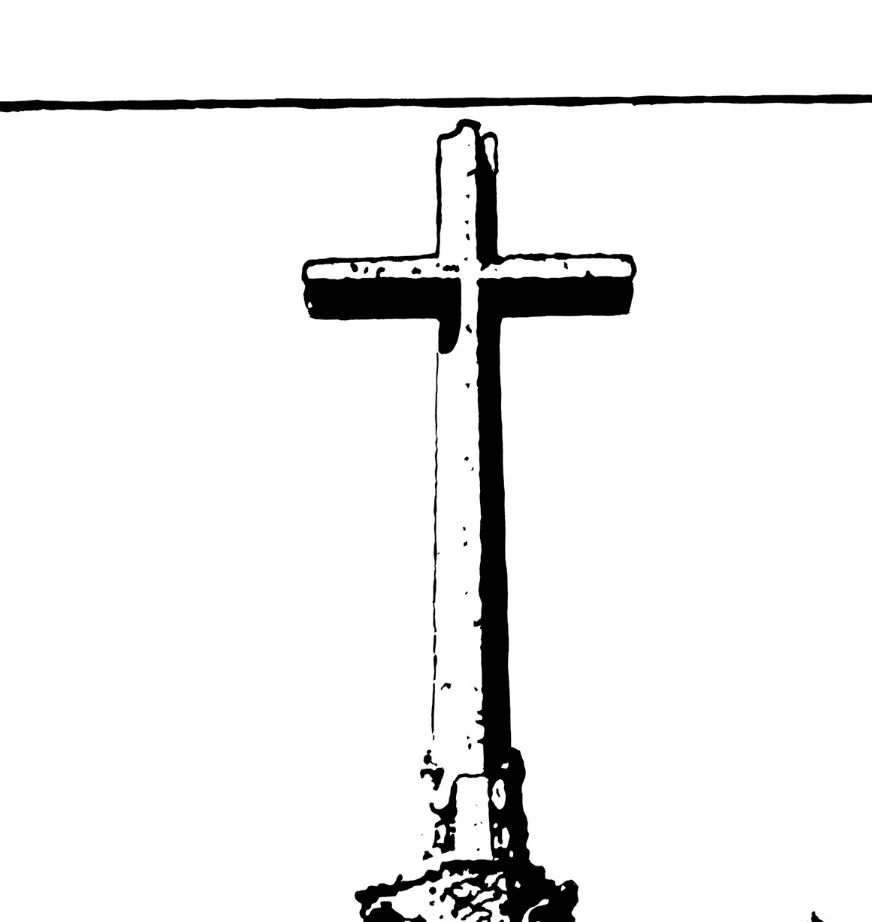
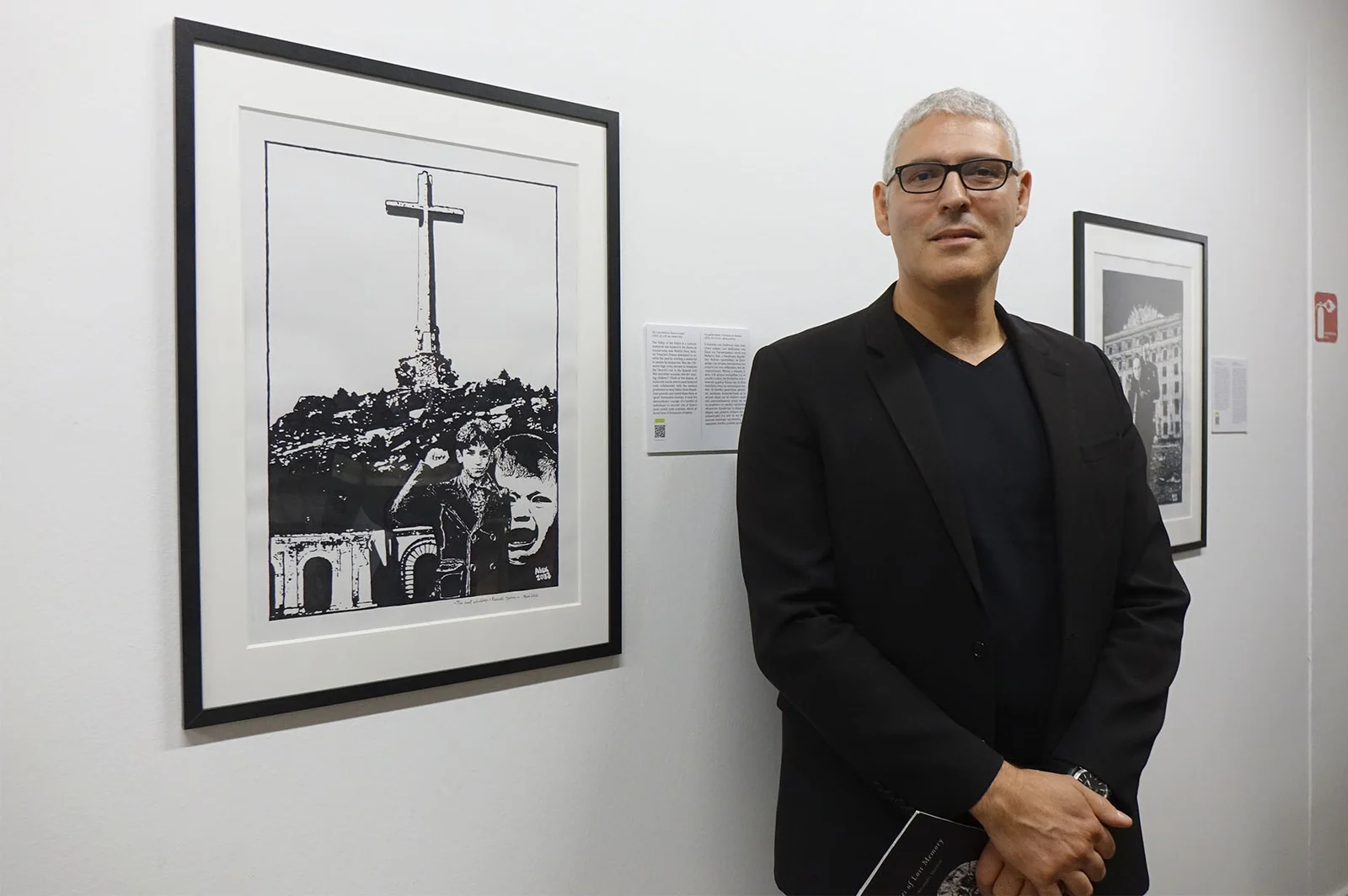
A monumental cross rises over children whose gestures belong to another history: protest, fear, separation and survival.
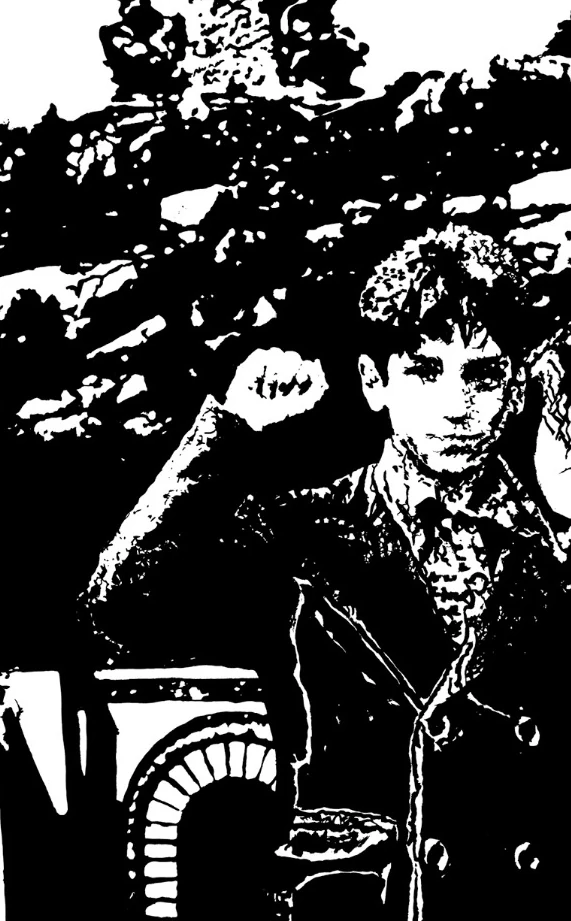
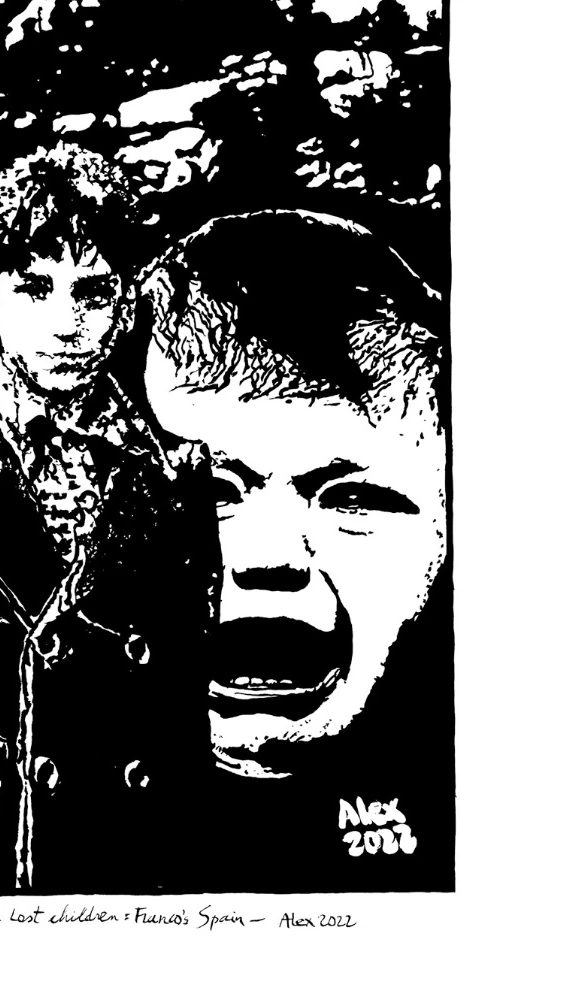
The drawing brings together two legacies of Francoist Spain that are rarely seen in the same image. Above stands the immense cross of the former Valley of the Fallen, now officially the Valle de Cuelgamuros. Below are children: one raises a clenched fist; another cries out; architectural fragments crowd the lower edge.
The composition refuses the monumental distance usually associated with Cuelgamuros. The cross may dominate the skyline, but the human story has been pushed into the foreground. The title turns attention away from the dictator and towards children whose family histories were fractured by war, imprisonment, political repression and systems of forced or irregular separation.
Monument, gesture, child
The work is built as a collision of scales. The monument asserts permanence. The children bring movement, vulnerability and unresolved memory back into the image.
Building the image from the monument down
The preparatory material shows that the cross and the hillside established the vertical axis first. The children and architectural fragments were then brought into the lower half, gradually changing the drawing from a landscape of power into a human confrontation with that landscape.
View process & sketches
Building the image from the monument down
The preparatory material shows that the cross and the hillside established the vertical axis first. The children and architectural fragments were then brought into the lower half, gradually changing the drawing from a landscape of power into a human confrontation with that landscape.
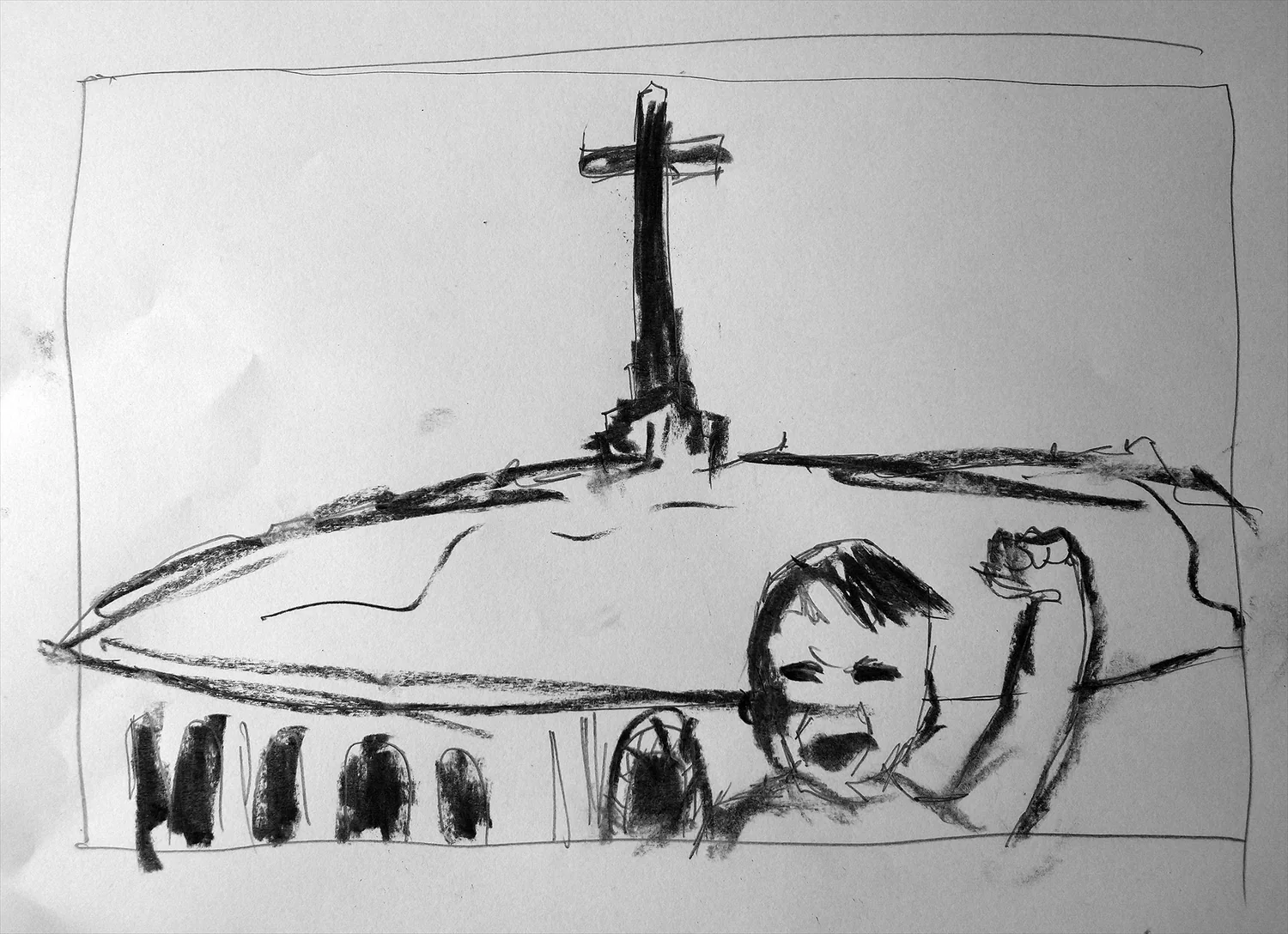
Initial compositional sketch: the cross, hillside, arches and crying child are already locked into the same frame.
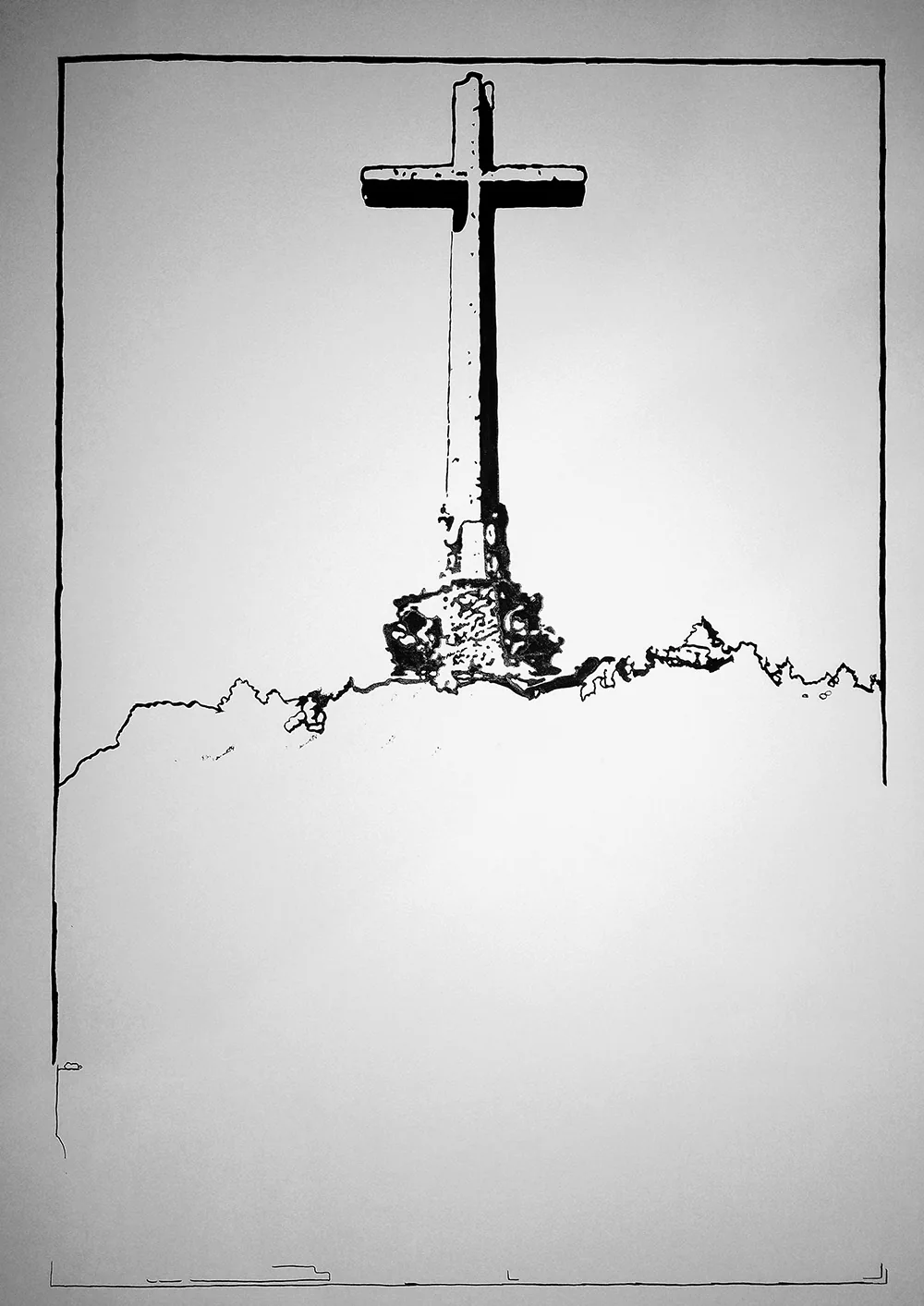
Early stage: the cross and ridge are established while most of the lower sheet remains open.
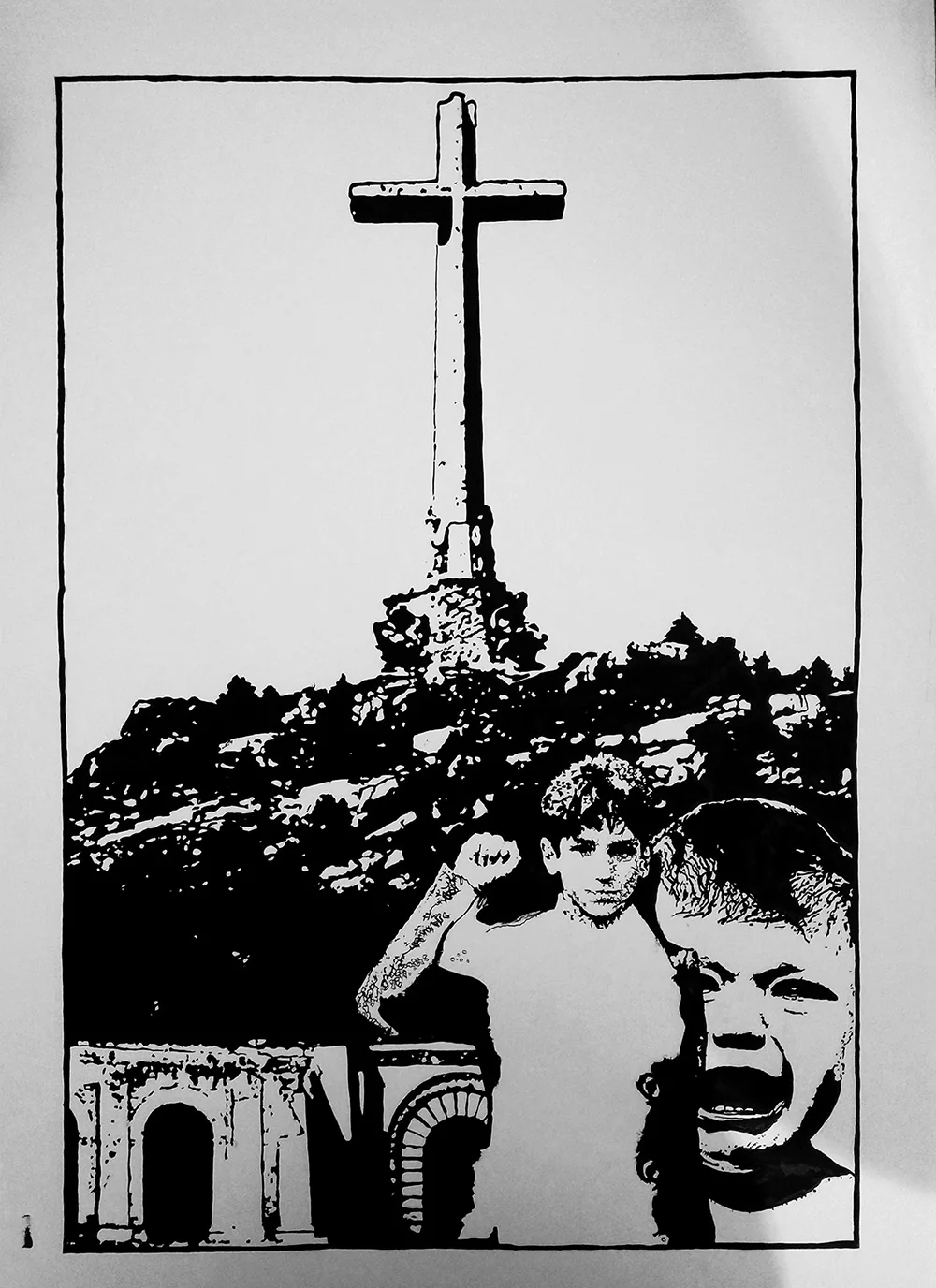
Later stage: the raised-fist figure and crying child enter the image beneath the monument.
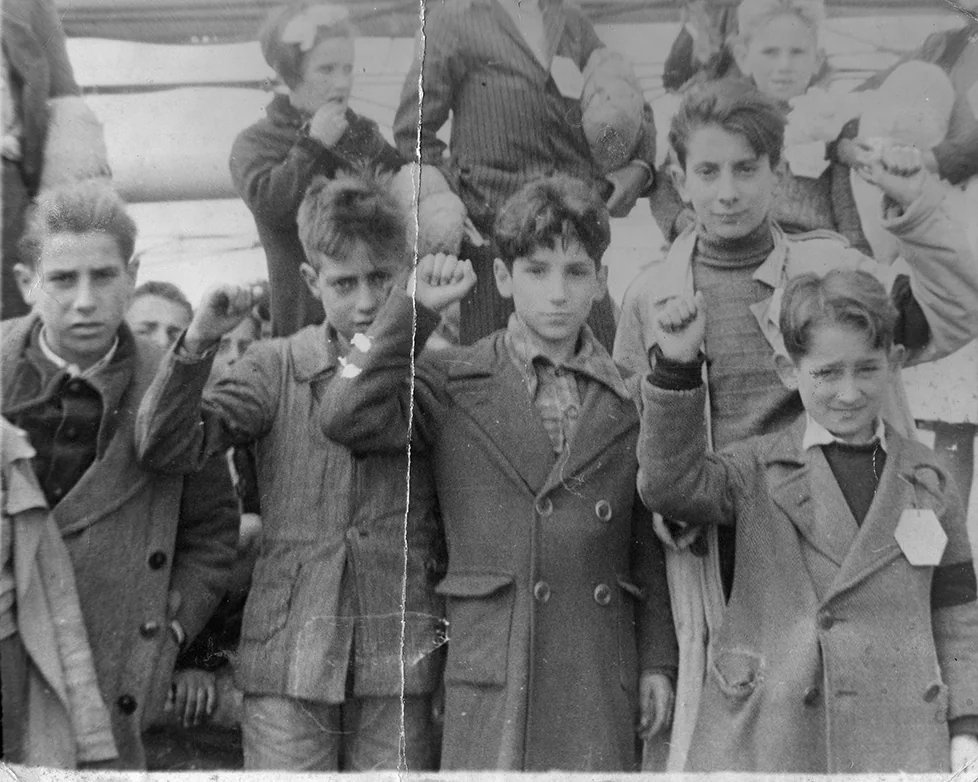
The monument was never a neutral backdrop
The military uprising of July 1936 against Spain’s democratic Second Republic led to a civil war that ended with Franco’s victory in 1939 and the establishment of a dictatorship that lasted until 1975. Cuelgamuros was conceived within that victory, not after it.
Read full historical context
The monument was never a neutral backdrop
The military uprising of July 1936 against Spain’s democratic Second Republic led to a civil war that ended with Franco’s victory in 1939 and the establishment of a dictatorship that lasted until 1975. Cuelgamuros was conceived within that victory, not after it.
From the Valley of the Fallen to Cuelgamuros
Franco ordered the construction of the monument in 1940. It took around nineteen years to complete and was inaugurated on 1 April 1959, the twentieth anniversary of his victory. Spanish government research now describes it as the principal monument of Francoism: a site conceived to celebrate military victory and initially to house the bodies of the victorious side.
Penal labour was used extensively in its construction. Over time, more than 33,000 people killed in the Civil War were transferred to its crypts. Those remains eventually included Republican soldiers and Republican civilians executed by Francoist forces; some were moved from mass graves without the knowledge or consent of their families.
The “lost children” were not one single phenomenon
The phrase niños perdidos del franquismo has been used for several forms of separation that must be distinguished rather than collapsed into one story. During and after the Civil War, children of Republican families could be separated from imprisoned, executed, displaced or politically stigmatised parents. Juvenile courts, welfare institutions and state-linked Catholic organisations participated in systems that judged some families politically or morally unfit to retain custody.
Historian Peter Anderson has shown that the removal of children from Franco’s political opponents formed part of a much larger history of state guardianship and juvenile justice. Ricard Vinyes and the documentary work of Montse Armengou and Ricard Belis brought the phrase “lost children of Francoism” into wider public memory by tracing forced separation, prison childhoods, state institutions and irregular adoptions.
From political repression to the later “stolen babies” cases
A related but not identical history continued beyond the immediate post-war repression. Thousands of later allegations concern newborn babies who may have been falsely declared dead, removed or given to other families through hospitals, maternity homes and charitable institutions. Amnesty International has documented complaints extending from the end of the Civil War into the democratic period, noting state responsibility or complicity in the early years and cases involving institutions run by religious congregations.
These later cases should not be used to simplify the earlier political removal of Republican children, nor should every adoption or disappearance be treated as proven theft. What links the histories is the prolonged loss of identity and the difficulty many families have faced in obtaining records, investigation and answers.
War
Families were broken by death, exile, imprisonment and displacement during the Civil War.
Dictatorship
Political and moral judgements about Republican and poor families shaped systems of custody, institutionalisation and re-education.
Afterlife
For many descendants, the unresolved question is not only what happened, but where the documentary evidence and missing identities went.
Cuelgamuros after Franco
Francisco Franco was buried in the basilica in 1975 and remained there until his exhumation on 24 October 2019. Spain’s 2022 Democratic Memory Law then formally changed the site’s name from the Valle de los Caídos to the Valle de Cuelgamuros and defined it as a place of democratic memory intended to explain the circumstances of its construction and the dictatorship in which it was created.
In April 2023, the remains of José Antonio Primo de Rivera, founder of Falange Española, were also removed from their privileged place in the basilica and transferred by his family to Madrid.
The monument therefore continues to change after the drawing was completed. Its stone remains fixed; its official meaning does not.
Exhibition history
View exhibition history
Exhibition history
- Full Circle, Brussels3 February – 25 April 2024 · original drawing
- Teloglion Fine Arts Foundation, Thessaloniki8 October – 10 November 2024 · original drawing
Francoism, child removal and Cuelgamuros
View sources & further reading
Francoism, child removal and Cuelgamuros
- Government of Spain, Valle de Cuelgamuros, official historical framework for the monument, its construction, burials and changing memorial status. Read online.
- Patrimonio Nacional, current institutional description of the Valle de Cuelgamuros and the 33,847 people buried there. Read online.
- Peter Anderson, The Age of Mass Child Removal in Spain: Taking, Losing, and Fighting for Children, 1926–1945, Oxford University Press, 2021. Oxford Academic.
- Ricard Vinyes, Montse Armengou & Ricard Belis, Los niños perdidos del franquismo, 2002 — on separation, institutions, prison childhoods and irregular adoptions. Book record.
- Amnesty International Spain, “Tiempo de verdad y de justicia,” on allegations of disappearance, appropriation and substitution of identity in the later “stolen babies” cases. Read online.
- Law 20/2022 on Democratic Memory, Article 54, renaming the former Valley of the Fallen as Valle de Cuelgamuros and redefining its public memorial function. BOE.