Redemption
Is in the Deep
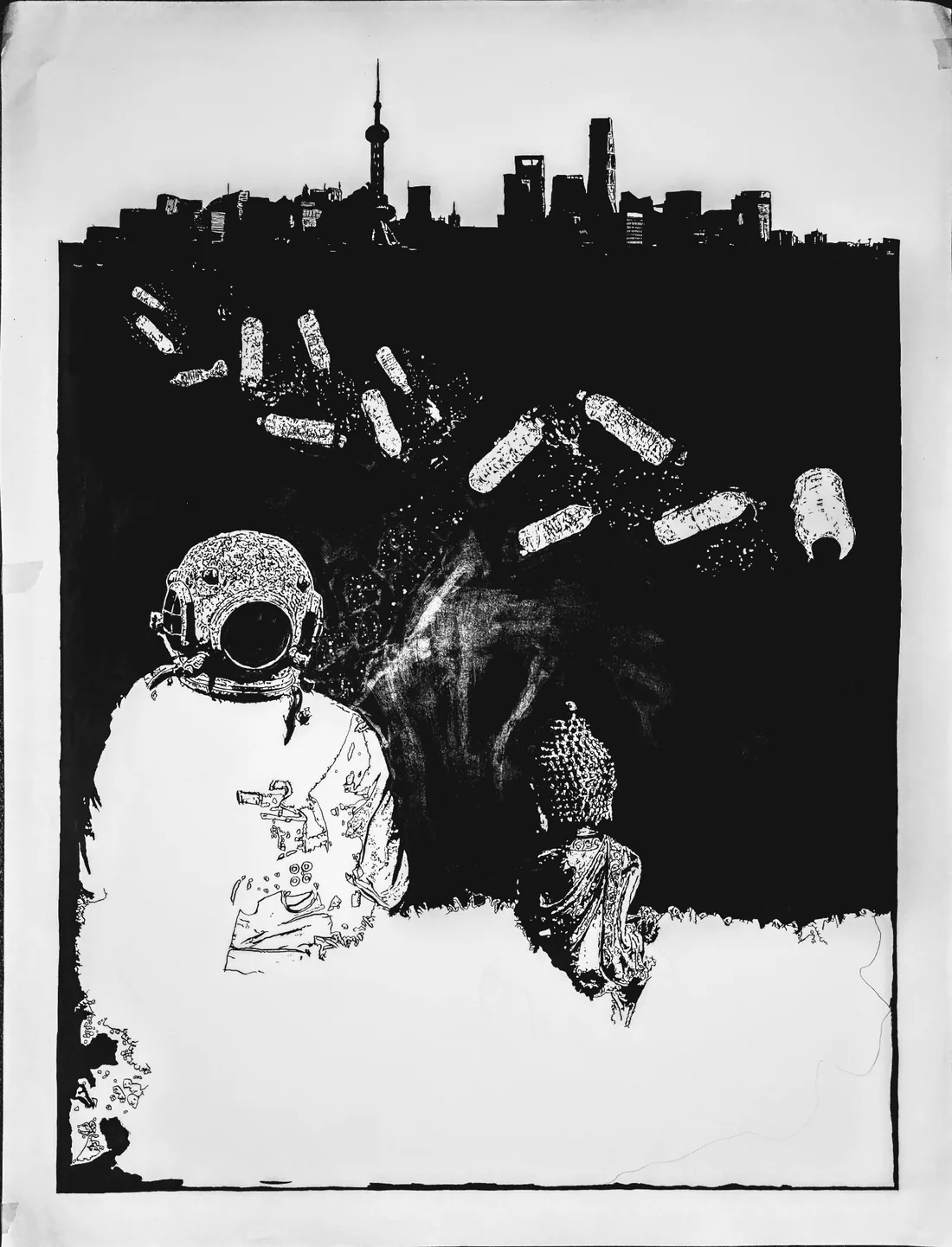
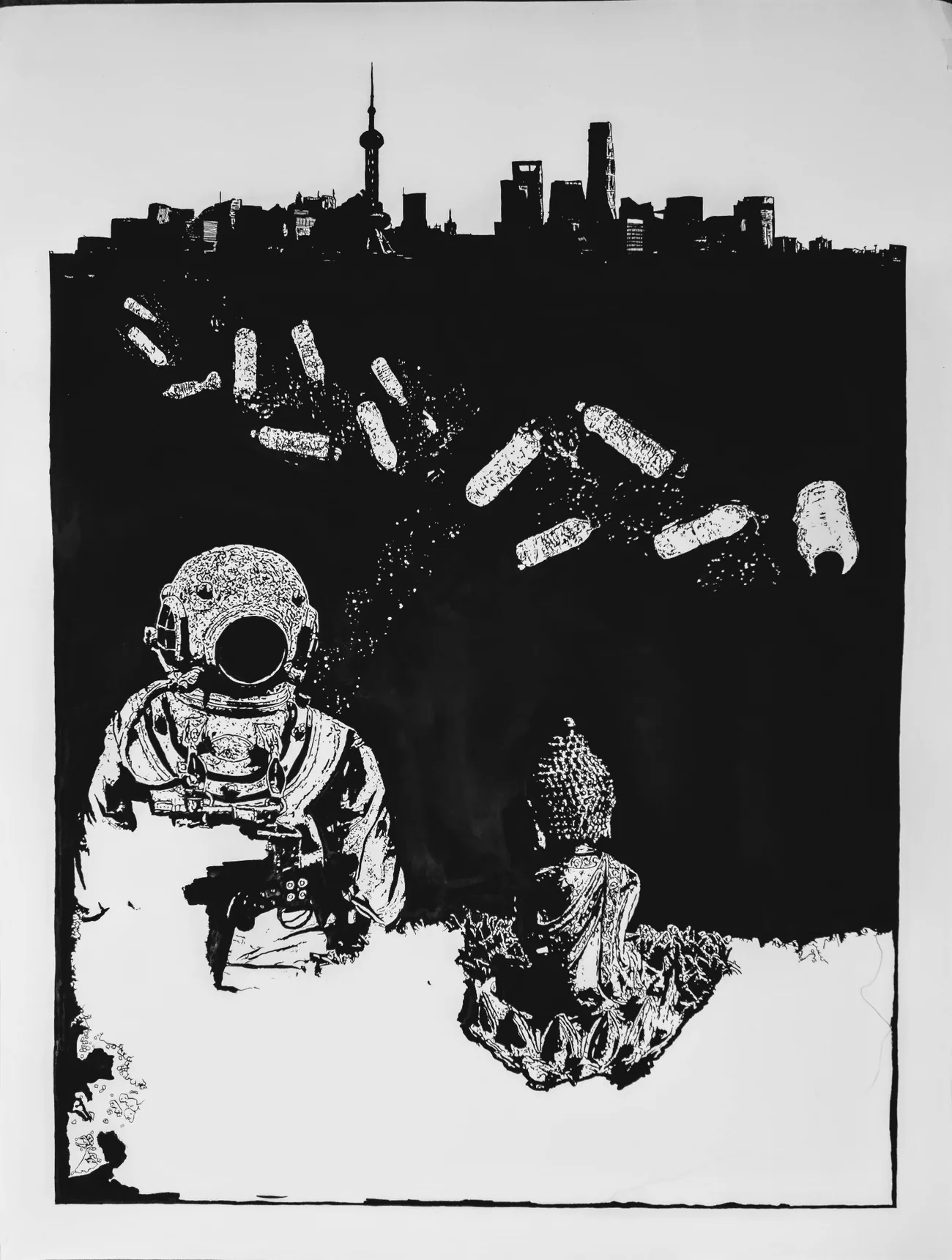
Shanghai rises as a black silhouette above a submerged world. Plastic bottles drift downward between a hard-hatted diver and a seated Buddha. The city is modern, vertical and triumphant; below it, the sea absorbs what the surface discards.
Not from a journey, but from a collision of ideas.
I have never been to China. This drawing did not begin with a remembered place in the way Thessaloniki or Berlin did. It began with images and ideas: the extraordinary skylines of rapidly transformed Asian cities, the scale of industrial growth, plastic accumulating in the seas, and the persistence of much older spiritual traditions inside radically modern environments.
The tension that interested me was not “East versus West”, nor a simple moral ranking of countries. It was the collision between different historical rhythms of industrialisation and the question of how late-industrialising powers pursue development at a moment when the environmental costs of the older industrial model are already impossible to ignore.
The black field came first.
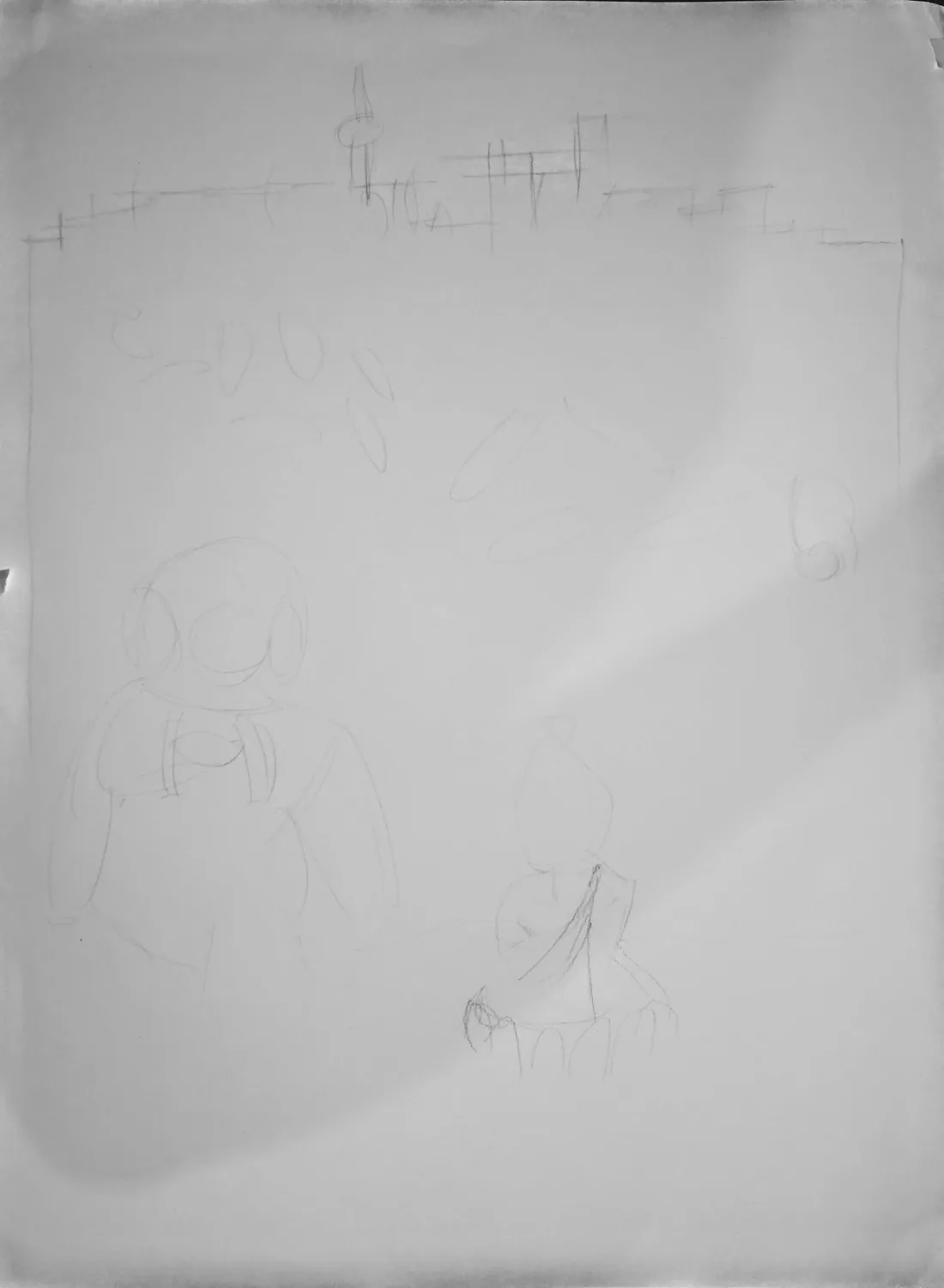
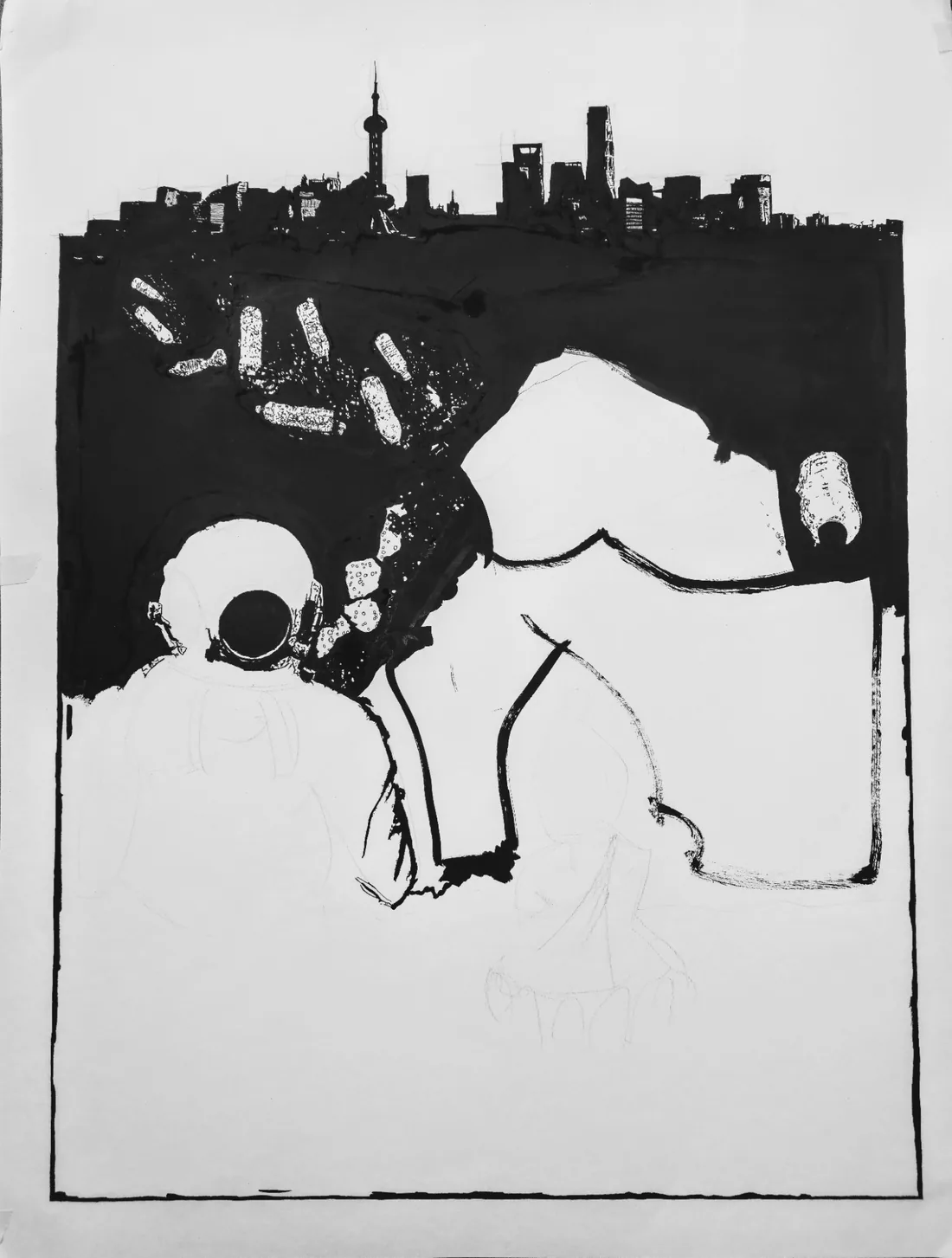
The progress photographs reveal how heavily the composition depends on large areas of ink. The skyline is established early, then the submerged figures and floating bottles are gradually cut out of the darkness.
View process & sketches
The black field came first.
The progress photographs reveal how heavily the composition depends on large areas of ink. The skyline is established early, then the submerged figures and floating bottles are gradually cut out of the darkness.
Modernity above, consequences below
Unlike many works in Lost Memory, this drawing is not built around a single historical episode. It is closer to a visual argument. The Shanghai skyline stands for the astonishing speed and confidence of contemporary urban transformation. The plastic bottles below it stand for another dimension of the same modernity: mass production, consumption and waste.
Read full historical context
Modernity above, consequences below
Unlike many works in Lost Memory, this drawing is not built around a single historical episode. It is closer to a visual argument. The Shanghai skyline stands for the astonishing speed and confidence of contemporary urban transformation. The plastic bottles below it stand for another dimension of the same modernity: mass production, consumption and waste.
The diver belongs to an older technological world. The heavy helmet suggests nineteenth- and early twentieth-century exploration of the seabed rather than sleek contemporary equipment. Opposite him sits the Buddha, immobile amid the debris. Neither figure “solves” the scene. They introduce two radically different ways of entering the deep: one through technology, the other through contemplation.
Uneven industrial histories
The environmental question behind the drawing is difficult precisely because industrial development has not occurred everywhere at the same time. Europe’s great phase of coal-driven industrialisation began much earlier; its wealth and urban infrastructure were built through processes whose environmental consequences became fully visible only later. Rapidly industrialising powers such as China and India have faced a different historical sequence: development has accelerated while knowledge of climate change, pollution and resource depletion is already part of the global conversation.
The drawing therefore should not be read as an argument that Europe occupies a position of environmental innocence. European consumption has long depended on global supply chains, imported goods and environmental costs displaced elsewhere. What interested me was the asymmetry: societies are being asked to restrain an industrial model at very different moments in their own economic histories.
The Buddha under the skyline
The seated Buddha is not intended as a shorthand for “traditional Asia” opposed to the modern city. His presence is quieter and more unsettling. A figure associated with detachment from desire appears amid the physical residue of mass consumption. The contrast is deliberately unresolved: the spiritual image survives, but it does not stop the bottles from falling.
Three vertical worlds
The composition is built in layers. The skyline forms a narrow black horizon at the top. Beneath it, the bottles drift through an almost depthless dark field. At the bottom, the diver and Buddha occupy the remaining white of the paper.
This vertical arrangement makes the city feel physically separated from the consequences below it. The waste appears to fall out of the urban world and into another realm.
Exhibition history
View exhibition history
Exhibition history
- Full Circle, Brussels3 February – 25 April 2024 · original drawing
- Teloglion Fine Arts Foundation, Thessaloniki8 October – 10 November 2024 · original drawing
A lighter research footprint
View sources & further reading
A lighter research footprint
This work began from a visual and conceptual constellation rather than from a specific archive or historical dossier. Its sources are consequently broader: contemporary urban imagery, marine plastic pollution, industrialisation, underwater technology and Buddhist visual culture.