Ayodhya
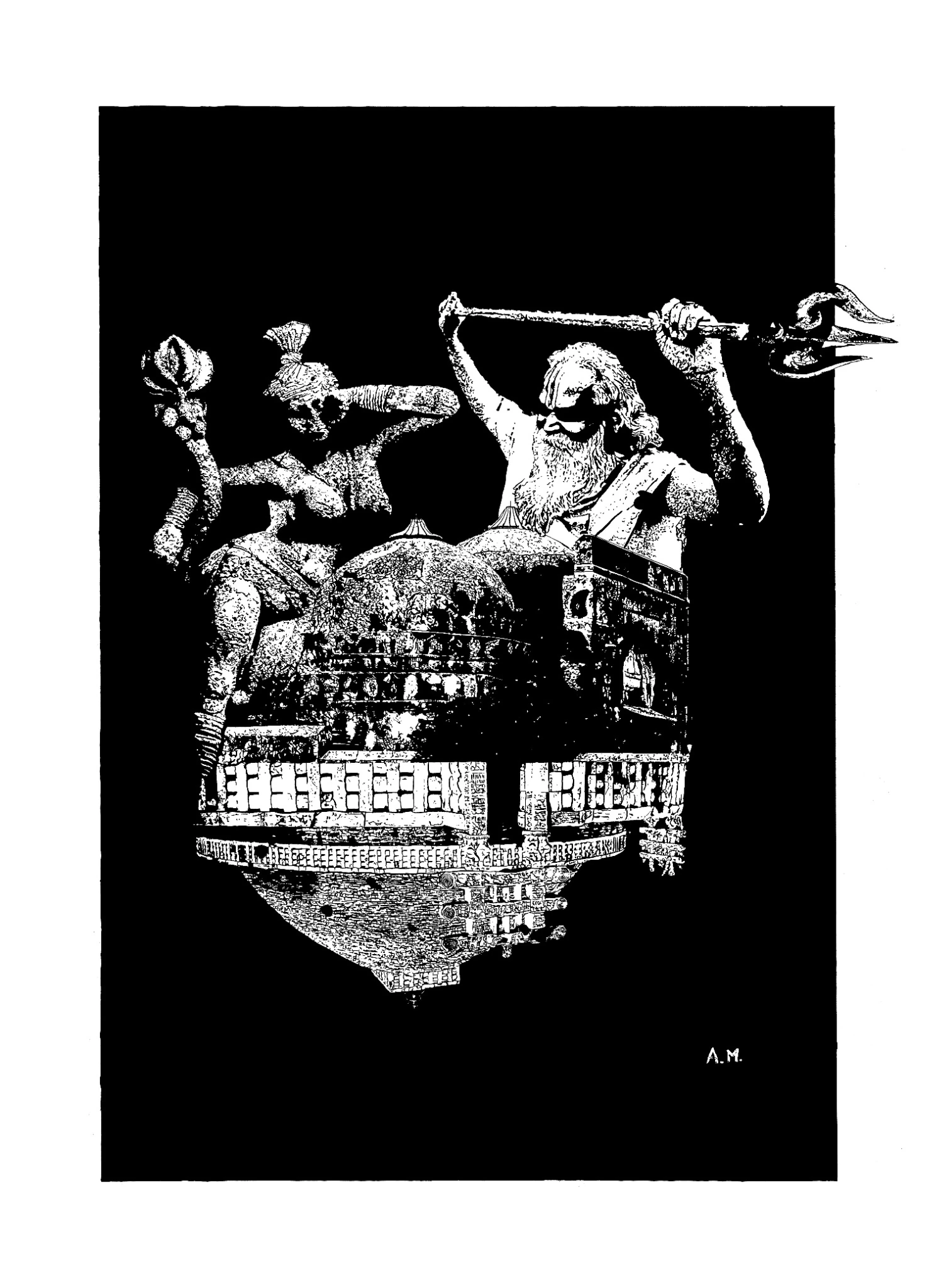
A mosque, an ascetic with a trident, a yakshi and an inverted Buddhist stupa are forced into the same image. None is allowed to occupy the sheet alone.
Ayodhya was made around a place where sacred geography, archaeology and political power have become almost impossible to separate. The drawing does not attempt to decide the dispute by illustration. Instead, it compresses competing traditions into one unstable body and asks what happens when material remains are required to prove belief.
The black field gives the figures the force of cut-outs or surviving fragments. The architecture below them seems solid at first, yet the image has no permanent top. Rotate the sheet and what appeared buried becomes monumental.
Three presences, no neutral ground
The figures are not decorative quotations. Each belongs to a different way of imagining the sacred landscape, and each changes the way the architecture beneath it is read.
What is underneath depends on where you stand.
The drawing is intended to be turned through 180 degrees. In its first orientation, the confrontation above the mosque dominates the sheet. The Buddhist form sits beneath it, apparently buried and upside down.
Turn the work and the hierarchy changes. The stupa rises into an upright monument while the figures that previously controlled the upper half are overturned. Rotation does not reveal a hidden “answer”; it makes the instability of archaeological and political claims part of the physical experience of looking.
From three traditions to one unstable image
View process & sketches
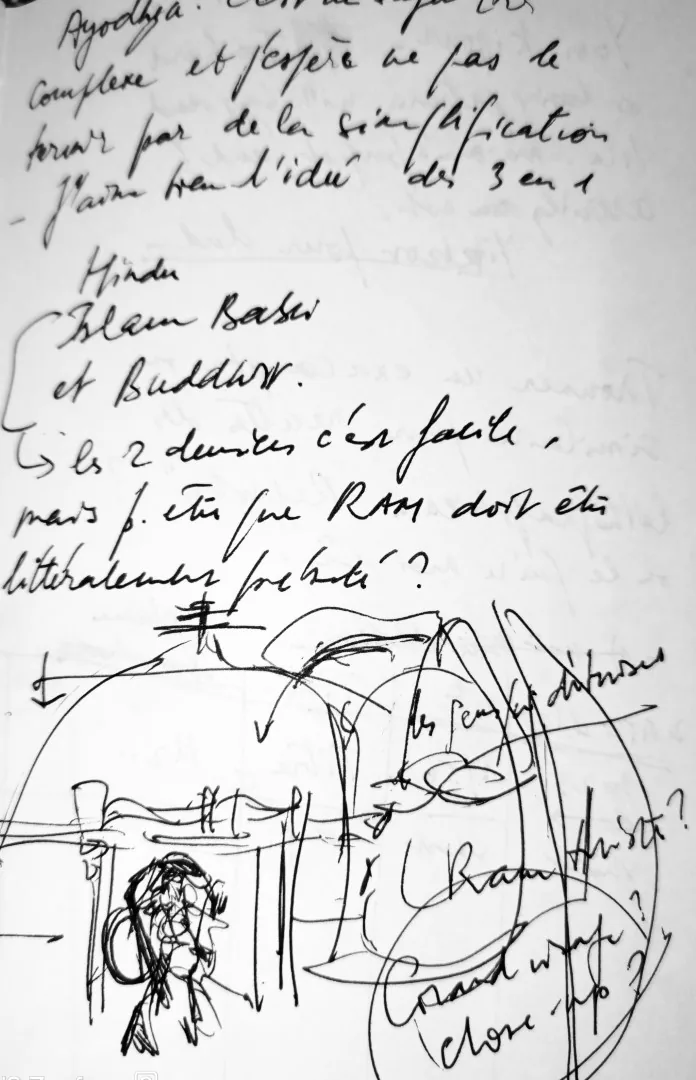
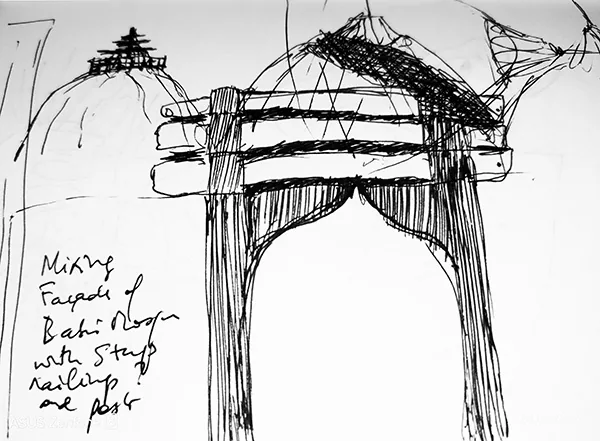
The earliest notes already contain the central problem: how to combine Hindu, Islamic and Buddhist references without reducing them to a tidy symbol. The composition then emerged through successive layers of black ink, leaving the figures and architecture as islands of white.
The sequence also shows something the finished drawing conceals: the image was built from the outside inward. Darkness arrived first; the contested monument was allowed to appear gradually inside it.
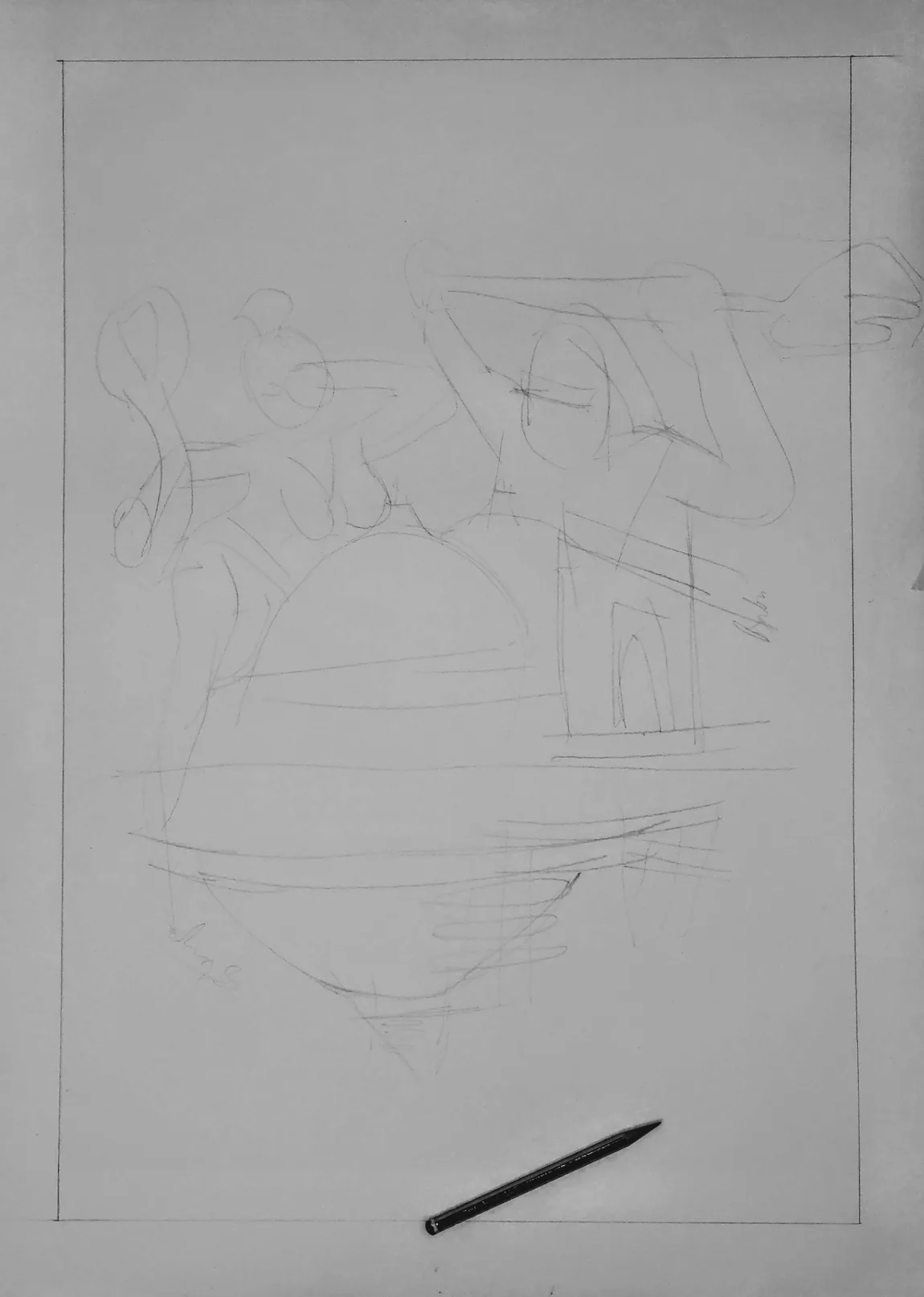
1 · First pencil layout: figures, domes and the inverted lower form are already present.
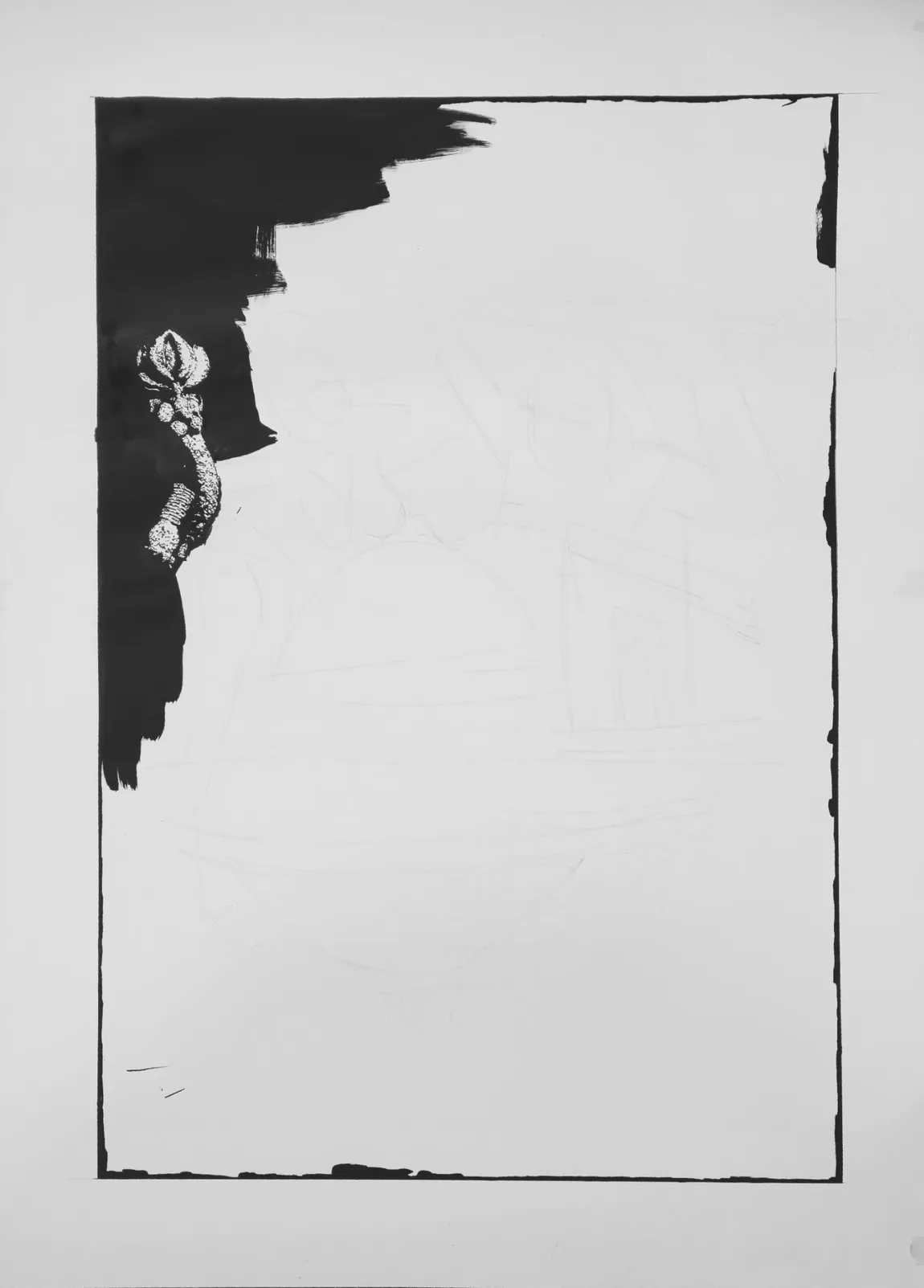
2 · The black ground begins at the edges; only a first fragment of the yakshi remains white.
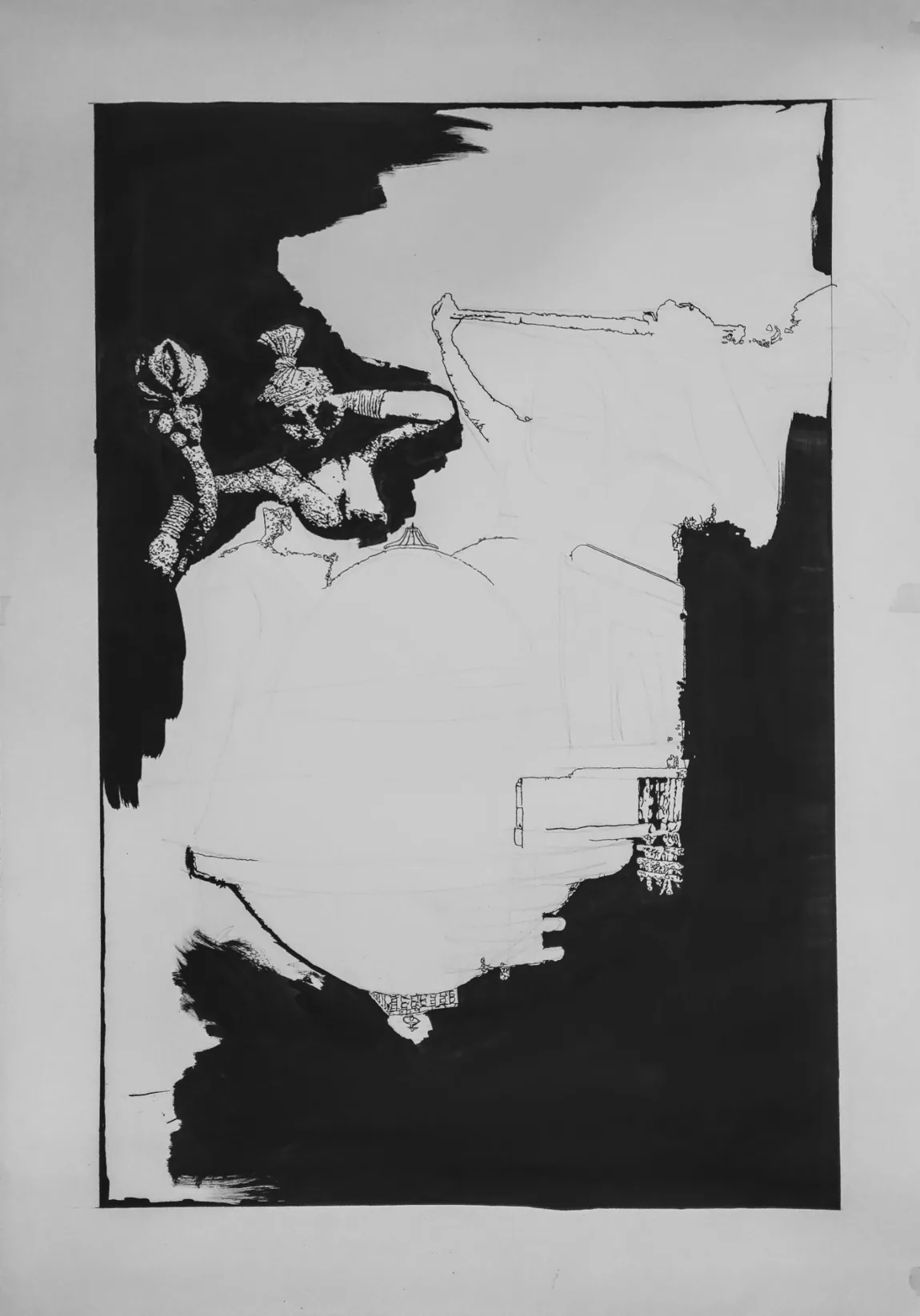
3 · The yakshi is developed while most of the architecture remains untouched paper.
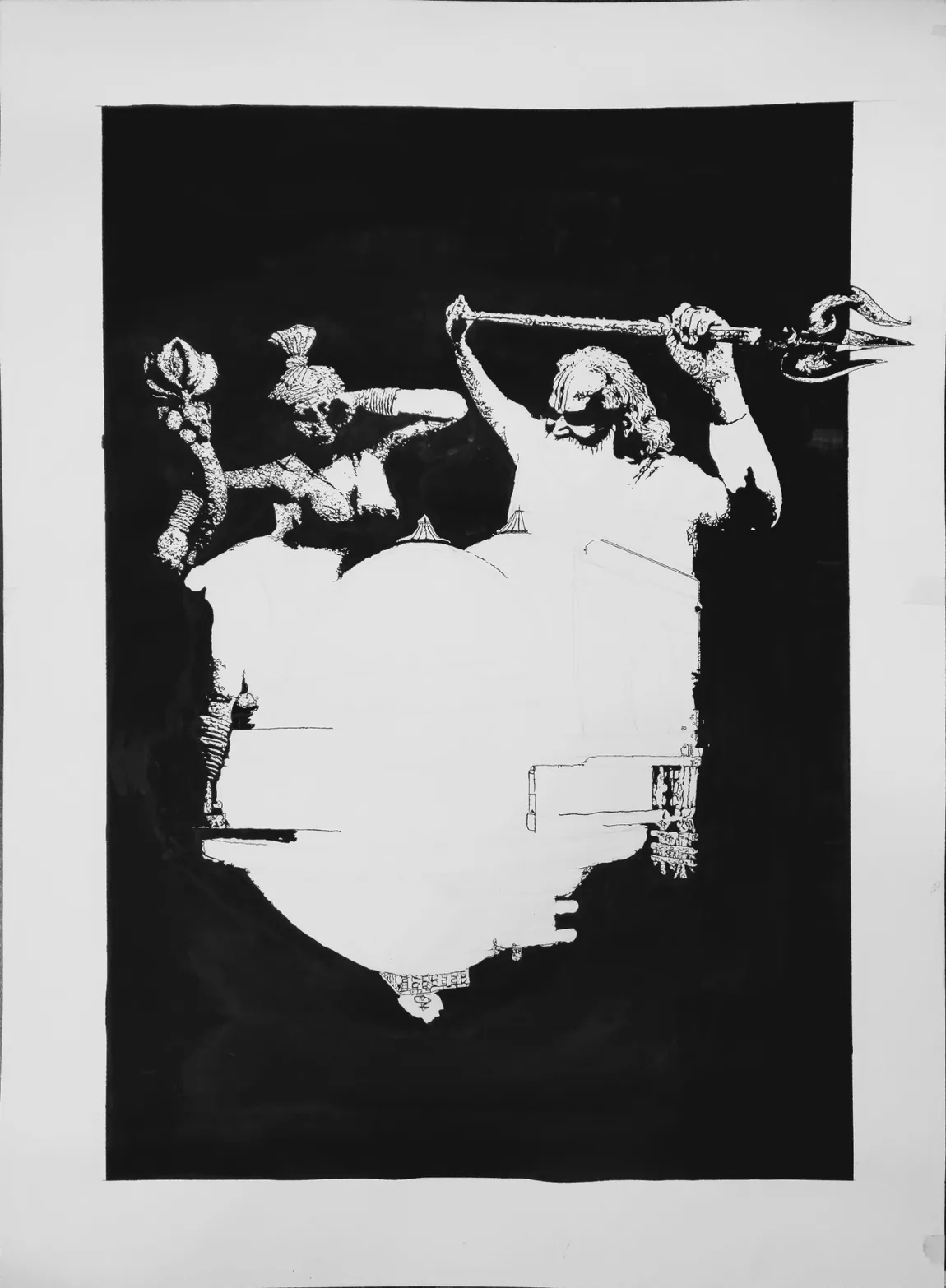
4 · The two upper figures are established before the central architecture is filled.
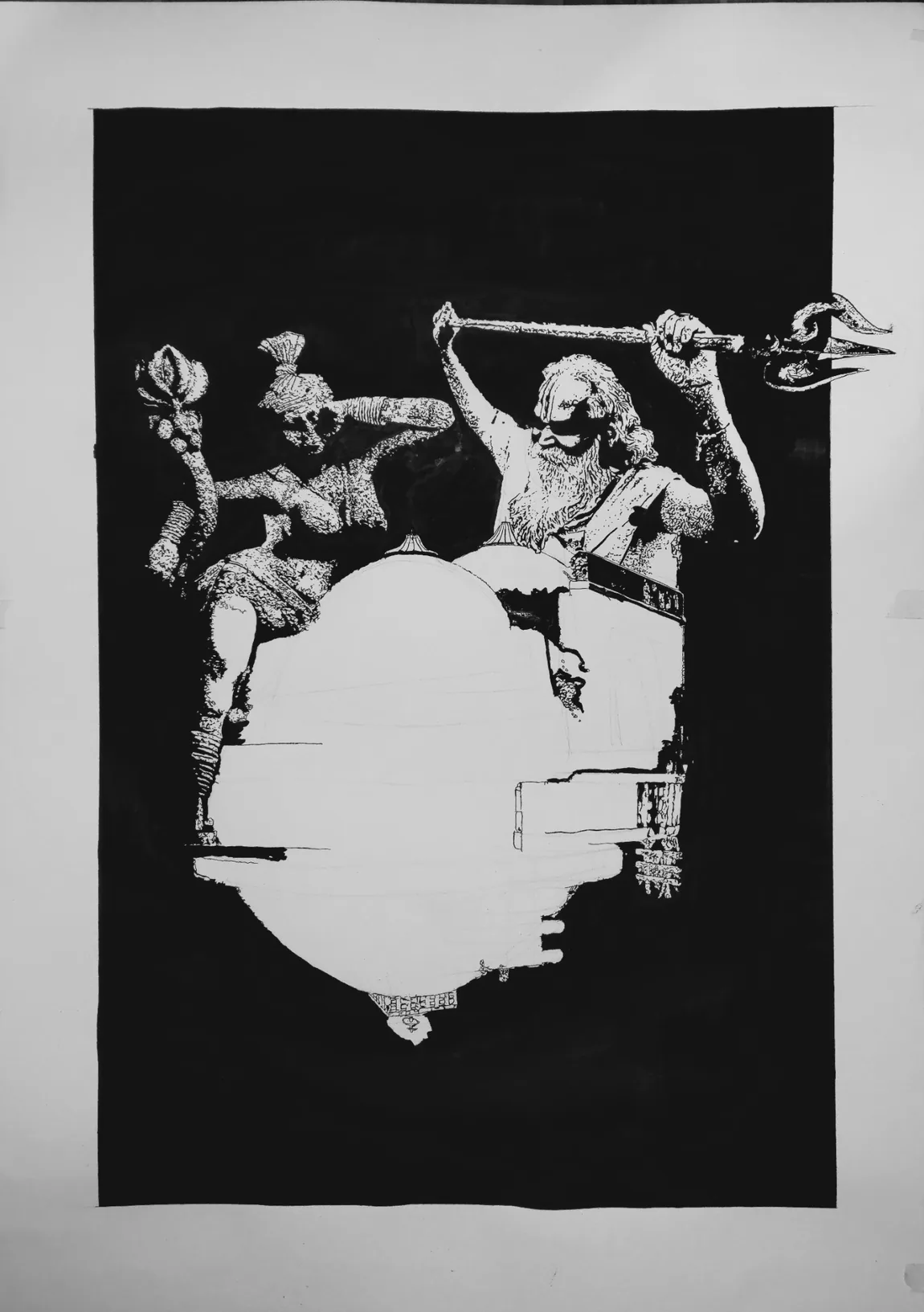
5 · The architectural layers begin to lock the two orientations together.
When archaeology is asked to settle belief
Ayodhya is one of the most charged sacred landscapes in South Asia. It is revered by Hindus as the birthplace of Rama and has also accumulated Buddhist, Jain and Muslim histories. The dispute that came to centre on the Babri Masjid transformed this layered landscape into a national argument about memory, evidence and political identity.
Read full historical context
The Babri Masjid and 6 December 1992
The Babri Masjid, a sixteenth-century mosque associated with the Mughal emperor Babur, stood at the centre of a long-running dispute over the place identified by many Hindus as Ram Janmabhoomi, the birthplace of Rama. On 6 December 1992, a large Hindu nationalist mobilisation demolished the mosque. The destruction was followed by communal violence across India in which roughly two thousand people were killed.
The demolition was not the spontaneous resolution of an archaeological question. It was the culmination of a political campaign in which the claim that an earlier Hindu temple had occupied the site became one of the most powerful symbols of the Hindutva movement and of the rise of the Bharatiya Janata Party.
What the archaeology can — and cannot — say
The archaeological history is more difficult than a slogan. Excavations and surveys became entangled with litigation and competing political narratives. In 2003, the Archaeological Survey of India excavated the disputed site under the authority of the Allahabad High Court. Its report argued for a substantial pre-existing, non-Islamic structure beneath the mosque and interpreted the underlying remains as suggestive of a Hindu religious structure.
The Supreme Court of India, in its 2019 judgment, accepted that the mosque had not been built on vacant land and considered the evidence supportive, on the civil standard of proof, of an underlying structure of Hindu religious origin. But the Court also stated important limits: the archaeological evidence did not establish that the earlier structure was a temple dedicated to Rama, and the ASI did not determine that a temple had been demolished in order to construct the mosque. The Court noted a gap of roughly four centuries between the twelfth-century underlying structure and the sixteenth-century mosque.
The Buddhist possibility
A Buddhist claim to the disputed site has also been made publicly, including by Buddhist organisations, and Ayodhya has a documented Buddhist past. The 2019 Supreme Court judgment also observed that individual finds could in some cases be compatible with Buddhist or Jain traditions and warned against a one-dimensional reading of the archaeological record.
But this possibility must remain what it is: a contested interpretation, not an established archaeological conclusion. The Court ultimately regarded the excavated underlying structure as more consistent, on balance, with a Hindu religious origin. In the drawing, the inverted stupa therefore does not announce that “a Buddhist monument was underneath the mosque”. It gives visual form to a larger problem: the layers excluded when archaeology is forced into a two-sided political argument.
Hindu memory
Ayodhya’s identification with Rama is a living sacred tradition, not merely an archaeological proposition. The political dispute intensified when devotional geography was translated into a claim for exclusive possession of one precise site.
Islamic history
The Babri Masjid formed part of the city’s Muslim history for centuries. Its destruction in 1992 remains a defining event in modern Indian communal and political history.
Buddhist and Jain pasts
Ancient and early-medieval Ayodhya cannot be reduced to a Hindu–Muslim binary. Textual and material evidence attest to a wider religious landscape, even though that does not prove a Buddhist monument at the exact mosque site.
2019–2024: judgment, temple, new landscape
In November 2019, the Supreme Court awarded the disputed land for the construction of a Ram temple while directing that five acres elsewhere in Ayodhya be provided for a mosque. The judgment ended the title litigation but did not erase the historical arguments surrounding the site.
On 22 January 2024, Prime Minister Narendra Modi led the consecration of the new Ram temple at the former disputed site. By then, the landscape represented in this 2023 drawing had already changed again: a place defined for decades by absence, ruins and competing claims had acquired a new monumental centre.
1528–29
Traditional date associated with the construction of the Babri Masjid.
1992
The mosque is demolished on 6 December during a Hindu nationalist mobilisation.
2003
The Archaeological Survey of India excavates the disputed site under court order.
2019–24
The Supreme Court judgment reallocates the site; the new Ram temple is consecrated in January 2024.
The yakshi does not win the argument.
At the left of the drawing is the only figure not brandishing an emblem of authority. The yakshi belongs to a visual tradition shared across Hindu, Buddhist and Jain art: a female nature spirit associated with fertility, vegetation, thresholds and abundance.
Here she turns away. That gesture matters more than assigning her to one religion. In a composition crowded by claims to territory, ancestry and sacred legitimacy, she embodies something older and less possessive: life, protection and the natural world.
She is not offered as a solution to Ayodhya. She is the figure who refuses the frenzy.
Exhibition history
View exhibition history
- Full Circle, Brussels3 February – 25 April 2024 · original drawing
- Teloglion Fine Arts Foundation, Thessaloniki8 October – 10 November 2024 · original drawing
Ayodhya, archaeology and contested memory
View sources & further reading
- Julia Shaw, “Ayodhya’s sacred landscape: ritual memory, politics and archaeological ‘fact’,” Antiquity 74 / online 2015. Cambridge Core.
- Sudeshna Guha, “Negotiating Evidence: History, Archaeology and the Indus Civilisation,” Modern Asian Studies 39.2 (2005), 399–426. DOI.
- Supreme Court of India, M. Siddiq (D) Thr Lrs v Mahant Suresh Das & Ors, judgment of 9 November 2019. Full judgment.
- Ashish Avikunthak, Bureaucratic Archaeology: State, Science, and Past in Postcolonial India, Cambridge University Press, 2021 — especially the chapters on the 2003 Ayodhya excavation. Cambridge Core.
- Reuters, January 2024, reporting on the consecration and opening of the Ram temple and the political history of the dispute. Read report.