Hiroshima
A black wave sweeps away from the blast. The A-bomb Dome survives beneath an immense, distorted mushroom cloud, while figures drawn from Japanese supernatural imagery flee something more terrifying than themselves.
A nightmare image arrived before the drawing did.
The composition came to me almost as a complete image one night. I wanted to show two things at once: the nuclear mushroom cloud and the force of the blast moving across the city.
The solution was to transform the river into a giant Hokusai-like wave moving away from the explosion. Instead of carrying ordinary human figures, it would carry away yōkai — beings that had frightened people for centuries, now fleeing in terror from the unnatural power of the atom.
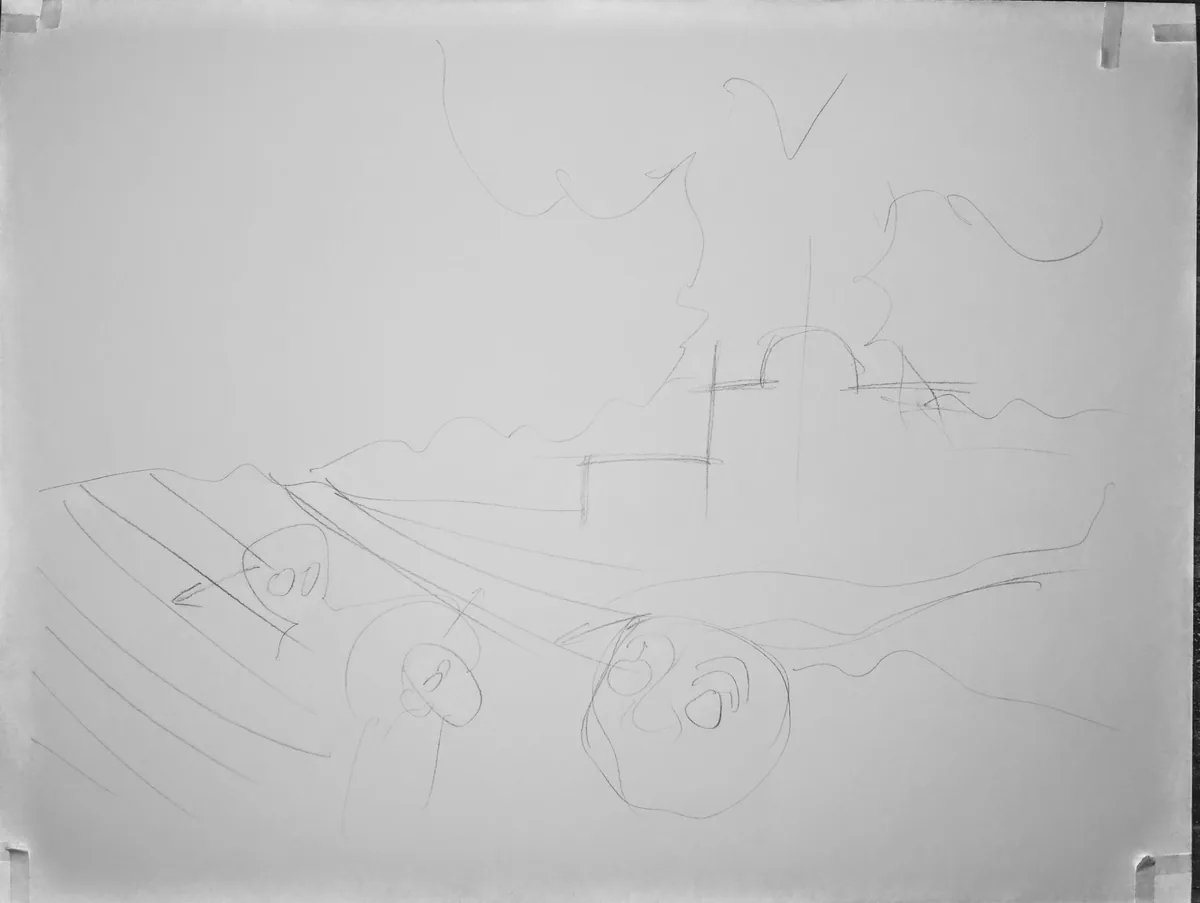
From a few pencil lines to a field of black.
The preliminary sketch fixes the movement before almost anything else: the dome, the blast, the wave and the fleeing figures. The later photographs show how the composition is slowly closed by large areas of Indian ink.
View process & sketches
From a few pencil lines to a field of black.
The preliminary sketch fixes the movement before almost anything else: the dome, the blast, the wave and the fleeing figures. The later photographs show how the composition is slowly closed by large areas of Indian ink.
When destruction exceeded the scale of inherited memory
On 6 August 1945, the uranium bomb known as “Little Boy” exploded over Hiroshima. The city was devastated by blast, heat, fire and radiation. Contemporary casualty estimates vary according to date and methodology, but the human loss was on a scale for which older historical comparisons were suddenly inadequate. The atomic bombing opened a technological and moral threshold that shaped the remainder of the twentieth century.
Read full historical context
When destruction exceeded the scale of inherited memory
On 6 August 1945, the uranium bomb known as “Little Boy” exploded over Hiroshima. The city was devastated by blast, heat, fire and radiation. Contemporary casualty estimates vary according to date and methodology, but the human loss was on a scale for which older historical comparisons were suddenly inadequate. The atomic bombing opened a technological and moral threshold that shaped the remainder of the twentieth century.
The drawing nevertheless begins by asking what inherited images people use when confronting destruction. In the ancient Mediterranean, the destruction of Carthage in 146 BCE became one such emblem. Later tradition even added the famous story that the Romans sowed the defeated city with salt — a powerful image, but not one supported by ancient evidence. Hiroshima belongs to a wholly different historical situation, yet both have become shorthand for the idea of a city annihilated by human decision.
The surviving dome
The Hiroshima Prefectural Industrial Promotion Hall stood close to the hypocentre. Its skeletal dome survived and became one of the most recognisable remains of the destroyed city. Preserved as the A-bomb Dome within Hiroshima Peace Memorial Park, it now functions not as a reconstructed building but as a deliberately retained ruin. In the drawing it sits at the visual centre of the catastrophe, a fragment of architecture beneath an impossible cloud.
Yōkai fleeing the atom
Japanese religious practice does not fit neatly into a Western opposition between “religious” and “secular”. Shinto and Buddhist practices frequently overlap with family custom, seasonal observance and attitudes toward place and ancestry. Yōkai belong to another broad field of Japanese supernatural beings and phenomena; yūrei are more specifically ghosts. They can be frightening, comic, grotesque or ambiguous.
In Hiroshima, the relationship is reversed. Creatures traditionally associated with fear and the uncanny are themselves terrified. They are pushed forward by the wave, away from an event created not by gods, spirits or monsters, but by human beings.
After 1945
Postwar Japan formally separated religion and state, and Article 9 of the 1947 Constitution renounced war as a sovereign right of the nation. Hiroshima subsequently developed into an international centre of nuclear remembrance and peace activism. Rather than reducing that transformation to a single cause, the drawing uses the preserved dome and the fleeing supernatural figures to ask what kind of memory can follow an event that made older categories of catastrophe seem insufficient.
Images that entered the drawing
The final composition is assembled from very different visual traditions: documentary photographs, the surviving Dome, ukiyo-e waves and supernatural figures, and the bomb itself.


These reference images situate the drawing within the architectural and visual sources that informed its composition.
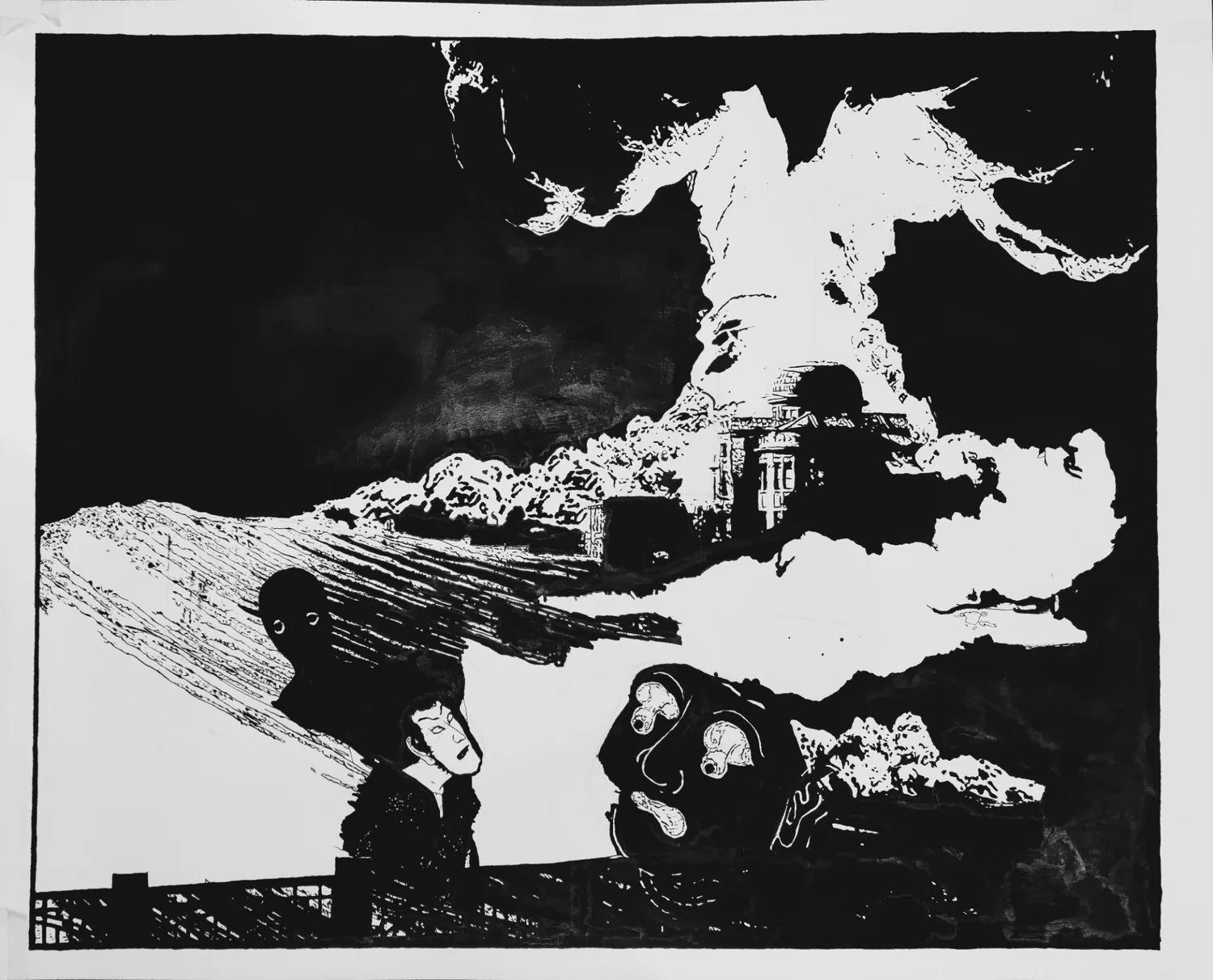
The black is part of the event.
Near completion, the open paper of the first sketch has almost disappeared. The flat black areas do not simply create contrast: they compress the sky and landscape around the white eruption, leaving the Dome and the fleeing figures caught between solid darkness and exposed paper.
Exhibition history
View exhibition history
Exhibition history
- Full Circle, Brussels3 February – 25 April 2024 · original drawing
- Teloglion Fine Arts Foundation, Thessaloniki8 October – 10 November 2024 · original drawing
Hiroshima, memory and the supernatural
View sources & further reading
Hiroshima, memory and the supernatural
- Hiroshima Peace Memorial / A-bomb Dome — historical and commemorative documentation on the preserved ruin.
- UNESCO World Heritage Centre, Hiroshima Peace Memorial (Genbaku Dome).
- Hiroshima Peace Memorial Museum — documentation on the bombing, casualties, artefacts and testimony.
- Japanese Constitution, Article 9 — the postwar renunciation of war.
- Visual sources — historical yōkai imagery and Hokusai prints used as points of departure for the composition.