Dreaming
of Babel
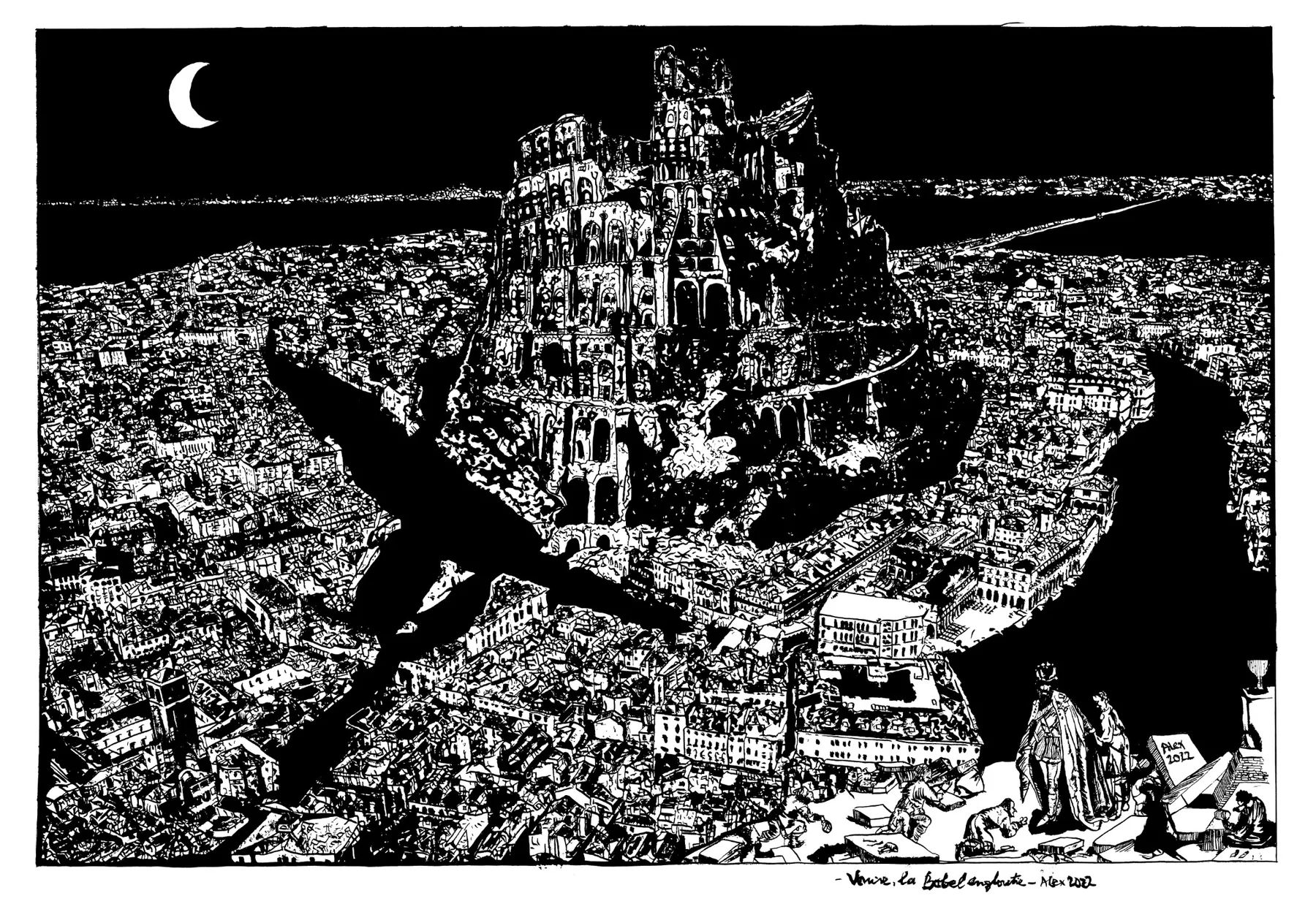
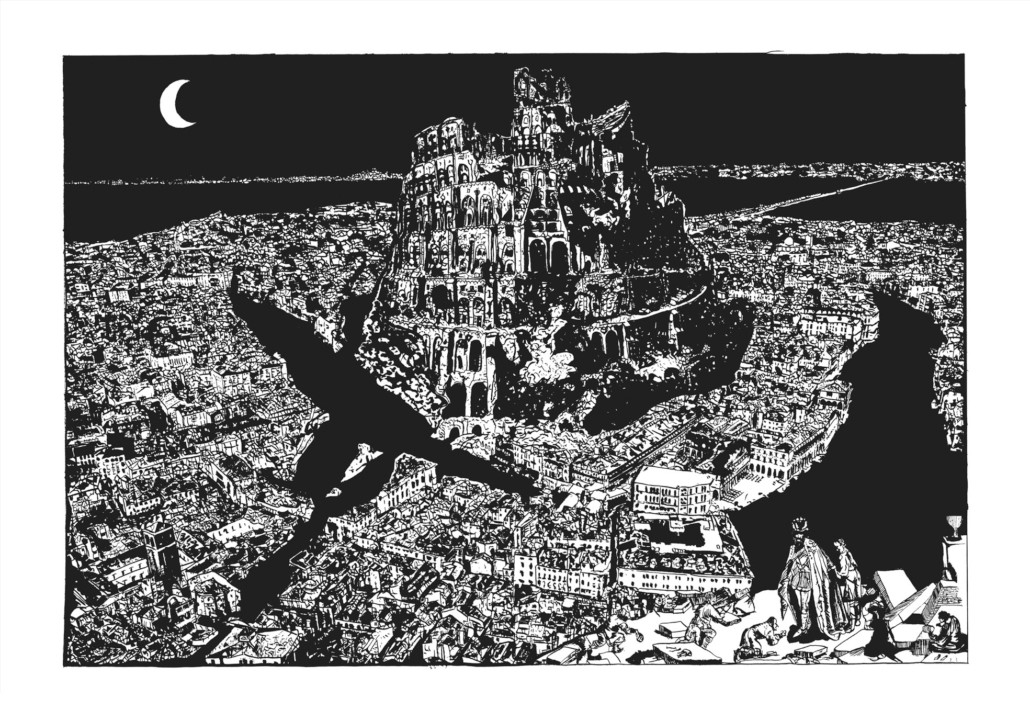
Bruegel’s Tower rises out of Venice at night. Around it, black architectural fragments, figures and borrowed histories compete for space. Dreaming of Babel is less an illustration of the biblical story than a collision between two cities: Babylon, imagined through its impossible tower, and Venice, a city built from layer upon layer of memory.
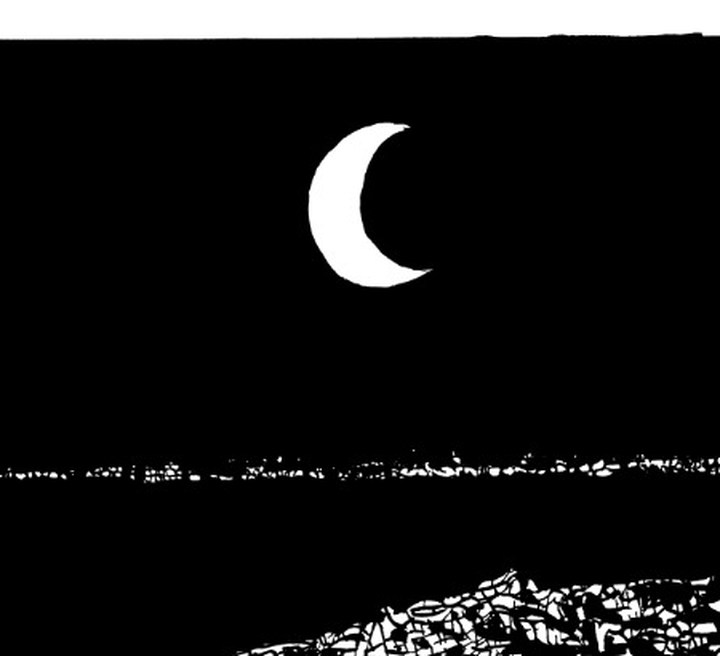
The first composition establishes the tower, the urban panorama and the crescent moon.
A signed and numbered edition translates the original drawing into a separate printed object.
The image returns at 75 × 110 cm with substantial iconographic changes rather than a simple enlargement.
Babel, Venice, and a city read through fragments.
The Tower of Babel has followed me through very different kinds of images and texts: the biblical story, the legends of Babylon, Isaac Asimov’s reading of the Old Testament, François Schuiten’s imagined cities, the archaeology of Etemenanki and, above all, Pieter Bruegel the Elder’s extraordinary Tower of Babel in Vienna.
Venice entered the drawing for a different reason. The Venice I wanted was the city at night and in winter: dark water, almost empty streets, hard contrasts of light and shadow, and buildings that seem to preserve several centuries at once. The drawing grew from bringing these two visual memories together — Babel’s impossible vertical ambition and Venice’s accumulated urban past.
The city appears before the page is filled.
View process & making
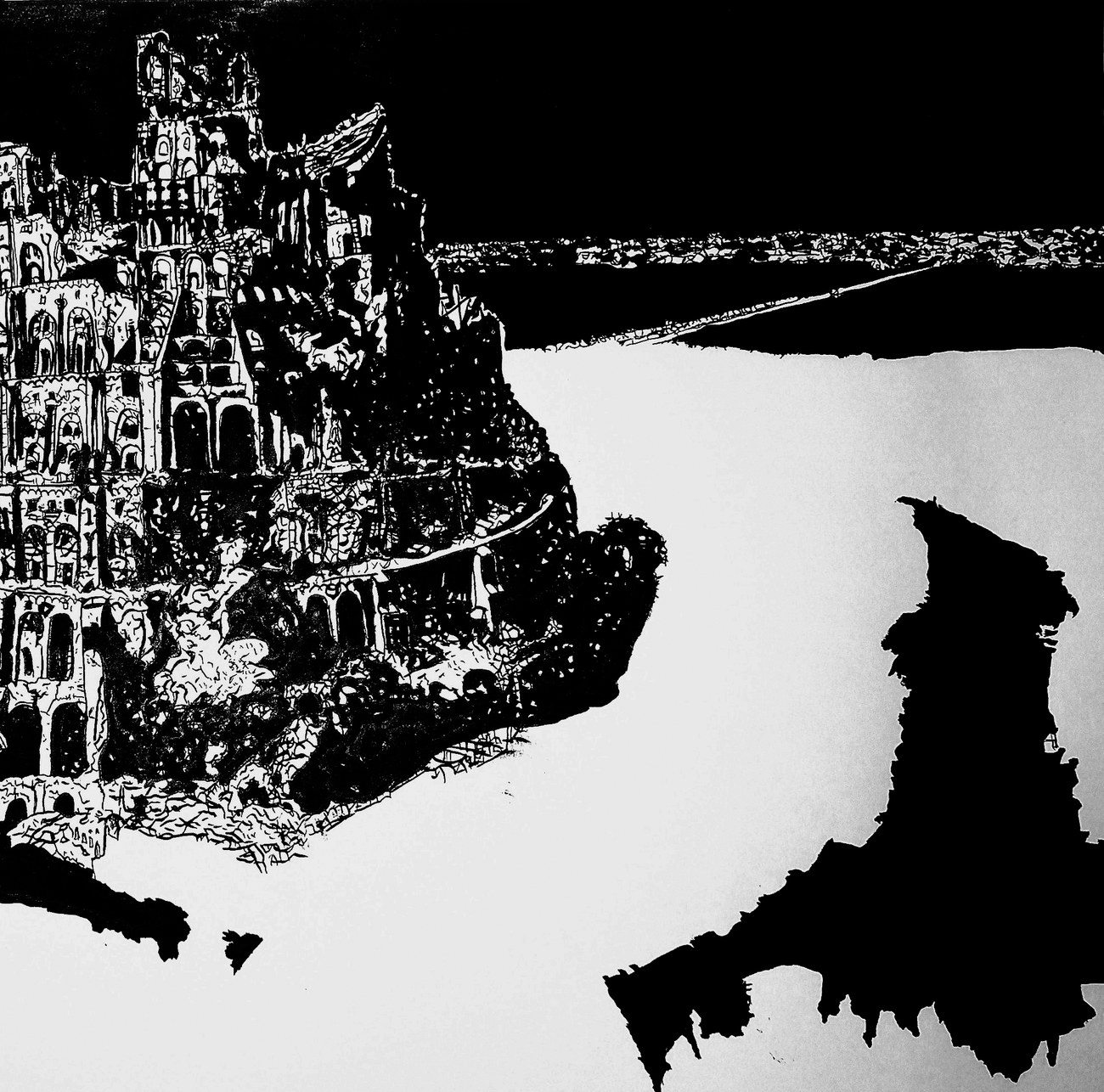
This photograph catches the original drawing at an unusually revealing stage. The tower and the dense black field are already established, while much of the lower sheet is still open and the city has not yet closed around them.
The unfinished paper makes the sequence of construction visible: architecture first, then the slow accumulation of ink, silhouettes and shadow.
Babel between archaeology, exile and imagination
The Tower of Babel occupies only a few verses in Genesis (11:1–9), yet its image has proved extraordinarily durable. A single human community, speaking one language, begins to build a city and a tower “with its top in the heavens”. The project ends with the confusion of languages and the dispersal of its builders. The biblical text plays on the name Babel and the Hebrew verb balal, “to confuse”, turning the name of the great Mesopotamian city into part of the story itself.
Read full historical context
Behind the later tradition stands the historical city of Babylon and its monumental ziggurat, Etemenanki. Ancient Near Eastern texts and archaeology have made it possible to reconstruct something of that building’s history, while also showing how far the biblical tower belongs to a later world of memory and interpretation. The association matters here not because the drawing attempts an archaeological reconstruction, but because Babel has always existed between a real ancient city and an imagined architecture.
A Jewish memory of Babylon
Babylon also entered Jewish history through exile. Nebuchadnezzar II’s campaigns against the kingdom of Judah in the early sixth century BCE led to the destruction of Jerusalem and the deportation of part of its population to Babylonia. The biblical wordplay is therefore not neutral: Babylon was at once an imperial centre, the place of exile and eventually one of the great centres of Jewish intellectual life.
The name also carries an irony. Akkadian Bāb-ilim was understood as “Gate of the God”, while Genesis deliberately connects Babel with the Hebrew root for confusion. The literary effect is clear even though the deeper etymology of the city’s name is more complicated than that neat opposition suggests.
Bruegel and the impossible city
The most immediate visual ancestor of Dreaming of Babel is Pieter Bruegel the Elder’s Tower of Babel of 1563, now in the Kunsthistorisches Museum in Vienna. Bruegel makes the surrounding port city appear tiny beside the tower and fills the structure with almost obsessive architectural and technical detail. What stayed with me was not simply the famous spiral form, but the sensation that the building has become a city in itself — immense, unfinished and already unstable.
In my drawing, that tower is transplanted into Venice. It rises behind a city seen in deep blacks and sharp white reserves, somewhere between recognisable architecture and memory. Venice is particularly suited to this kind of displacement: a city formed by trade, migration, borrowed forms and historical layers, where the past is continuously visible without ever belonging to a single period.
The result is not a reconstruction of Babylon and not a portrait of Venice. It is a city assembled from both: an urban palimpsest in which an ancient story, a Renaissance image and a modern experience of Venice occupy the same sheet.
Not an enlargement.
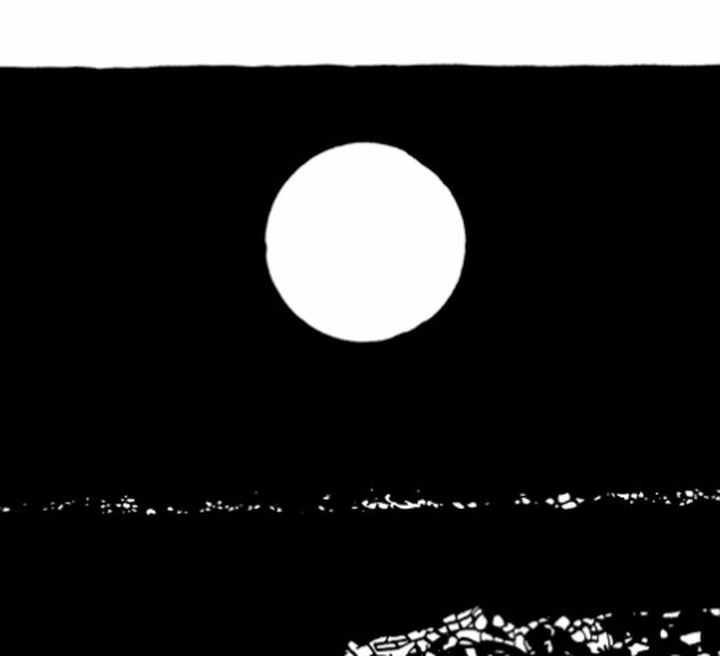
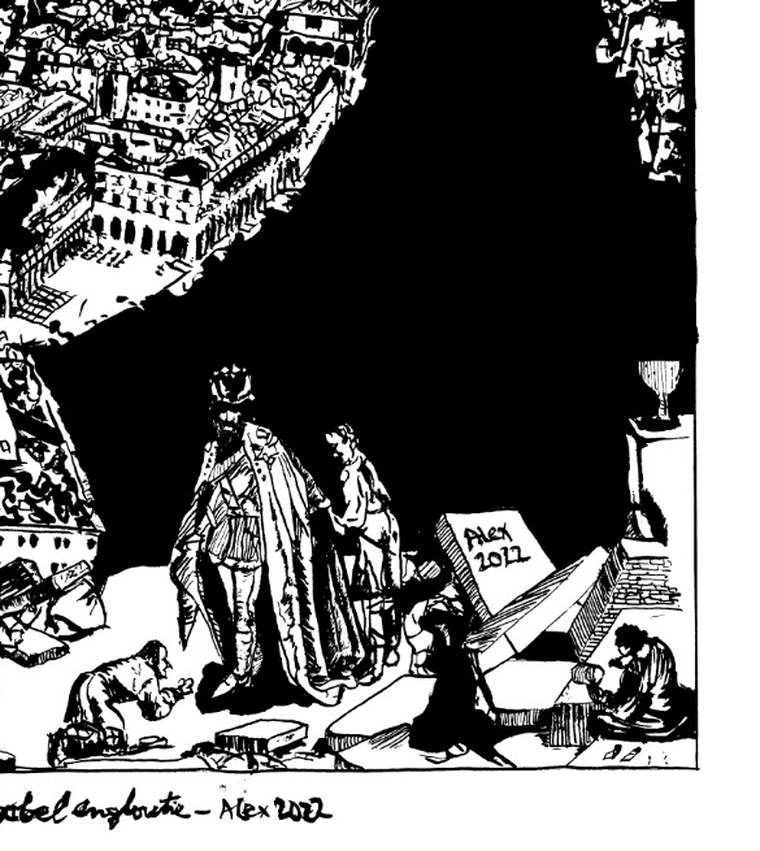
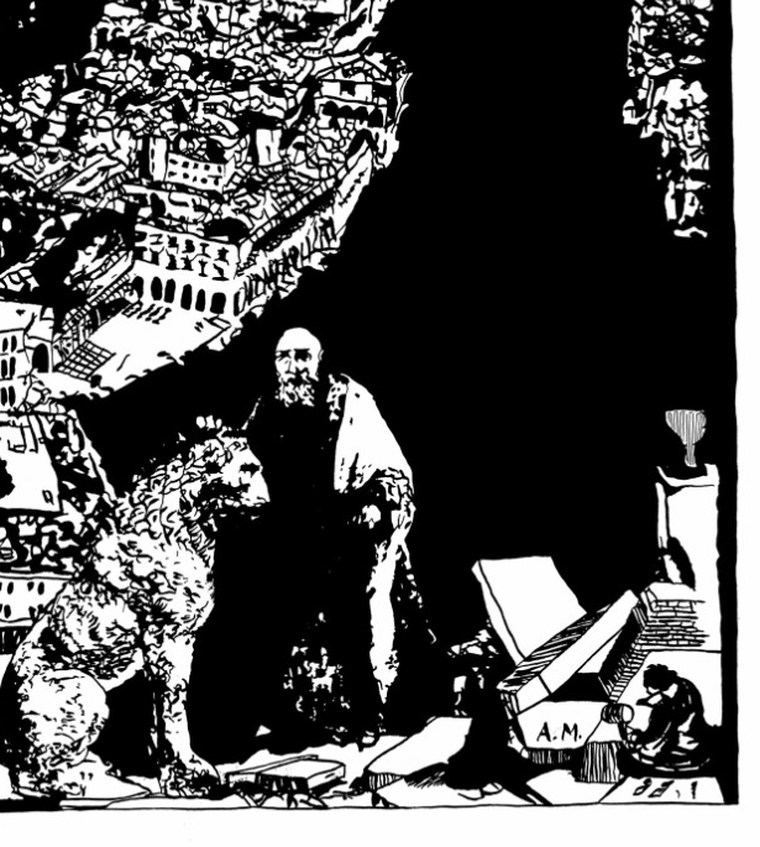
In the 2026 version, the crescent moon of the original gives way to a full moon and the lower-right scene is rebuilt. The change is deliberate: this is not a magnified copy of the 2022 drawing but a return to the same city with new historical material.
Leon (Judah Aryeh) Modena (1571–1648), the Venetian rabbi, preacher, scholar and writer, now enters the composition. His Ari Nohem — The Roaring Lion — was composed in Venice in 1639 as a sustained critique of the Kabbalah. The title offered a visual route into the new drawing: Leon / Aryeh and his “roaring lion” could be made physically present within Venice.
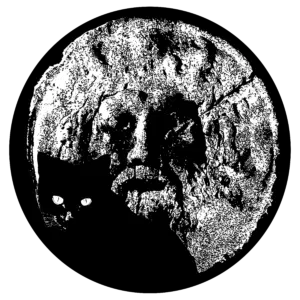
The lion is based on the Piraeus Lion at the entrance to the Venetian Arsenale, a sculpture I have long loved. The ancient Greek marble originally stood at Piraeus and was brought to Venice by Francesco Morosini after the Venetian capture of Athens in 1687. Medieval runic inscriptions cut into its flanks add another historical layer. Greek, medieval and Venetian histories are therefore already carried by the object itself.
By introducing Modena and the Arsenale lion, the 2026 drawing shifts the balance of the work. Venice is no longer simply the setting into which Babel is inserted; its Jewish and Mediterranean histories move into the foreground.
Two transformations visible at a glance
Dreaming of Babel · lithograph
The 2024 lithograph translates the 2022 composition into a separate printed object. It was produced by Bruno Robbe on Rives BFK paper and issued in a signed and numbered edition of 50.
€250 · Brussels hand delivery by appointment · Elsewhere in Belgium & EU: €15 packaging/shipping · EU delivery only
Buy this lithographBrussels hand delivery · €250Exhibition history
View exhibition history
- European Jewish Community Centre, Brussels8 December 2023 – 15 January 2024 · original drawing
- Full Circle, Brussels3 February – 25 April 2024 · original drawing
- Teloglion Fine Arts Foundation, Thessaloniki8 October – 10 November 2024 · lithograph
- Musée BIBLE+ORIENT, University of Fribourg25 March – 25 December 2025 · lithograph
- European Parliament, Brussels30 September 2025 · Cities of Lost Memory: Remembering the Jewish Journey · lithograph
Babel, Bruegel, Venice and Leon Modena
View sources & further reading
- Genesis 11:1–9. The biblical account of the city, tower, confusion of languages and dispersal.
- George, Andrew R., “The Tower of Babel: Archaeology, history and cuneiform texts”, Archiv für Orientforschung 51 (2005–2006), pp. 75–95. SOAS repository.
- Pieter Bruegel the Elder, The Tower of Babel, 1563, Kunsthistorisches Museum, Vienna. KHM collection record.
- Asimov, Isaac, Asimov’s Guide to the Bible, Vol. 1: The Old Testament, Avon Books, 1971, esp. pp. 54–55.
- Peeters, Benoît & François Schuiten, La Tour, Les Cités obscures, Casterman, 2008.
- Dweck, Yaacob, The Scandal of Kabbalah: Leon Modena, Jewish Mysticism, Early Modern Venice, Princeton University Press, 2011. book record.
- Leon (Judah Aryeh) Modena, Ari Nohem (The Roaring Lion), composed in Venice in 1639; first printed in 1840.
- The Piraeus Lion, Venetian Arsenale. Ancient Greek marble brought from Piraeus to Venice after Francesco Morosini’s campaign of 1687; the sculpture also preserves medieval runic inscriptions. Treccani.
- Jakob Gautel, Tour de Babel, installation, 2006–2013.