Brotherly
Love
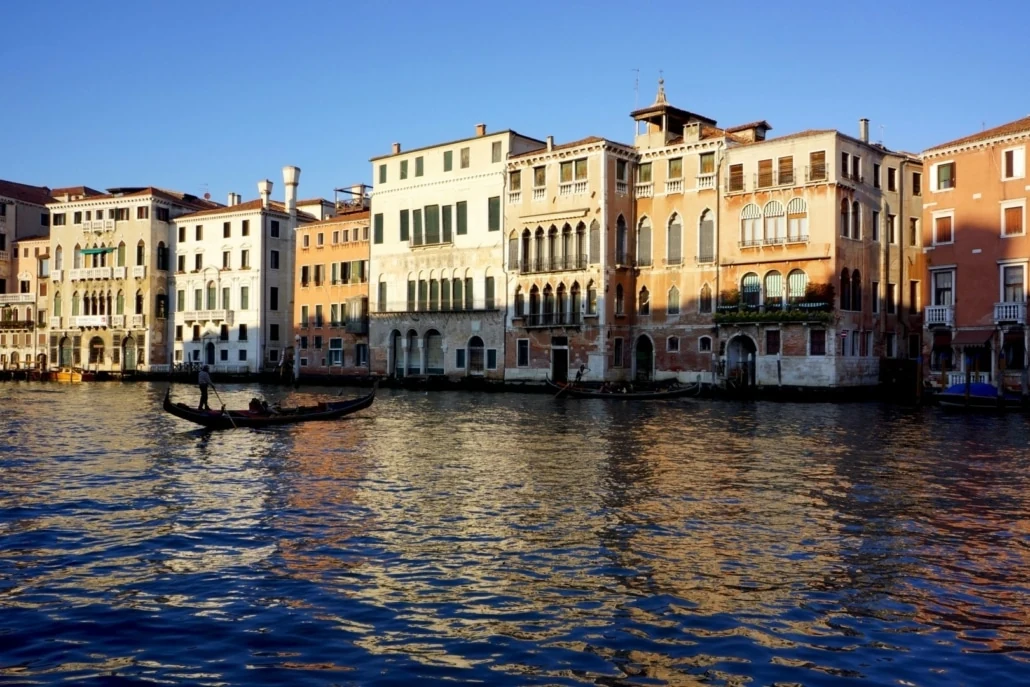
Two porphyry rulers embrace while sinking into the Grand Canal. Behind them stands Ca’ da Mosto, one of Venice’s oldest palazzi. A chain cuts across the water. Every element points elsewhere — to Constantinople, to 1204, and to a relationship between two Christian cities that was at once intimate, profitable and violently destructive.
Brotherly Love is deliberately affectionate in form and bitter in title. The embrace comes from the famous Tetrarchs now embedded in St Mark’s Basilica. Their bodies suggest fraternity; their Venetian afterlife tells a story of conquest and appropriation.
Four clues
The drawing is built as a historical puzzle. The Tetrarchs, the palazzo, the chain and the embrace each carry a different part of the argument; together they turn a Venetian night scene into a compressed history of the Latin and Byzantine worlds.
Two Christian cities, one broken relationship
Venice and Constantinople were tied together for centuries by trade, diplomacy, privilege, rivalry and religion. Venice emerged from the Byzantine sphere, while Constantinople remained the capital of the eastern Roman Empire. By the late twelfth century their relationship had become increasingly difficult, yet neither city could simply ignore the other.
Read full historical context
Two Christian cities, one broken relationship
Venice and Constantinople were tied together for centuries by trade, diplomacy, privilege, rivalry and religion. Venice emerged from the Byzantine sphere, while Constantinople remained the capital of the eastern Roman Empire. By the late twelfth century their relationship had become increasingly difficult, yet neither city could simply ignore the other.
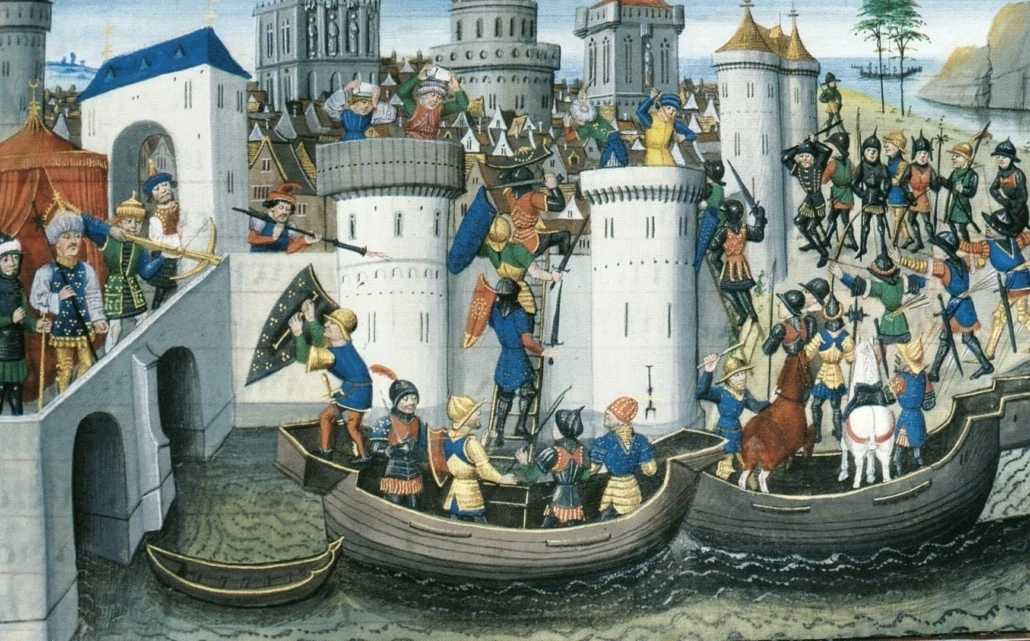
The Fourth Crusade exposed that entanglement in its most destructive form. The expedition that had been preached for the Holy Land was diverted first to Zara and then to Constantinople. In April 1204 the crusading army captured and sacked the Byzantine capital. Venetian participation was decisive, but the causes were not reducible to a single conspiracy: crusading debts, dynastic politics, Venetian commercial interests and the ambitions of the crusade’s leaders converged in a catastrophe that neither Latin nor Greek Christianity ever forgot.
The irony becomes sharper through the sculpture itself. The porphyry group now known as the Tetrarchs shows pairs of rulers embracing — an image of concord and shared authority. The monument is generally understood to have come from Constantinople and to have reached Venice in the aftermath of the sack. A Byzantine monument associated in scholarship with the city’s Philadelphion — literally, a place-name built on the idea of brotherly love — thus became one of the most visible pieces of Constantinople embedded in Venice.
Centuries later, on 4 May 2001, Pope John Paul II spoke in Athens of the sack of Constantinople as a disaster and expressed Catholic “deep regret” for the participation of Latin Christians. The wound had lasted far longer than the political order created in 1204.
1204
Constantinople was captured and sacked by the Fourth Crusade.
Spolia
Objects and architectural material from Constantinople entered Venice’s churches and public fabric.
2001
John Paul II publicly expressed regret for the Latin Christian role in the sack.
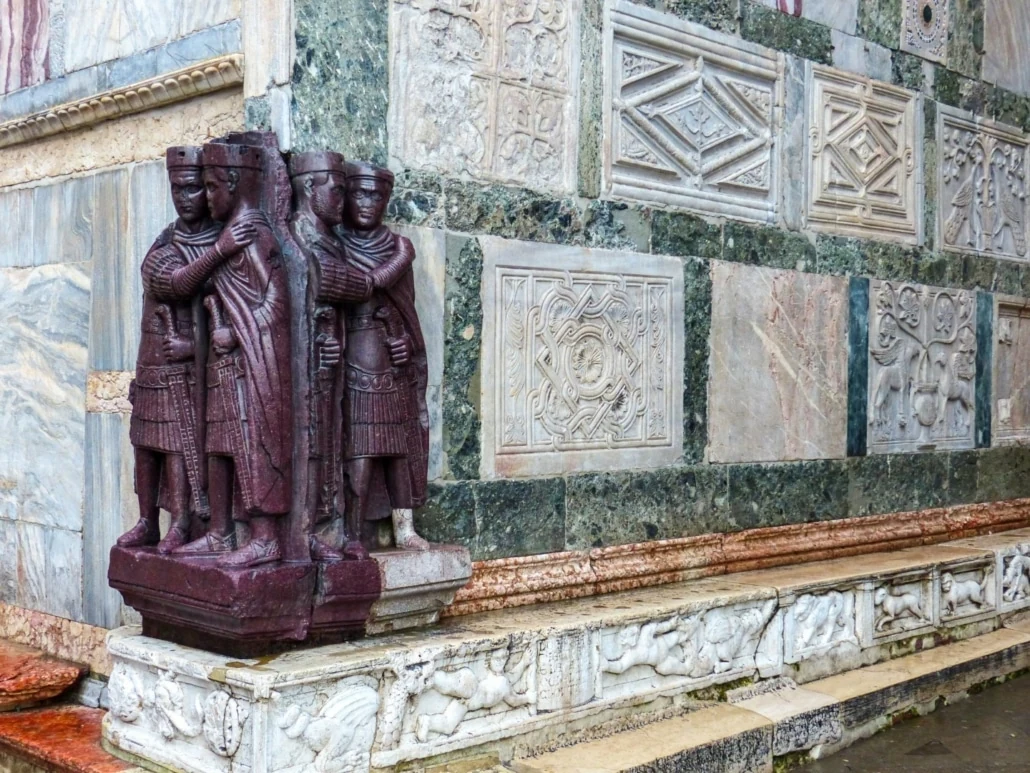
Concord turned into spolia
The sculpture is almost too perfect for the subject. Four rulers cling to one another with rigid arms, a late Roman image of unity made in costly imperial porphyry. In Venice, however, the group is no longer simply Roman. Its location makes it a trophy of movement: from the eastern capital to the façade of San Marco.
The drawing takes that fixed monument off the wall and puts it into the water. The two visible rulers do not stand triumphantly. They sink. Their embrace can be read as tenderness, dependence or mutual destruction.
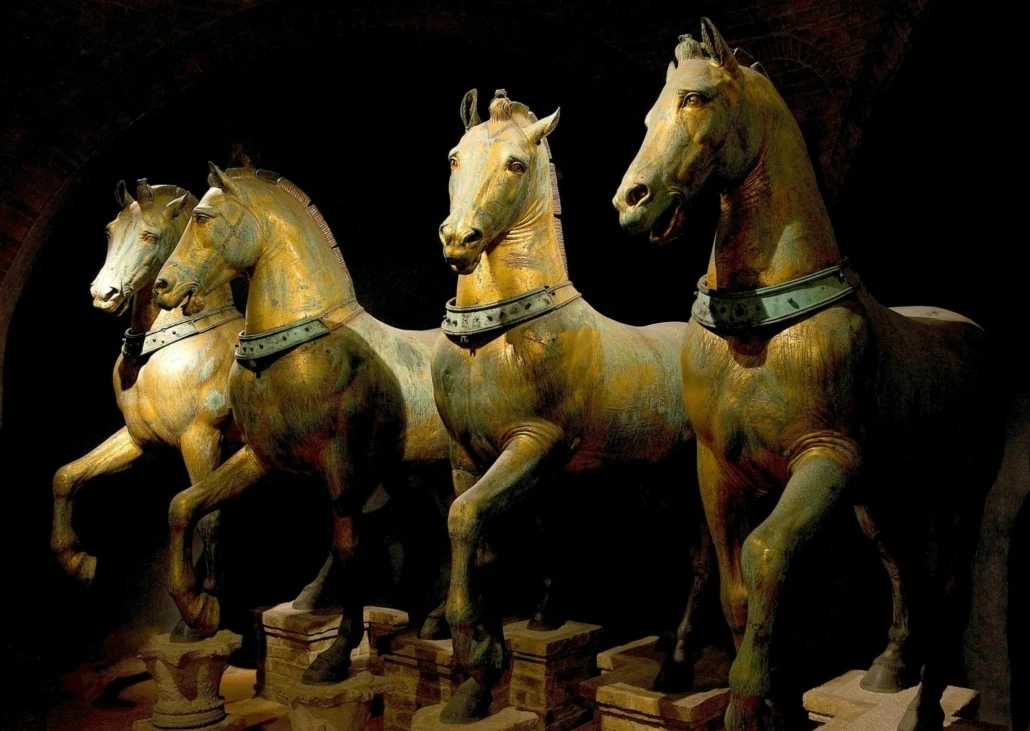
Venice wearing Constantinople
The drawing does not illustrate the Fourth Crusade directly. Instead it uses the afterlife of Constantinople in Venice: monuments, façades and objects that survived because they were moved, reused or displayed elsewhere.
View visual context
Venice wearing Constantinople
The drawing does not illustrate the Fourth Crusade directly. Instead it uses the afterlife of Constantinople in Venice: monuments, façades and objects that survived because they were moved, reused or displayed elsewhere.
One barrier remembers another
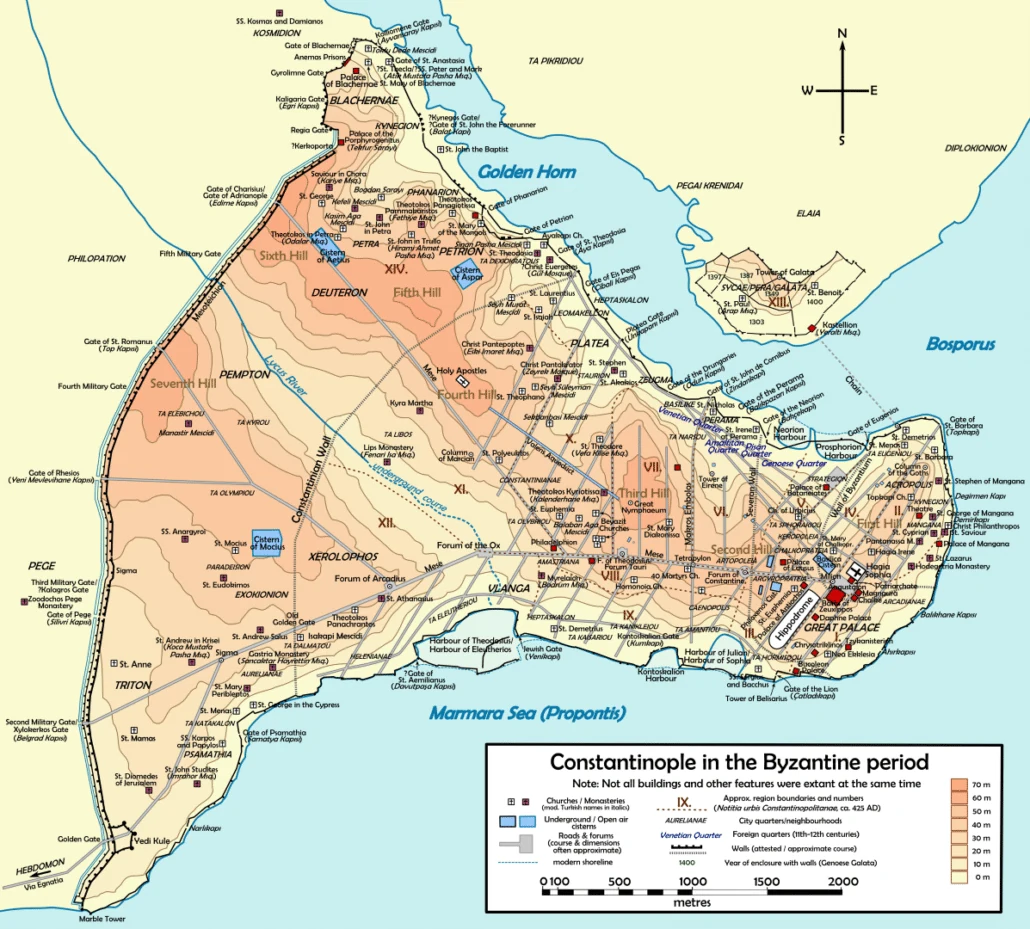
The chain in the drawing is intentionally anachronistic and associative. Venice itself used barriers to control access to its waterways, while Constantinople’s Golden Horn was famously protected by a great chain that could be raised across the harbour. That chain remained part of the city’s defensive memory until the Ottoman conquest of 1453.
In Brotherly Love, the chain is fastened to Venice. It crosses the Grand Canal beside Ca’ da Mosto and catches the sinking Tetrarchs. The object that once protected a city becomes a bond: Venice and Constantinople are connected by the very mechanism that keeps them apart.
The idea before the final composition
An earlier version brought the Tetrarchs forward against a broad Venetian horizon. It already contained the core metaphor — rulers displaced from Constantinople into Venice — but the image remained too declarative.
The final composition tightened the historical argument. Ca’ da Mosto became specific, the figures moved into the Grand Canal, and the chain turned the relationship between the two cities into something physical. The Tetrarchs no longer merely occupy Venice; they are caught in it.
Alternative composition, not retained as the final work.
Building Venice in black
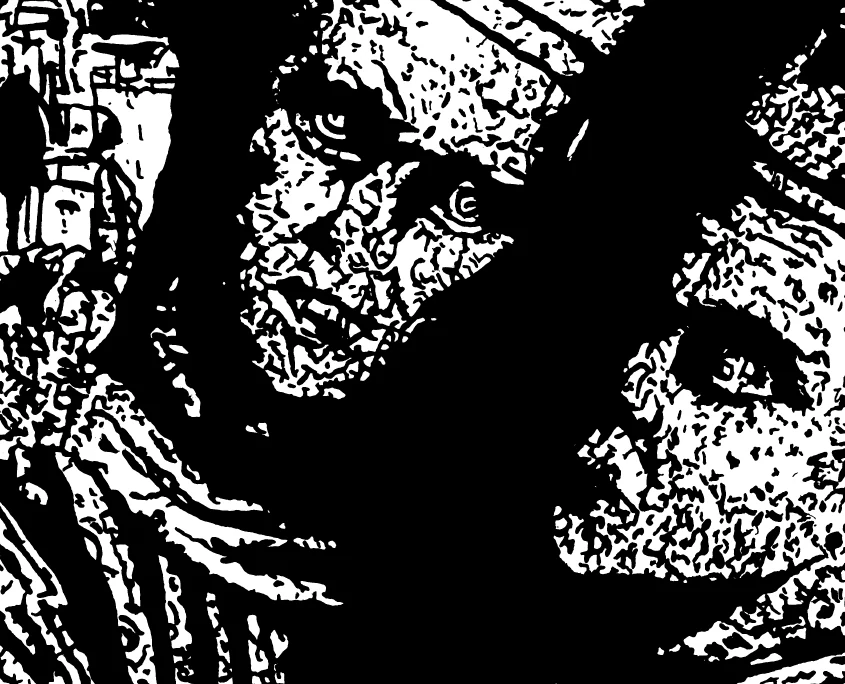
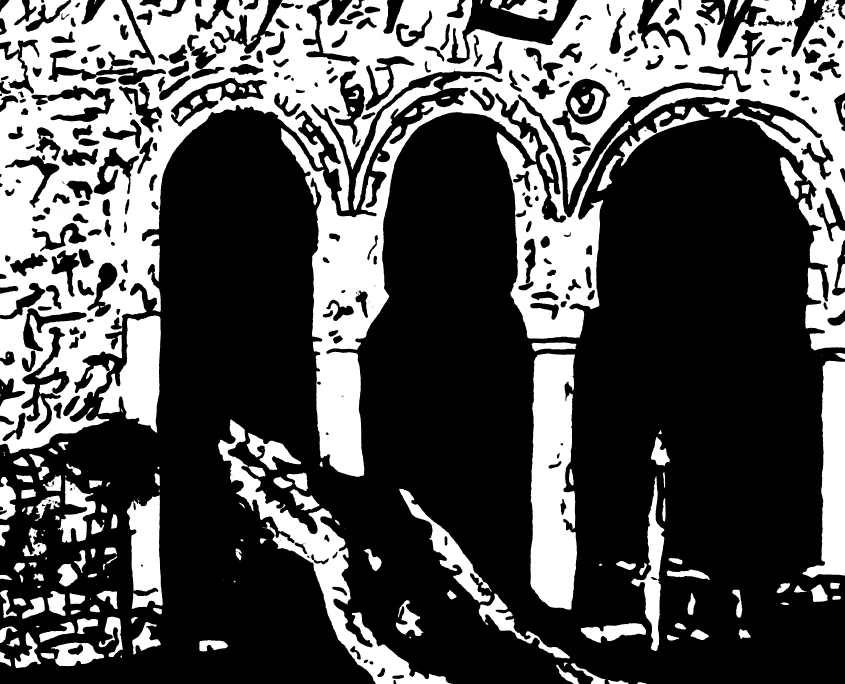
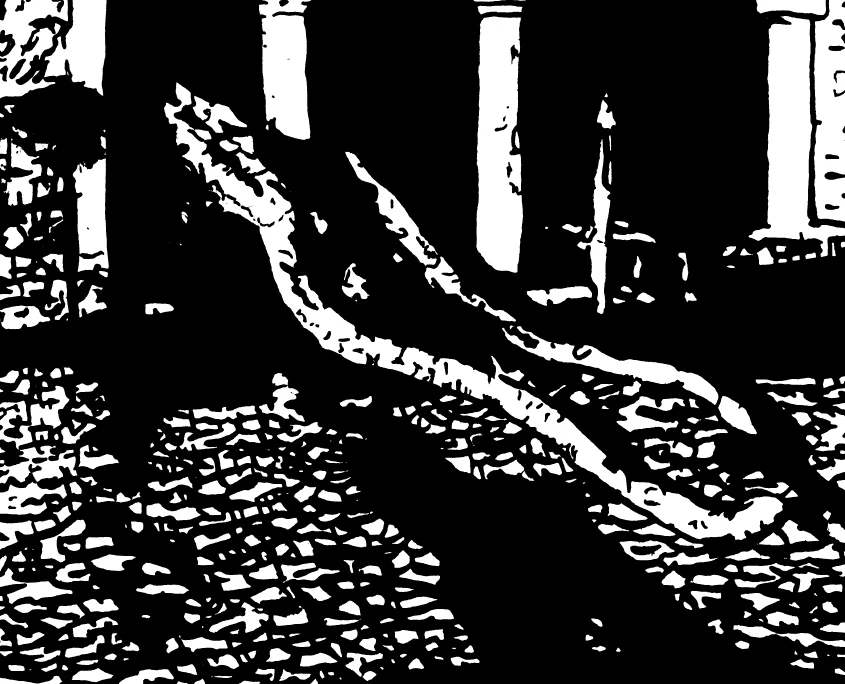
Only a small selection of the work-in-progress photographs is shown here. The sequence makes visible the method: large black masses first define the night and the canal; architecture is then recovered through white paper and dense line; the Tetrarchs arrive late, after their stage has been built.
View process & sketches
Building Venice in black
Only a small selection of the work-in-progress photographs is shown here. The sequence makes visible the method: large black masses first define the night and the canal; architecture is then recovered through white paper and dense line; the Tetrarchs arrive late, after their stage has been built.
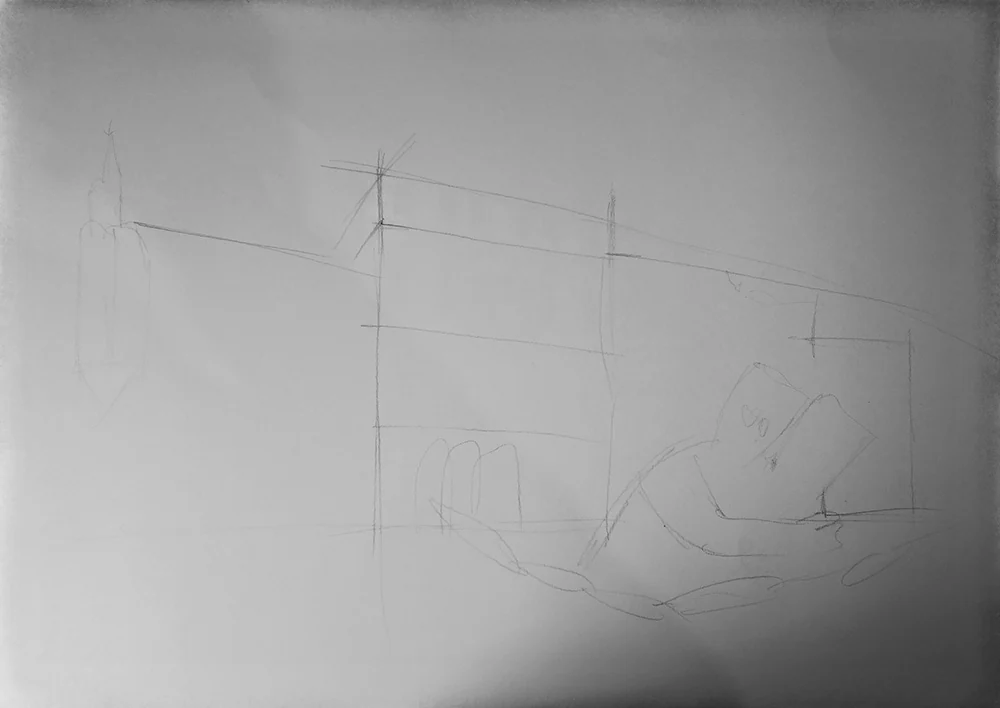
1 · The first black field establishes the left edge of the Venetian façade.
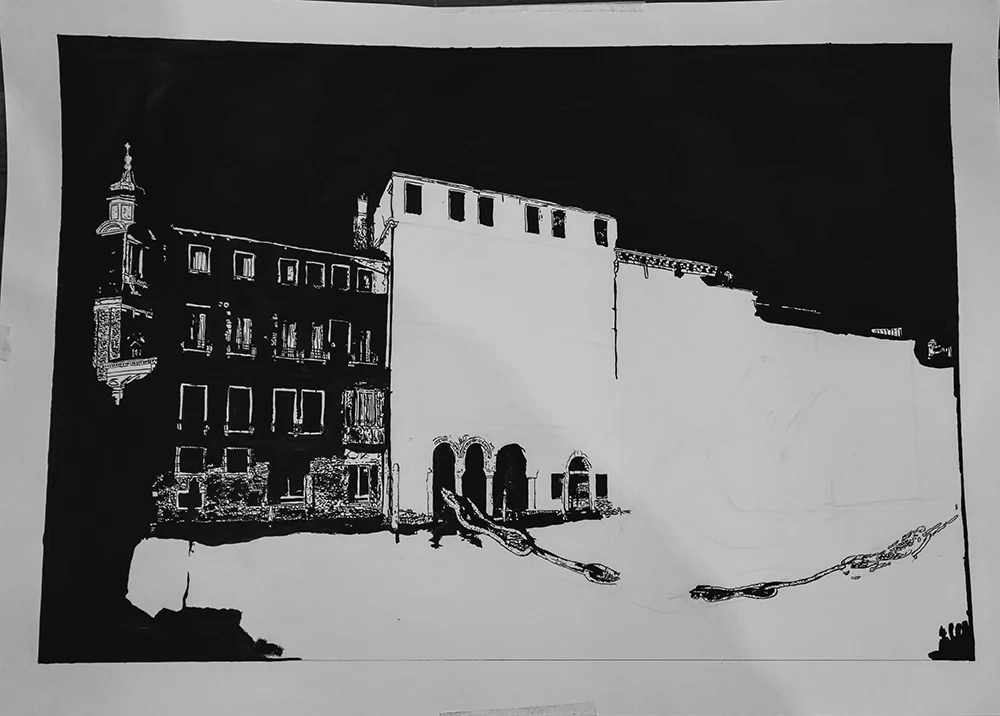
2 · Ca’ da Mosto and the adjacent buildings begin to emerge from the untouched paper.
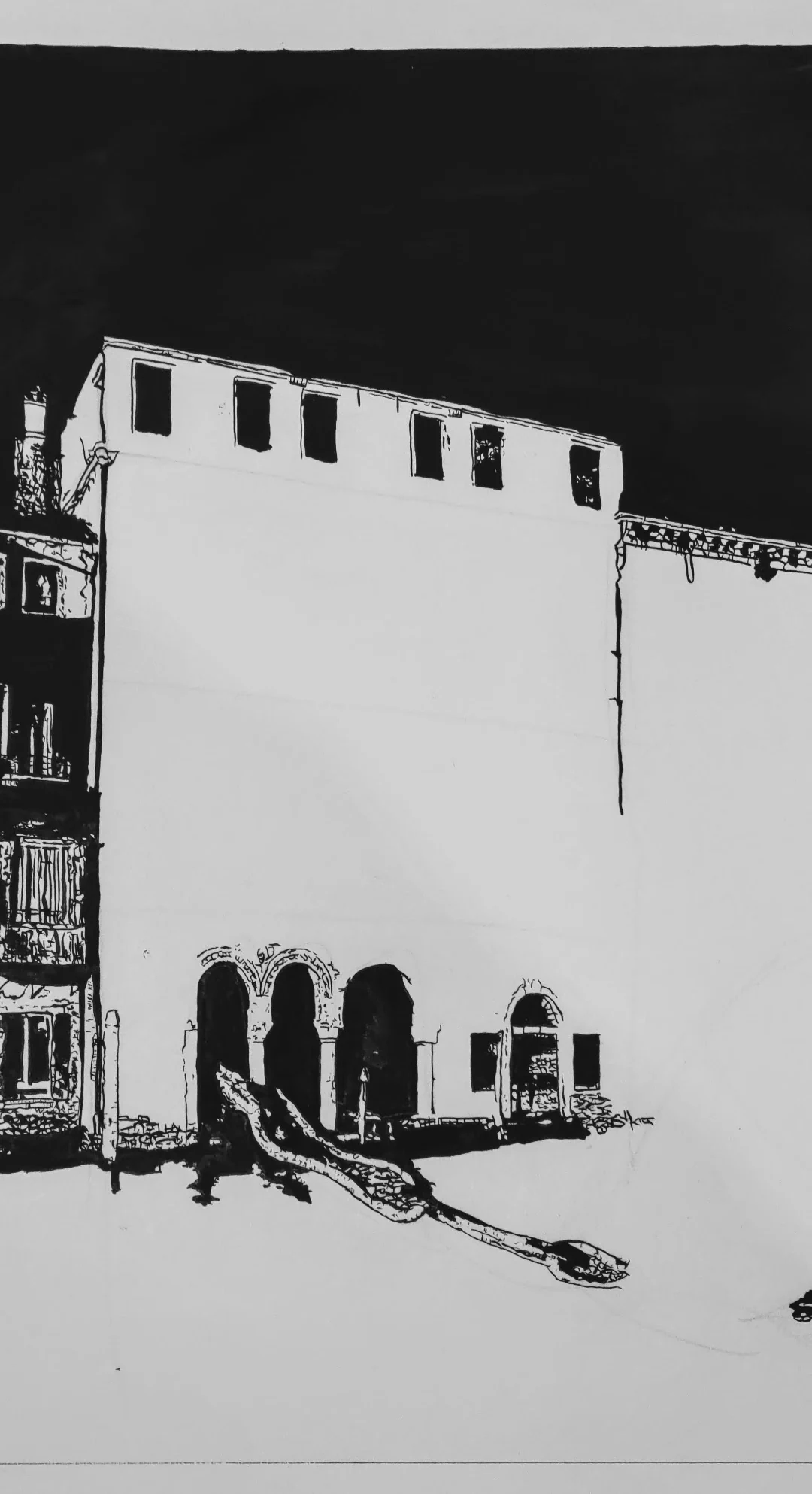
3 · The lower arches and the first length of chain fix the geometry of the canal.
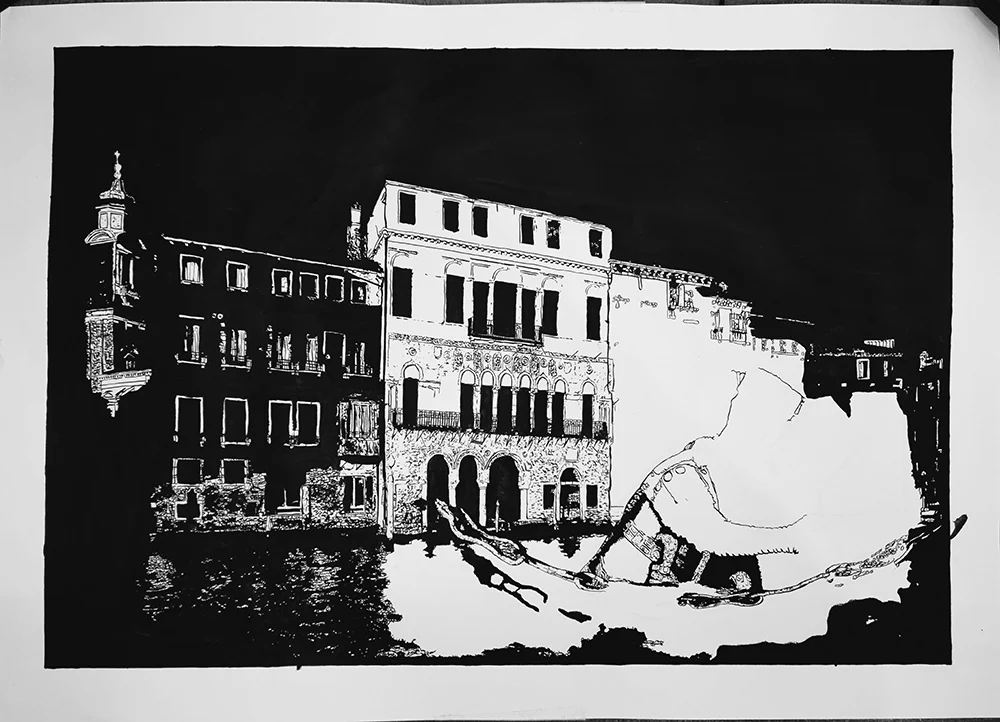
4 · The palazzo is nearly complete while the figures remain a reserve of blank paper.
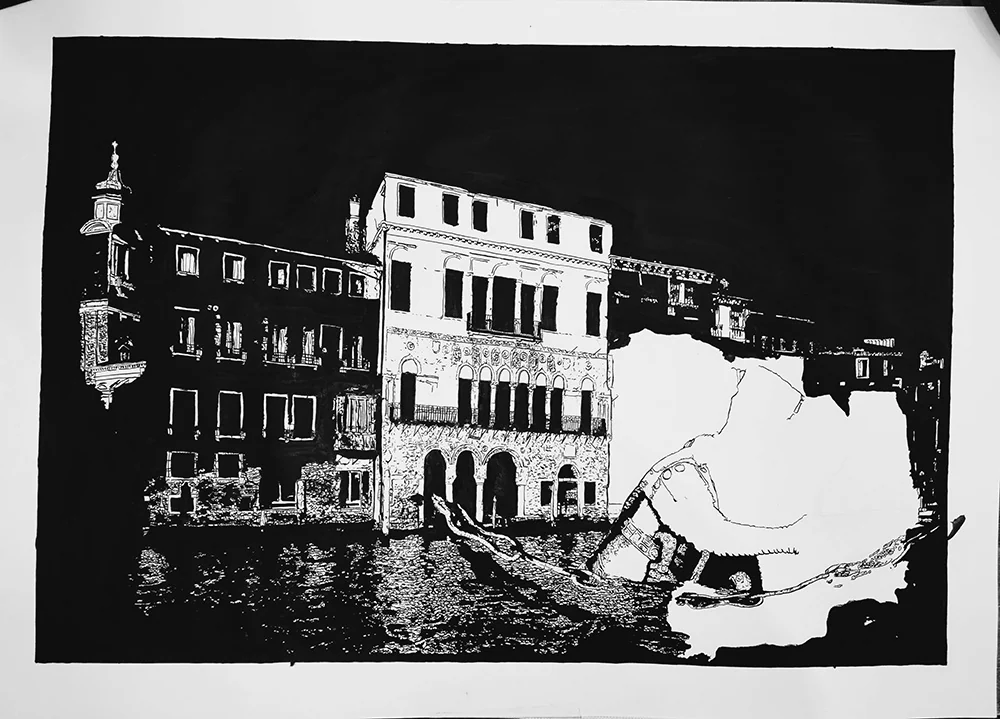
5 · The pair begins to take shape inside the already finished Venetian setting.
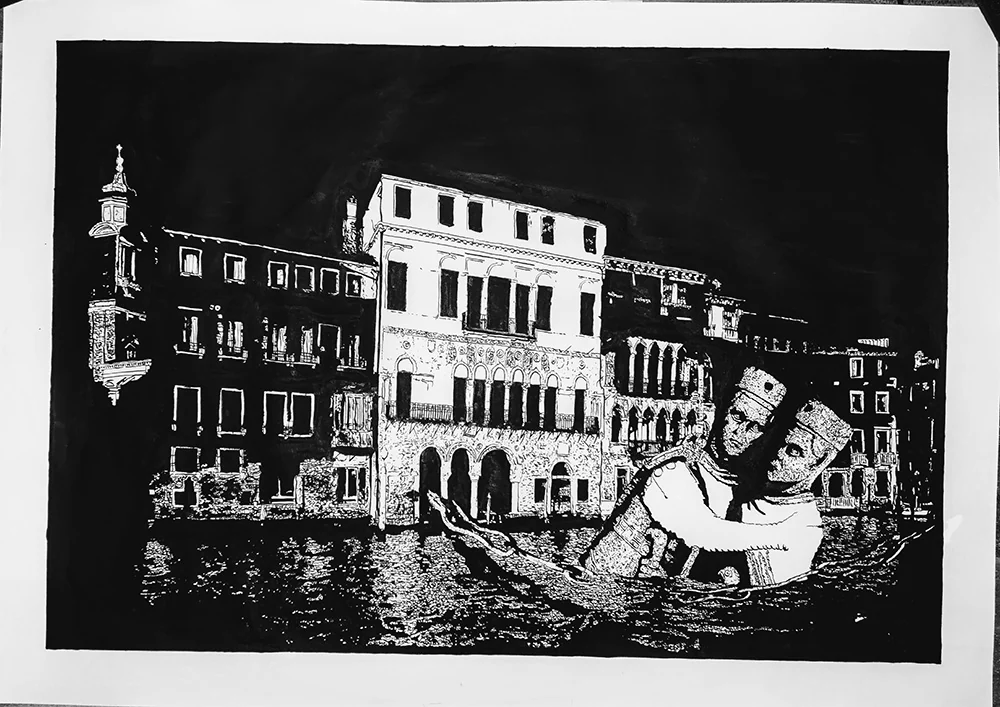
6 · Faces, robes, water and chain are brought together in the final black-and-white balance.
Brotherly Love · lithograph
A signed and numbered hand-printed lithographic edition was produced by Bruno Robbe from the original drawing.
€250 · Brussels hand delivery by appointment · Elsewhere in Belgium & EU: €15 packaging/shipping · EU delivery only
Buy this lithographBrussels hand delivery · €250The original has left the studio
The 2023 original is no longer available. It was acquired for the Arthur Langerman Collection. The work is therefore presented as a collected drawing rather than as an object for sale.
That provenance is particularly apt for a work concerned with the movement, survival and re-contextualisation of images: Brotherly Love now has its own history beyond the studio.
1204, spolia and the two cities
View sources & further reading
1204, spolia and the two cities
- John Paul II, address to Archbishop Christodoulos of Athens, 4 May 2001 — the Pope’s expression of regret for the sack of Constantinople and the participation of Latin Christians. Read online.
- Ludovico Rebaudo, “Il gruppo dei tetrarchi: una lettura del reimpiego,” in Riuso di monumenti e reimpiego di materiali antichi in età postclassica: il caso della Venetia, 2012, pp. 147–158.
- Michael Angold, “The road to 1204: the Byzantine background to the Fourth Crusade,” Journal of Medieval History 25/3 (1999), pp. 257–278.
- Thomas F. Madden, Enrico Dandolo and the Rise of Venice, Johns Hopkins University Press, 2003; and Thomas F. Madden & Donald E. Queller, The Fourth Crusade: The Conquest of Constantinople, University of Pennsylvania Press, 1997.
- Geoffrey de Villehardouin, Chronicle of the Fourth Crusade and the Conquest of Constantinople; Robert of Clari, The Conquest of Constantinople — two major contemporary Latin accounts.
- DiSpLay — Digital Spolia Layering, Ca’ Foscari University of Venice — research on the reuse and movement of ancient decorative sculpture in Venice. Project site.