Rising from
the Temple’s Ashes
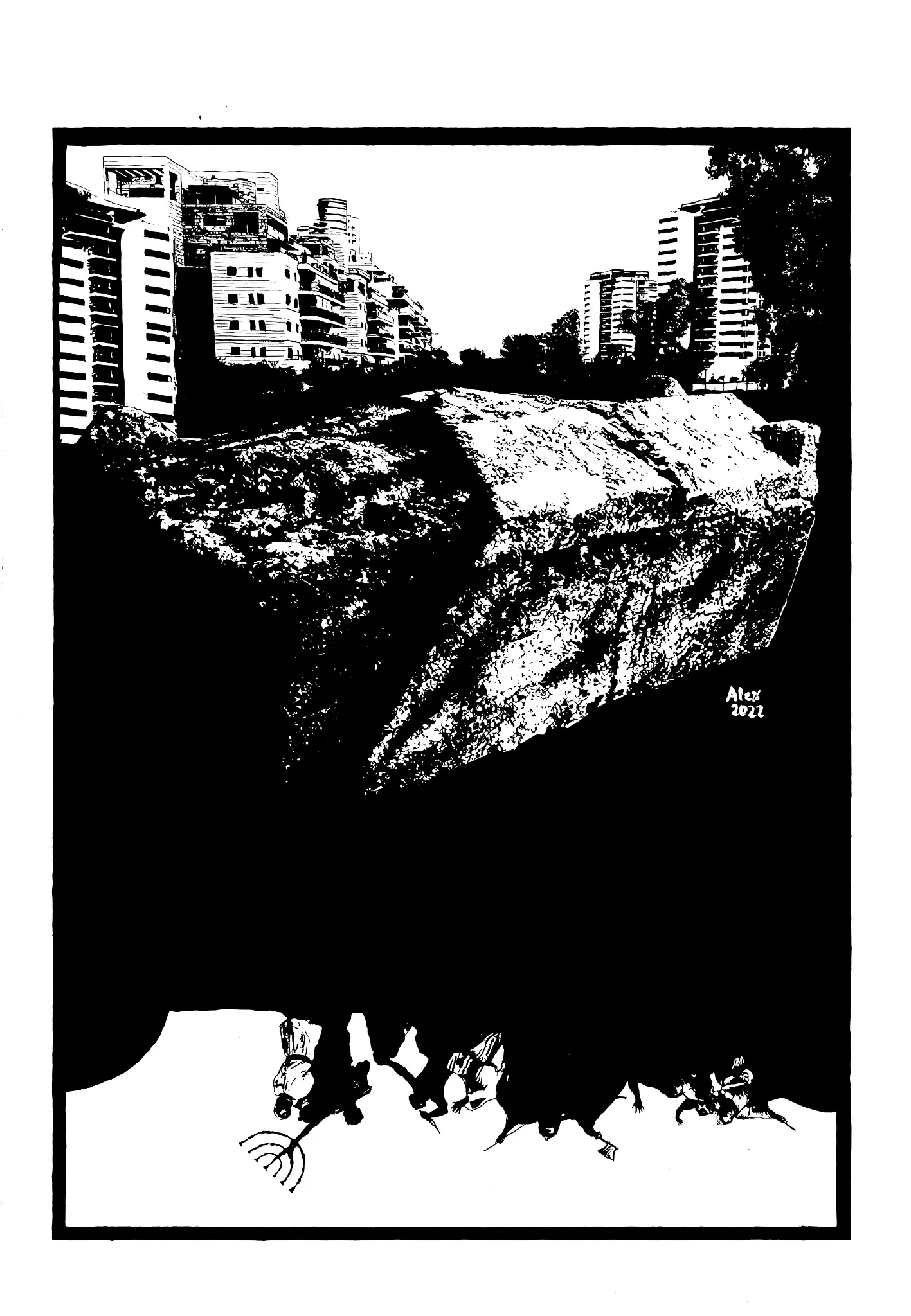
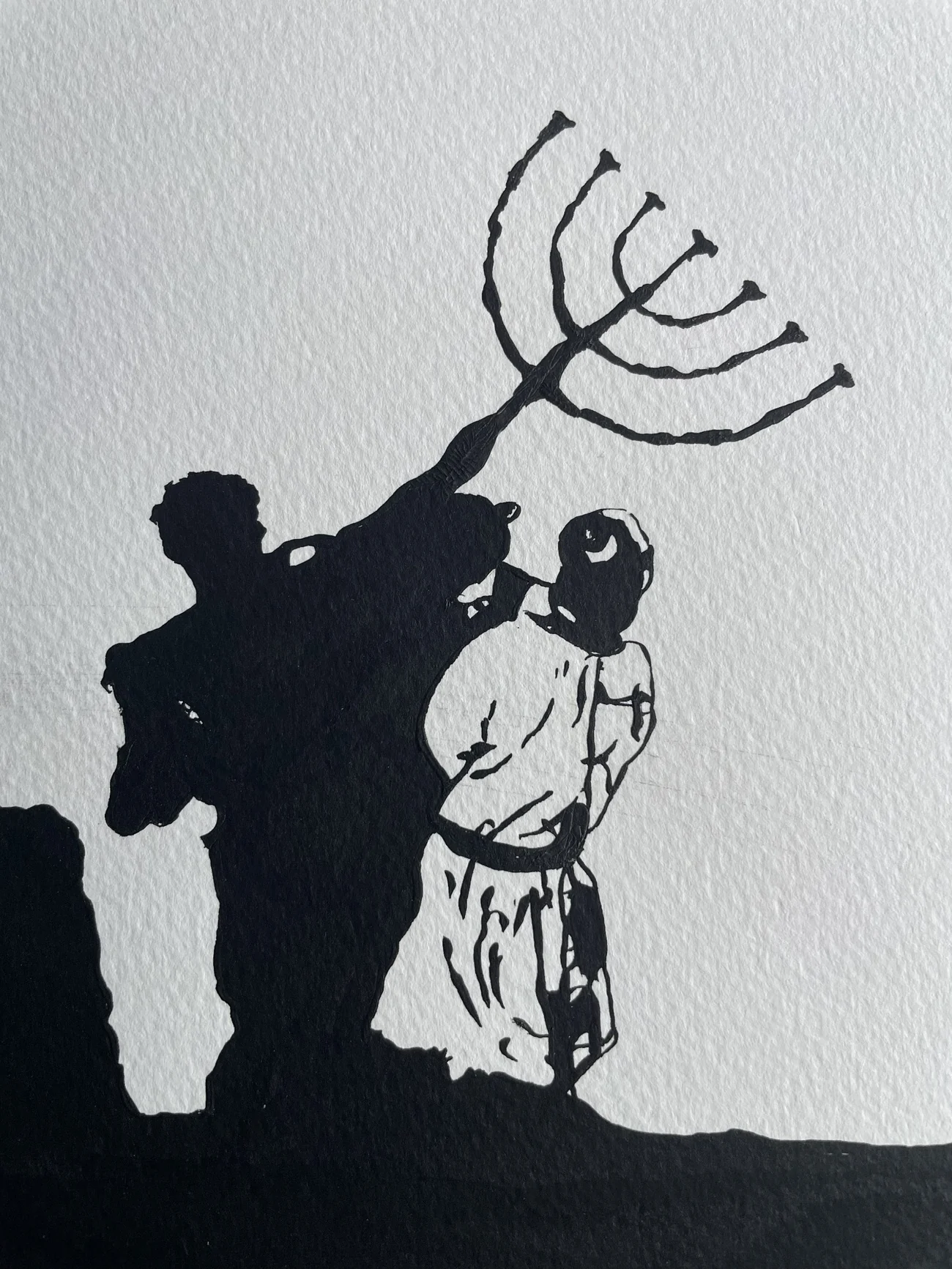
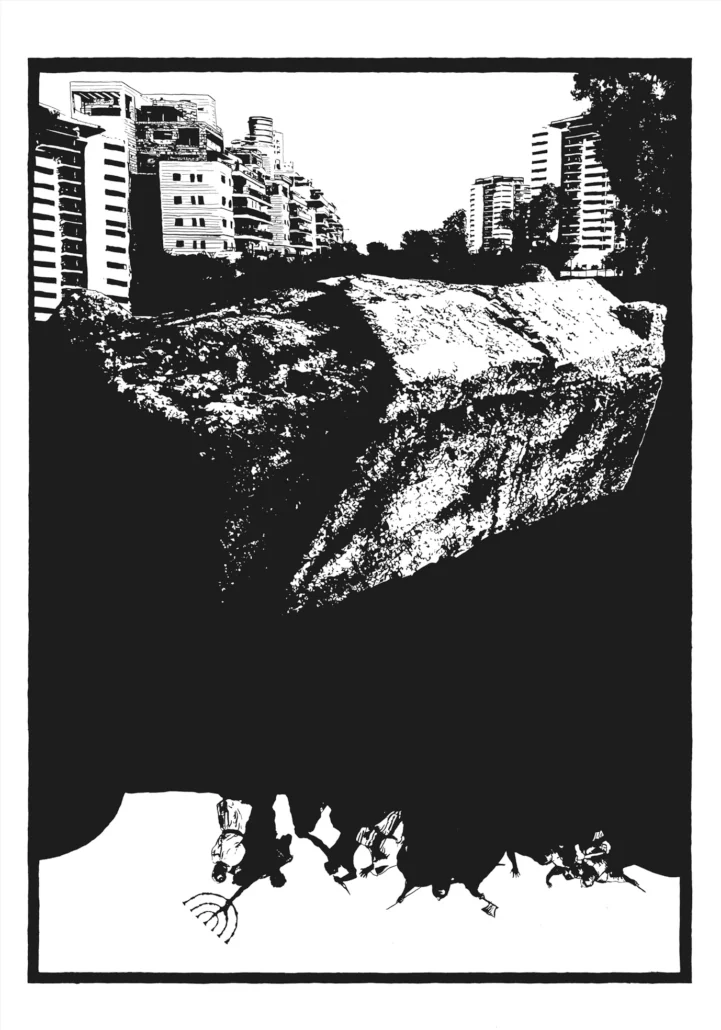
A Roman-period sarcophagus rises between two worlds. Above it is modern Yavne. Below it — or above it, once the sheet is turned — figures emerge from the destruction of Jerusalem. The coffin is not only a sign of death. It becomes the passage through which continuity is imagined.
A family conversation in Yavne.
Yavne entered the work through my uncle, an architect and long-standing artist who has lived there for many years. He spoke to me about the excavations taking place within the modern city and about Roman-period burials and sarcophagi appearing beneath a rapidly developing urban landscape.
What struck me was the historical coincidence. These burials belonged to the same broad period in which Yavne became one of the principal centres of Jewish religious and intellectual life after the destruction of Jerusalem in 70 CE. The dead of that period were quite literally re-emerging beneath the contemporary city.
The contrast was irresistible: modern apartment blocks above, a sarcophagus between, and below it the memory of Jerusalem’s destruction. That became the structure of the drawing.
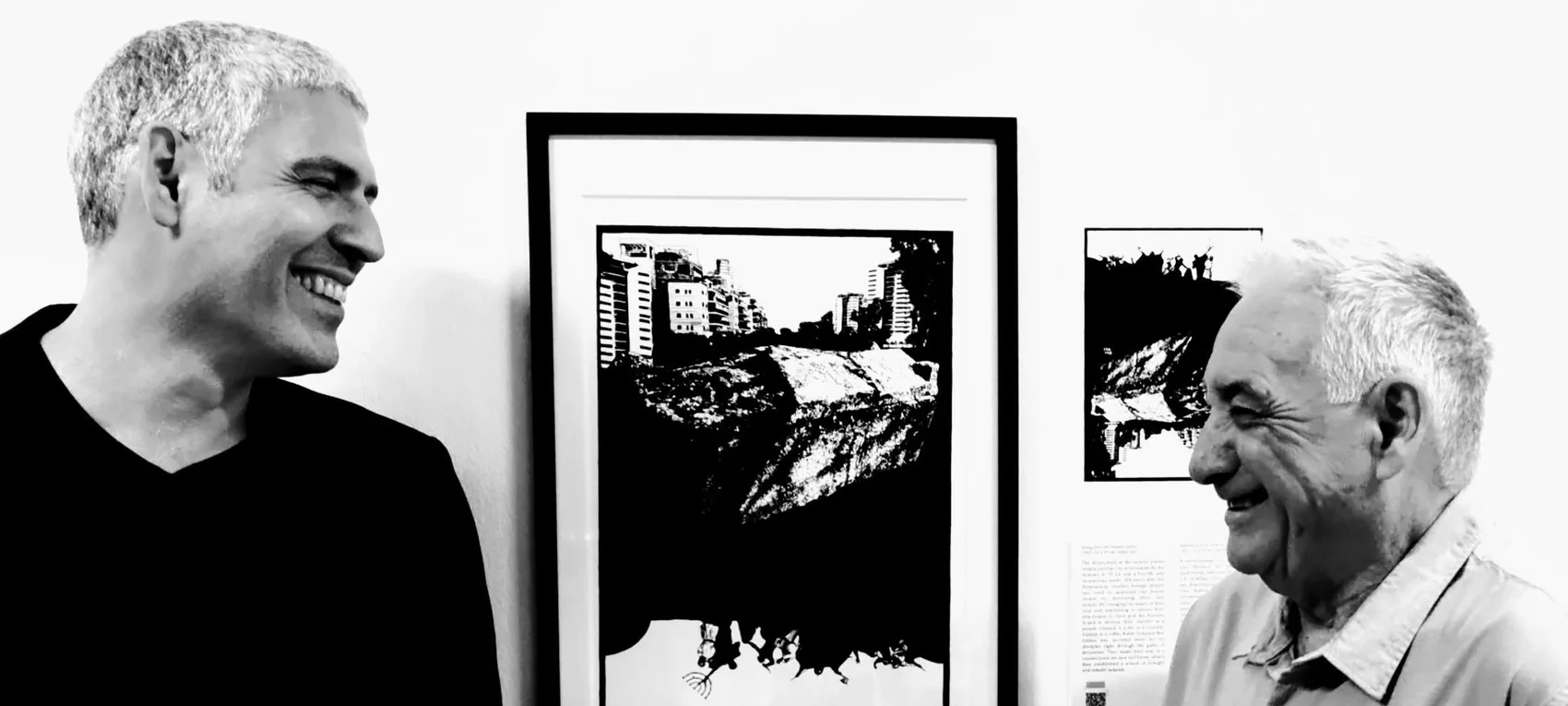
Building a hinge between two histories.
The progress photographs show how the composition was constructed around a central void. Modern Yavne is established first; the mass of black then expands around the sarcophagus and the inverted figures. The black field is not background. It is the rupture between the two worlds.
View process & sketches
Building a hinge between two histories.
The progress photographs show how the composition was constructed around a central void. Modern Yavne is established first; the mass of black then expands around the sarcophagus and the inverted figures. The black field is not background. It is the rupture between the two worlds.
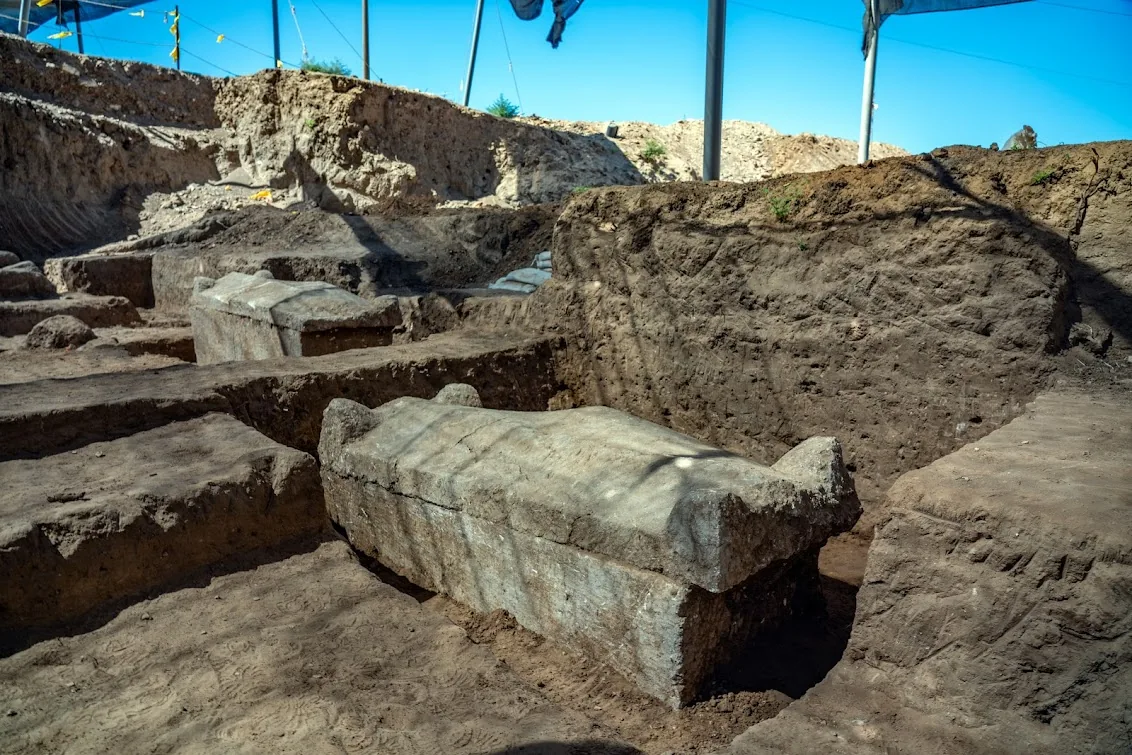
The dead of the period return to view.
Large-scale excavations east of Tel Yavne have exposed Roman-period cemeteries used from the first centuries CE onward, including stone and lead sarcophagi. Recent work has also identified buildings and a cemetery dating to the late first and second centuries — the period traditionally associated with Yavne’s post-70 community of sages.
Archaeology cannot tell us that a particular sarcophagus belonged to a member of the Sanhedrin. What matters for the work is the coincidence of period and place: burials from the era of Yavne’s transformation reappearing inside the modern city.
From destruction to continuity
The destruction of Jerusalem and the Second Temple by the Romans in 70 CE was one of the defining ruptures in Jewish history. Temple sacrifice, pilgrimage and a religious life centred on Jerusalem could no longer continue in the same way. Yavne became associated in rabbinic memory with the sages who helped reshape Jewish learning and communal practice for a world in which the Temple no longer stood.
Read full historical context
From destruction to continuity
The destruction of Jerusalem and the Second Temple by the Romans in 70 CE was one of the defining ruptures in Jewish history. Temple sacrifice, pilgrimage and a religious life centred on Jerusalem could no longer continue in the same way. Yavne became associated in rabbinic memory with the sages who helped reshape Jewish learning and communal practice for a world in which the Temple no longer stood.
That transition is what makes this one of the most positive works in the black-and-white series. The drawing begins with destruction, but it does not end there. Judaism survives not by restoring the lost Temple, but by finding forms through which law, prayer, study and memory can continue.
A coffin as a vehicle of survival
Rabbinic tradition gives the funerary image an extraordinary second meaning. In the story preserved in the Babylonian Talmud, Rabban Yohanan ben Zakkai escapes besieged Jerusalem by pretending to be dead. His disciples carry him toward burial and through the city gates. Once outside, the narrative leads to his encounter with the Roman command and to the famous request associated with Yavne and its sages.
The story should be read as rabbinic tradition rather than simple eyewitness history. But as an image it is extraordinary: apparent death becomes the means of survival. A man carried out of a burning city as a corpse becomes associated with the place where Jewish religious and intellectual life would be rebuilt.
Yavne and the reinvention of Jewish life
Yavne’s exact post-70 institutions are debated by historians. Later traditions sometimes describe a reconstituted Sanhedrin there, while modern scholarship is more cautious about applying that institutional name. What is not in doubt is Yavne’s importance in rabbinic memory as a centre of sages, teaching and legal discussion after the catastrophe of 70.
That is the movement at the heart of the drawing: not resurrection in a literal sense, but continuity through transformation. The sarcophagus joins the destroyed world of Jerusalem to a Judaism capable of surviving without the Temple.
Images of Jerusalem’s destruction
The destruction of the Temple generated its own visual afterlife. The Arch of Titus fixed the Roman victory in monumental relief, with the Temple menorah carried in triumph. Judaea Capta coinage circulated the conquest throughout the empire. Medieval Christian images could turn the siege of Jerusalem into explicitly anti-Jewish narratives, including the story of Mary of Bethezuba, the mother who eats her child during famine as described by Josephus.
My drawing moves in the opposite direction. Jerusalem’s destruction remains present, but it is not the conclusion of the story. The work looks beyond the triumphal image of defeat toward the less spectacular history of reinvention that followed it.
Which world is rising?
The drawing has no completely stable top. In one orientation, modern Yavne occupies the upper part of the sheet and the destroyed world hangs below. Turn it through 180 degrees and the direction of movement changes.
The rotation matters because the work is about transition rather than a single chronological line. Destruction, burial and renewal occupy the same sheet and exchange visual weight as the viewer turns it.
The image returns at a different scale.
The 2026 version revisits the composition as a new drawing rather than simply enlarging the 2022 sheet. At 75 × 110 cm, the physical behaviour of the ink and paper becomes much more visible, and the human figures acquire a different presence.
Rising from the Temple’s Ashes · lithograph
The lithograph is a distinct printed object based on the 2022 drawing, produced by Bruno Robbe on Rives BFK paper and issued in a signed and numbered edition of 50.
€250 · Brussels hand delivery by appointment · Elsewhere in Belgium & EU: €15 packaging/shipping · EU delivery only
Buy this lithographBrussels hand delivery · €250Exhibition history
View exhibition history
Exhibition history
- European Jewish Community Centre, Brussels8 December 2023 – 15 January 2024 · original drawing
- Full Circle, Brussels3 February – 25 April 2024 · original drawing
- Teloglion Fine Arts Foundation, Thessaloniki8 October – 10 November 2024 · lithograph
- Musée BIBLE+ORIENT, University of Fribourg25 March – 25 December 2025 · lithograph
- European Parliament, Brussels30 September 2025 · Cities of Lost Memory: Remembering the Jewish Journey · lithograph
Yavne, Yohanan ben Zakkai and the memory of 70 CE
View sources & further reading
Yavne, Yohanan ben Zakkai and the memory of 70 CE
- Babylonian Talmud, Gittin 56a–b. The rabbinic account of Yohanan ben Zakkai’s escape from Jerusalem and the narrative associated with Yavne. Sefaria.
- Eriola Jakoel, Alla Nagorsky, Pablo Betzer & Daniel Varga, “May My Coffin Be Perforated to the Earth: Roman-Period Cemeteries at Yavne”, Cornerstone 11 (2023). Israel Antiquities Authority publication.
- Israel Antiquities Authority, archaeological reports on late first- and second-century remains and cemeteries at Yavne.
- Flavius Josephus, The Jewish War, Books 5–6, for the siege and destruction of Jerusalem.
- Arch of Titus and Judaea Capta coinage, Roman visual programmes commemorating the suppression of the revolt and the capture of Jerusalem.
- Earlier Lost Memory research on medieval images of Jerusalem’s destruction and Francesco Hayez’s Destruction of the Temple of Jerusalem.