The Winter Famine
in Arnhem, 1945
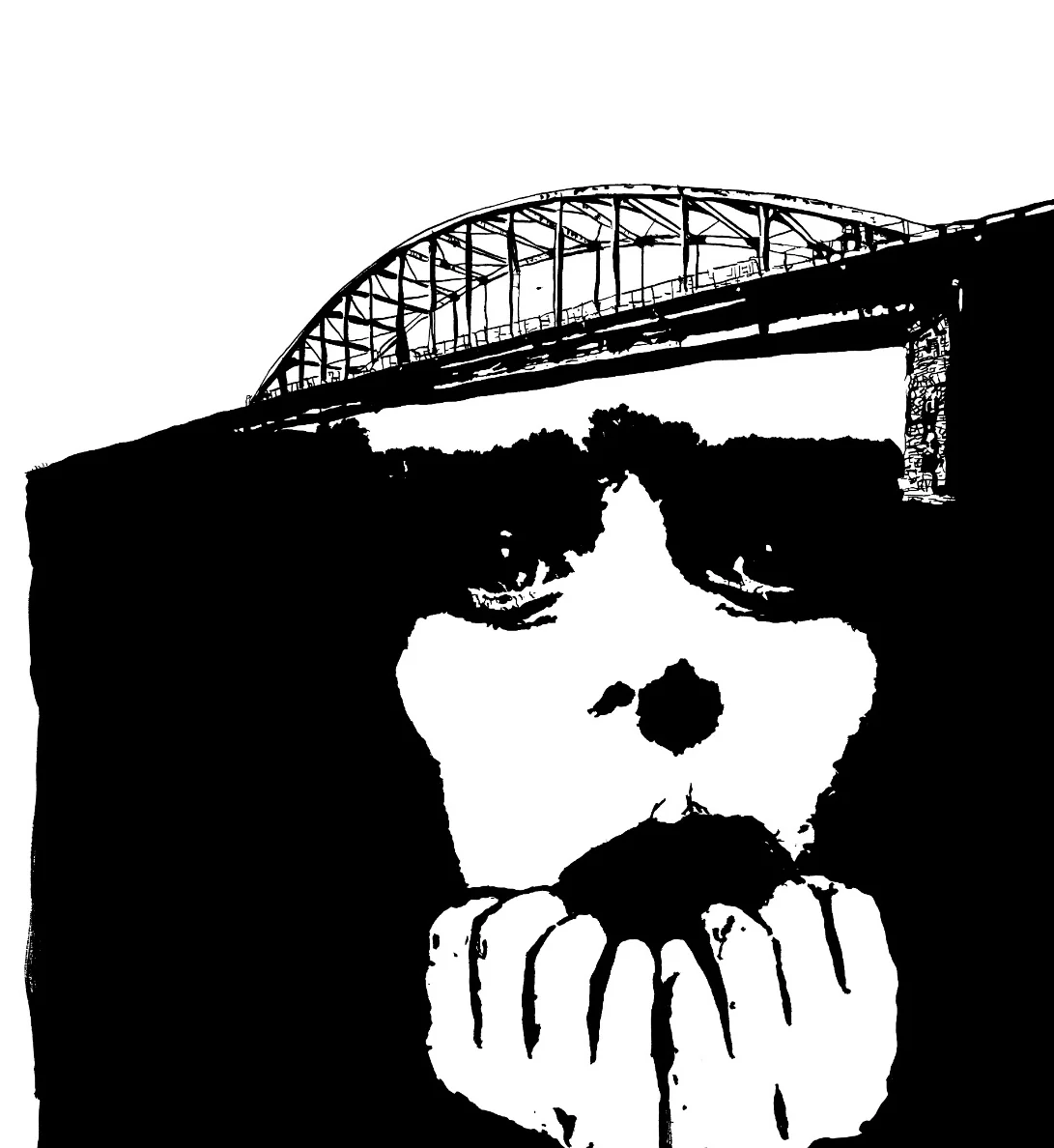
The face of a young woman emerges from a field of black. The dark foliage along the river forms her eyebrows, while the Arnhem bridge sits above her head like a hard rim. Her hands are drawn up to her mouth, the gesture small and instinctive. The bridge is not simply a landmark: it marks the point at which liberation stalled.
A bridge remembered from childhood.
I first crossed the Arnhem bridge by bicycle with my father when I was about twelve or thirteen. It was part of my first long cycling trip, and the bridge stayed in my memory long before I understood how much history had accumulated around it.
Years later, when I began thinking about a drawing on the Dutch Hunger Winter, Arnhem returned to me as the visual point of entry. The bridge was the place where the Allied advance had failed in September 1944. The famine that followed was centred mainly in the still-occupied western Netherlands, not in Arnhem itself — but the failure at Arnhem belongs to the chain of events that left millions of Dutch civilians facing another winter under occupation.
The bridge becomes part of the face.
The surviving process photograph shows that the bridge was established before the image was closed by black ink. The young woman’s face is not placed beneath a separate historical scene: bridge, riverbank and face are fused into a single structure.
View process & sketches
The bridge becomes part of the face.
The surviving process photograph shows that the bridge was established before the image was closed by black ink. The young woman’s face is not placed beneath a separate historical scene: bridge, riverbank and face are fused into a single structure.
The large black field then removes almost everything that might locate the figure in an ordinary space. What remains is the bridge, the eyes, the nose, the mouth and the hands — enough to make hunger immediately legible without illustrating famine literally.
Arnhem was the failed gateway, not the centre of the famine
Operation Market Garden began on 17 September 1944. Its aim was to seize a chain of bridges through the Netherlands and open a route into Germany. British airborne troops reached the road bridge at Arnhem and held its northern end for several days, but the operation ultimately failed. The Rhine remained a barrier to the Allied advance.
Read full historical context
Arnhem was the failed gateway, not the centre of the famine
Operation Market Garden began on 17 September 1944. Its aim was to seize a chain of bridges through the Netherlands and open a route into Germany. British airborne troops reached the road bridge at Arnhem and held its northern end for several days, but the operation ultimately failed. The Rhine remained a barrier to the Allied advance.
The consequences for Arnhem itself were devastating. After the battle, the German authorities ordered the civilian population out of the city and surrounding area. Around 150,000 people from Arnhem and the region were forced to evacuate; many did not return until after liberation in 1945. Arnhem became, for a time, an emptied and heavily damaged city.
The Hunger Winter
The famine of 1944–45 affected above all the densely populated western Netherlands. After the Dutch government in exile called a national railway strike in support of Market Garden, the German occupation authorities retaliated by stopping food transport into the western provinces for several weeks. Transport disruption, fuel shortages, the military front and an exceptionally severe winter then compounded the crisis.
By the winter, food rations had collapsed. Civilians travelled long distances by bicycle or on foot in search of food; tulip bulbs and sugar beet entered emergency diets; furniture and timber were burned for heat. Around 20,000 people are estimated to have died as a result of the famine, with millions more affected by severe hunger and deprivation.
Why Arnhem?
The drawing is therefore not intended to claim that Arnhem itself was the geographical centre of the Hunger Winter. Its role is symbolic and causal. Arnhem marks the dramatic failure of the attempt to end occupation quickly. The bridge becomes an image of a liberation that came within sight and then receded, while the young woman’s face carries the civilian cost of the months that followed.
After the war
Friedrich Christiansen, the German military commander in the Netherlands, was tried in Arnhem after the war and sentenced in 1948 for war crimes committed during the occupation. His prosecution belongs to the wider history of occupation and retaliation. The drawing itself, however, is less concerned with an individual perpetrator than with the civilian experience produced by military failure, occupation policy and scarcity.
Trees for eyebrows. A bridge like a helmet.
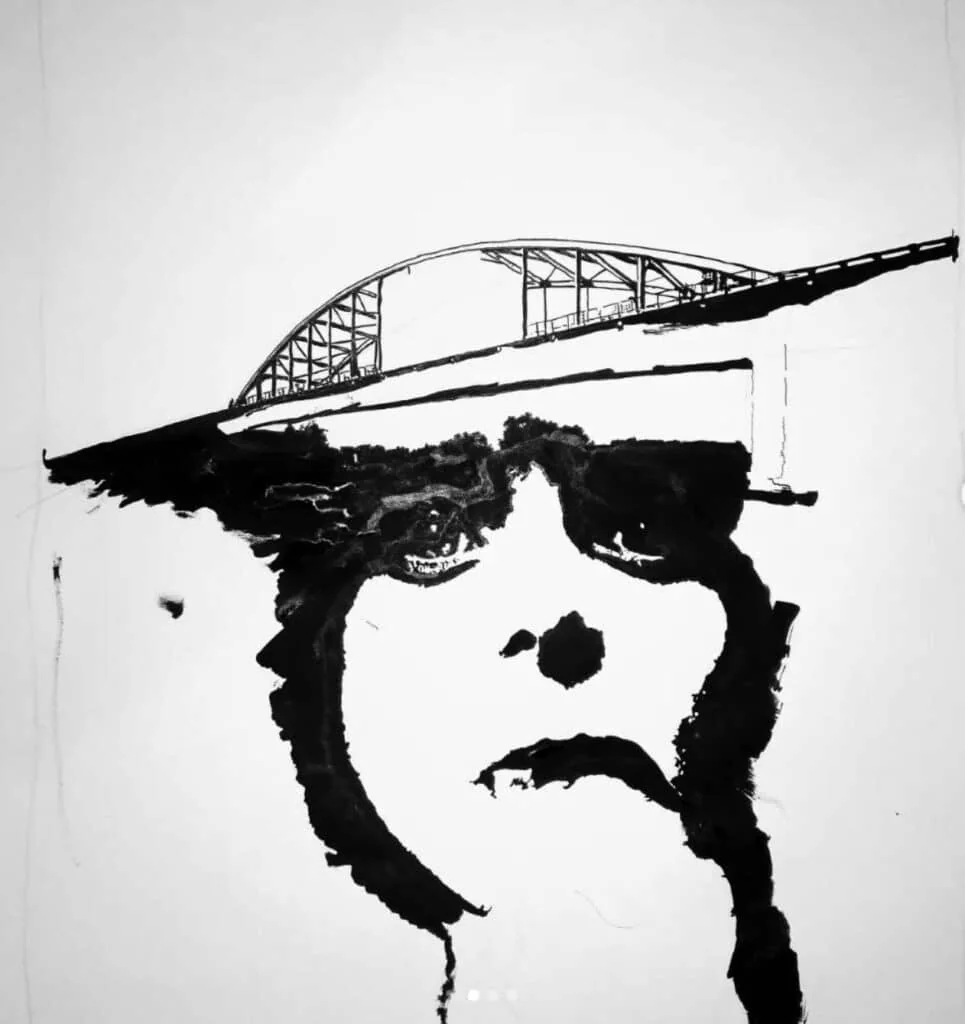
The eyebrows are not formed by the bridge. They come from the dark frondescence of the trees along the riverbank, which settles directly into the young woman’s face.
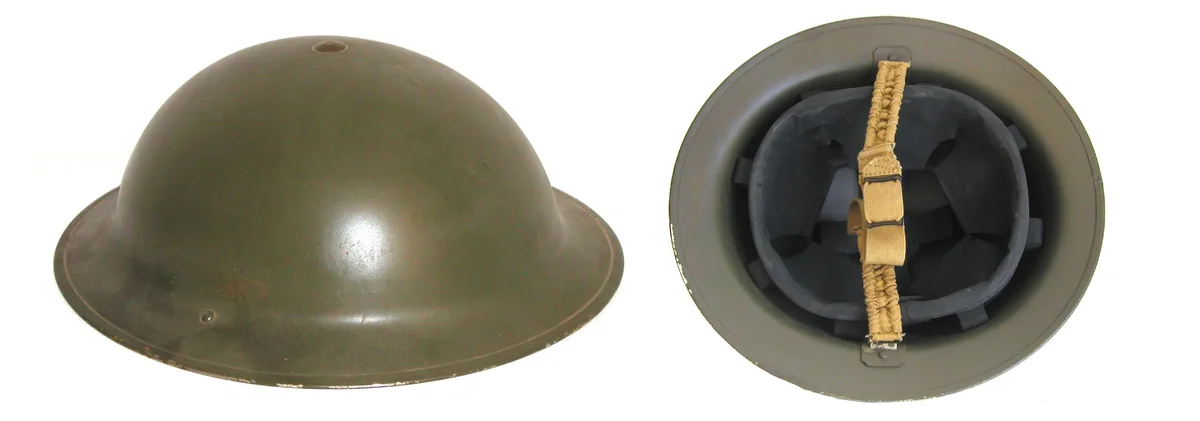
Above them, the bridge has always suggested another shape to me: the shallow, flared profile of a British Mark II “Tommy” helmet. The resemblance is especially visible in the work-in-progress image, before the surrounding black areas close the composition.
It is an association rather than a literal historical object inserted into the scene, but it gives the bridge a second visual role: landmark and wartime silhouette at once.
Exhibition history
View exhibition history
Exhibition history
- European Jewish Community Centre, Brussels8 December 2023 – 15 January 2024 · original drawing
- Full Circle, Brussels3 February – 25 April 2024 · original drawing
- Teloglion Fine Arts Foundation, Thessaloniki8 October – 10 November 2024 · original drawing
Arnhem and the Hunger Winter
View sources & further reading
Arnhem and the Hunger Winter
- Stephen Badsey, Arnhem 1944: Operation Market Garden, London, Osprey Publishing, 1993.
- Antony Beevor, Arnhem: The Battle for the Bridges, 1944, London, Viking, 2018.
- Zena Stein et al., Famine and Human Development: The Dutch Hunger Winter of 1944–45, 1975.
- Anne Frank House, “Hunger winter: hunger and cold in the Netherlands” — overview of the railway strike, food embargo and civilian deprivation. Read online.
- Airborne Museum Hartenstein, documentation on the evacuation of Arnhem and the surrounding region after Operation Market Garden. Read online.