The
Vanished

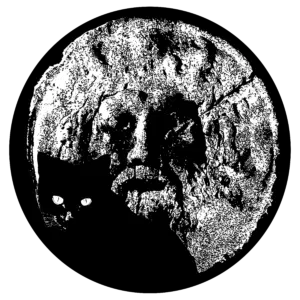
The White Tower does not rise calmly above Thessaloniki. It is caught in a black tide, while fragments of the city’s vanished Jewish cemetery return to the surface.
The first composition establishes the White Tower, the dark sea and the re-emergence of the cemetery.
A separate signed and numbered edition produced with lithographer Bruno Robbe.
The subject is revisited at 75 × 110 cm, where scale, paper and black surfaces become more physically present.
A monument made unstable
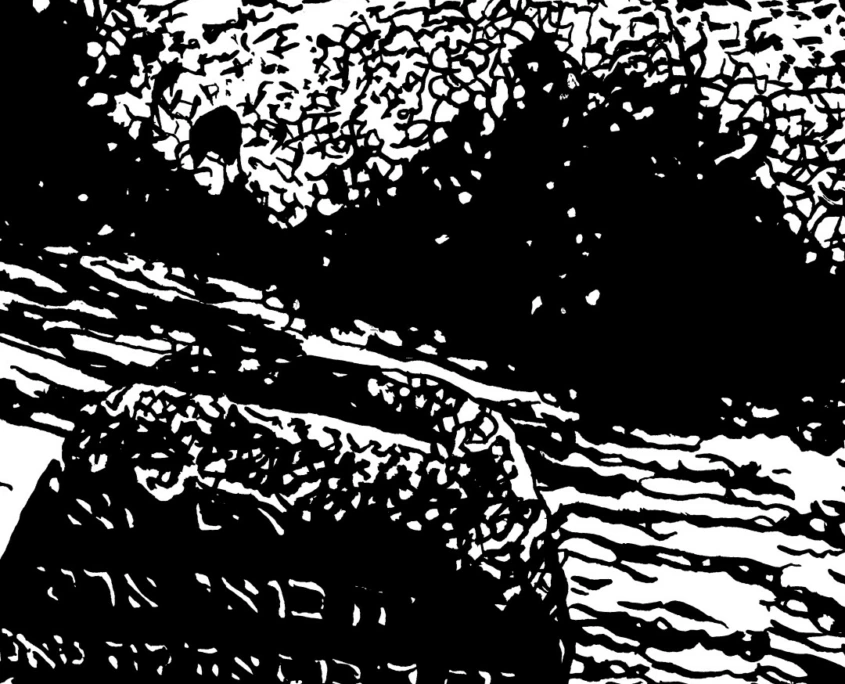
The composition begins with one of Thessaloniki’s most recognisable forms, the White Tower, but refuses the usual postcard view. The monument is submerged rather than monumental. Below it, the lines of water and black ink carry other fragments upward: tombstones, inscriptions and the material traces of a community that the modern city can no longer show in the same way.
The reversal is deliberate. What survives above ground is pushed towards disappearance; what disappeared is made visible again.
Before the drawing, there was the city.
Thessaloniki was not a city I discovered through this work. My first archaeological excavations took place at Dion, near Mount Olympus, and Thessaloniki gradually became one of the cities to which I returned most often. Friends, repeated visits and the experience of northern Greece came long before The Vanished.
The drawing began later, from the discrepancy between the city I knew and another Thessaloniki that was much harder to see: the great Jewish city that had once existed there.
From first lines to ink
Three preparatory stages show the composition emerging slowly: first the construction of the White Tower, then the first black field, and finally the denser network of ink that begins to pull the image together.
View process & sketches
From first lines to ink
Three preparatory stages show the composition emerging slowly: first the construction of the White Tower, then the first black field, and finally the denser network of ink that begins to pull the image together.


Madre de Israel
For centuries, Thessaloniki was one of the great Jewish centres of the Mediterranean. Its Sephardic population shaped the language, commerce and social life of the city to such an extent that Salonica became known as the Madre de Israel — the Mother of Israel.
Read full historical context
Madre de Israel
For centuries, Thessaloniki was one of the great Jewish centres of the Mediterranean. Its Sephardic population shaped the language, commerce and social life of the city to such an extent that Salonica became known as the Madre de Israel — the Mother of Israel.
The Nazi occupation brought that world close to destruction. In 1943, the overwhelming majority of Thessaloniki’s Jews were deported to Auschwitz-Birkenau. The immense Jewish cemetery, already under attack during the occupation, was destroyed and its stones were dispersed and reused across the city. Much of the site later became part of the Aristotle University campus.
The Vanished is not intended as an illustrated historical lesson. The history enters the drawing through absence: through the things a visitor can no longer encounter in the streets, and through the physical traces that have been buried, reused or absorbed into the modern city.
The image returns at a different scale.
The 2026 version does not replace the 2022 drawing. It returns to the same subject as a new physical object. At 75 × 110 cm, the relation between architecture, black surface and exposed paper changes: forms become more monumental, but the hand also becomes easier to see.
At close range, the drawing reveals the grain of the paper, the density of the ink and the small variations left by the hand. This material presence matters to a body of work that can otherwise look deceptively graphic on screen.


The lithograph
€250 · Brussels hand delivery by appointment · Elsewhere in Belgium & EU: €15 packaging/shipping · EU delivery only
Buy this lithographBrussels hand delivery · €250From Brussels to Thessaloniki
View exhibition history
From Brussels to Thessaloniki
View sources & further reading
Open bibliography and resources
- Hesse, C. & Laqueur, T., “Bodies Visible and Invisible: The Erasure of the Jewish Cemetery in the Life of Modern Thessaloniki”, in The Holocaust in Greece, Cambridge University Press, 2018.
- Mazower, M., Salonica, City of Ghosts: Christians, Muslims and Jews, 1430–1950, 2004.
- Saltiel, L., The Holocaust in Thessaloniki: Reactions to the Anti-Jewish Persecution, 1942–1943, Routledge, 2021.
- Karababas, A., Sur les traces des Juifs de Grèce, VA éditions, 2023.