Superstition
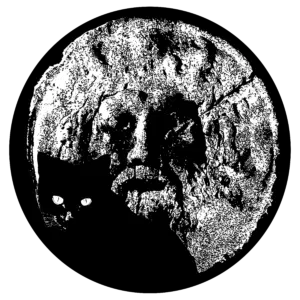
A black cat stares out from the darkness. Behind it, what first reads like a full moon slowly becomes a face: the ancient marble disk known as the Bocca della Verità. Two superstitions, separated by centuries, occupy the same image.
Three gazes
The drawing is deliberately spare. The cat’s pale eyes meet the viewer first. Behind them, the pierced eyes of Oceanus are dark and empty. The marble itself is a third presence: a fragment of antiquity that has accumulated meanings long after its original function disappeared.
A drain that learned to judge
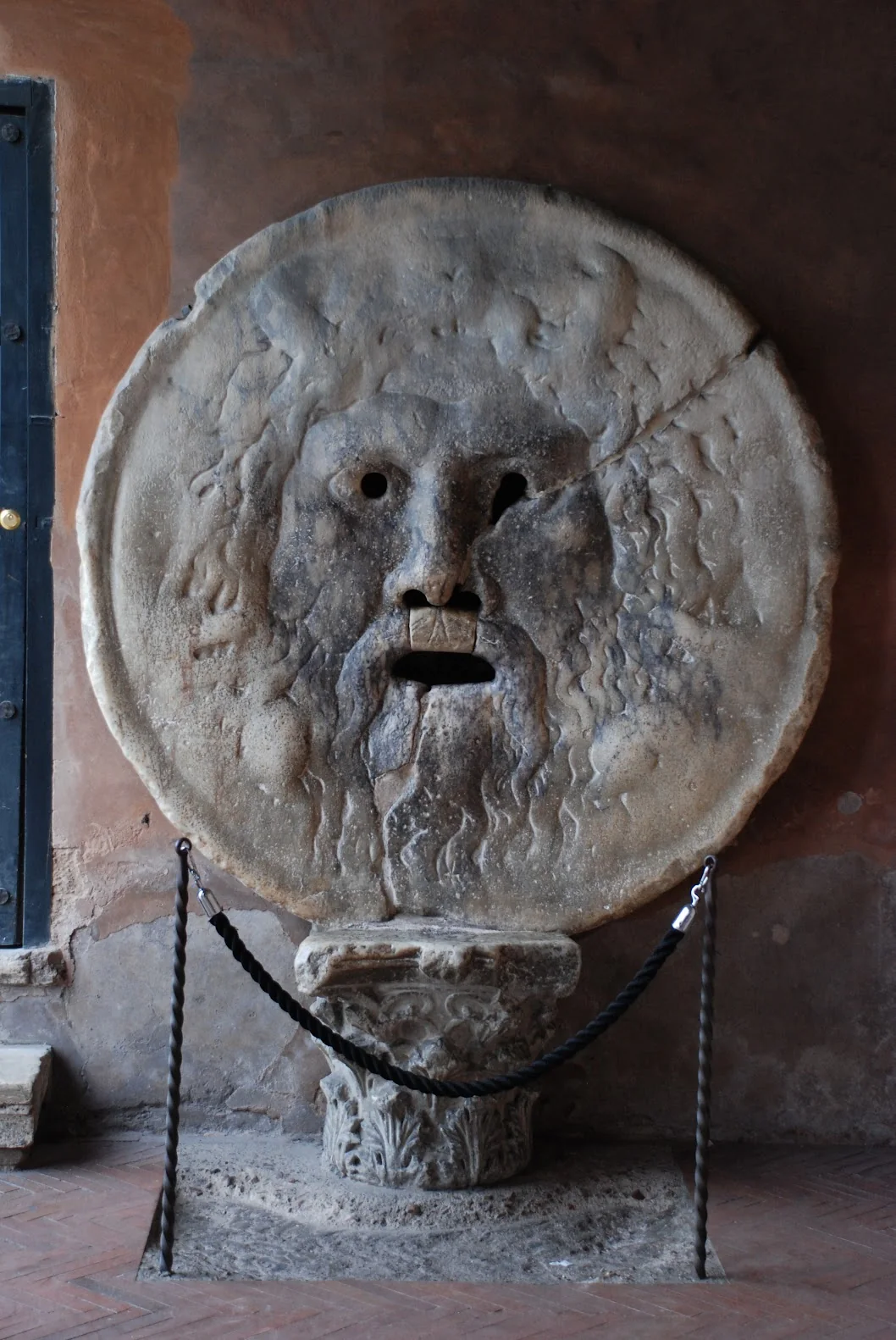
The Bocca della Verità is a large ancient Roman marble disk, probably dating to the second century CE. Its bearded face is generally identified with Oceanus. The openings through the eyes, nostrils and mouth make a practical origin plausible: rather than a cult image, it was most likely part of Rome’s water or drainage infrastructure.
Read full historical context
A drain that learned to judge
The Bocca della Verità is a large ancient Roman marble disk, probably dating to the second century CE. Its bearded face is generally identified with Oceanus. The openings through the eyes, nostrils and mouth make a practical origin plausible: rather than a cult image, it was most likely part of Rome’s water or drainage infrastructure.
Once its original function had been forgotten, the object acquired another life. Medieval Rome was full of ancient statues whose meanings were no longer understood. Pagan images could be treated as uncanny presences, and stories grew around them. The disk became the “Mouth of Truth”, credited with the power to expose lies and, eventually, to punish the dishonest by biting off a hand placed inside its mouth.
The legend survived Christianity, antiquarian scholarship and modern tourism. In the twentieth century it reached an enormous international audience through Roman Holiday (1953), when Gregory Peck frightens Audrey Hepburn with the famous hand-in-the-mouth trick. A Roman drain cover had become an oracle, then a test of fidelity, then a tourist ritual — without ever ceasing to be the same piece of marble.
Antiquity
A Roman marble disk, probably associated with water and drainage, bearing the face of Oceanus.
Middle Ages
Its practical meaning faded and the stone accumulated legends about truth, deceit and supernatural punishment.
Modern Rome
The ritual persists as popular culture: visitors still queue to place a hand inside the mouth.
Moon, mask, manhole
The circular composition encourages an immediate mistake. At a glance, the stone resembles a moon behind the cat. Only gradually do the eyes, nose, mouth and beard resolve into the face of Oceanus.
That misreading is part of the work. A utilitarian object becomes divine, demonic and magical because people project stories onto it. The cat performs the same operation. It is simply an animal, yet centuries of folklore can make its colour and its path into a sign.
From circle to face
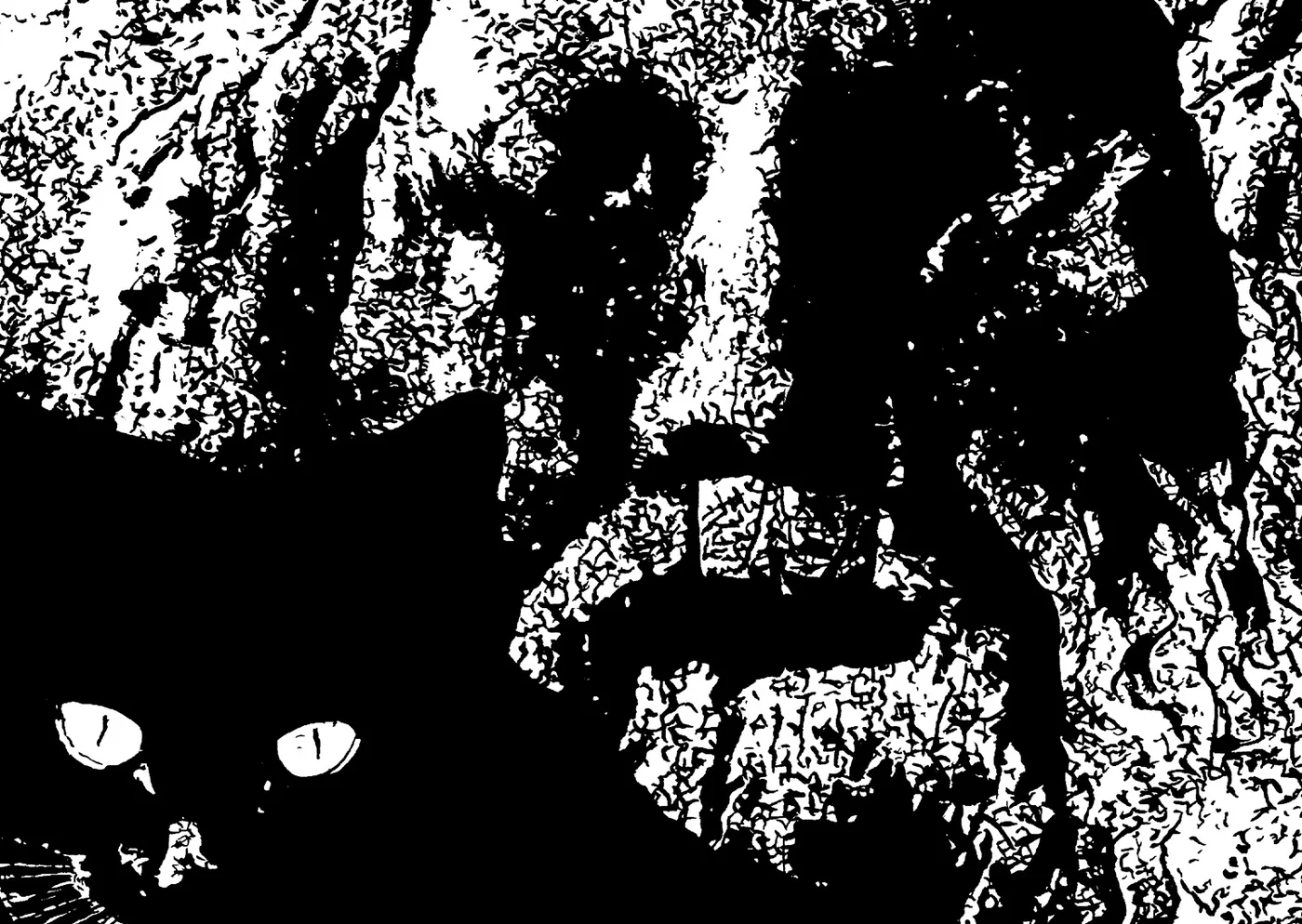
Five stages from the work-in-progress sequence show the structure clearly: the black cat and circular boundary establish the composition first; the face of Oceanus is then built inside the disk; the broad surrounding black field arrives last and changes the image from study to apparition.
View process & sketches
From circle to face
Five stages from the work-in-progress sequence show the structure clearly: the black cat and circular boundary establish the composition first; the face of Oceanus is then built inside the disk; the broad surrounding black field arrives last and changes the image from study to apparition.
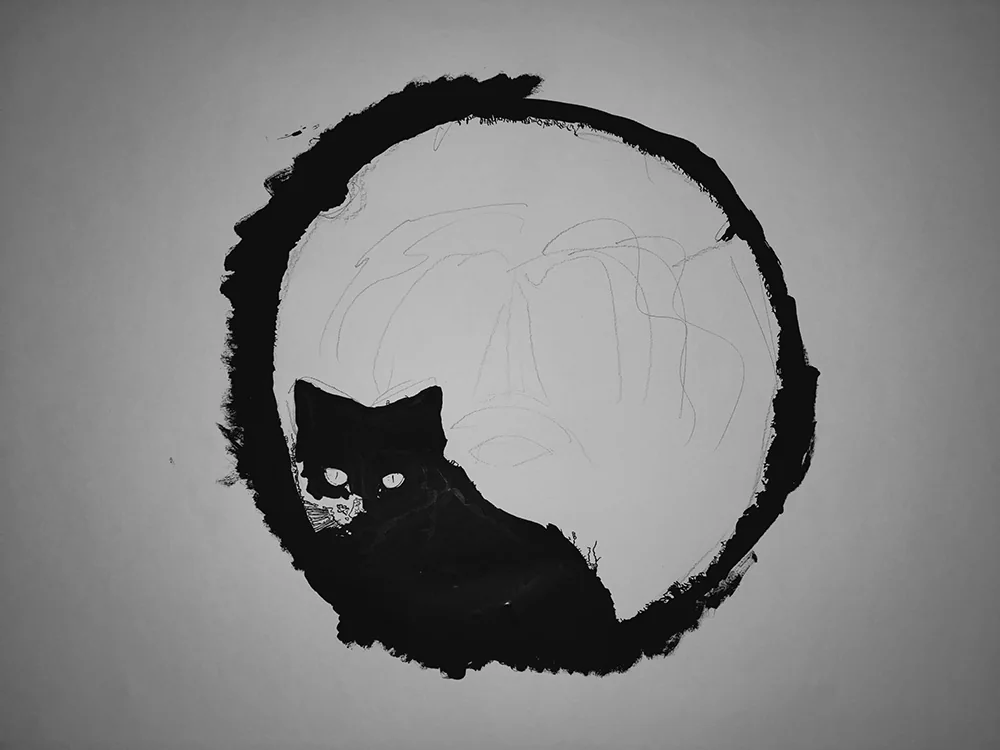
1 · Cat, eyes and circular boundary establish the entire geometry.
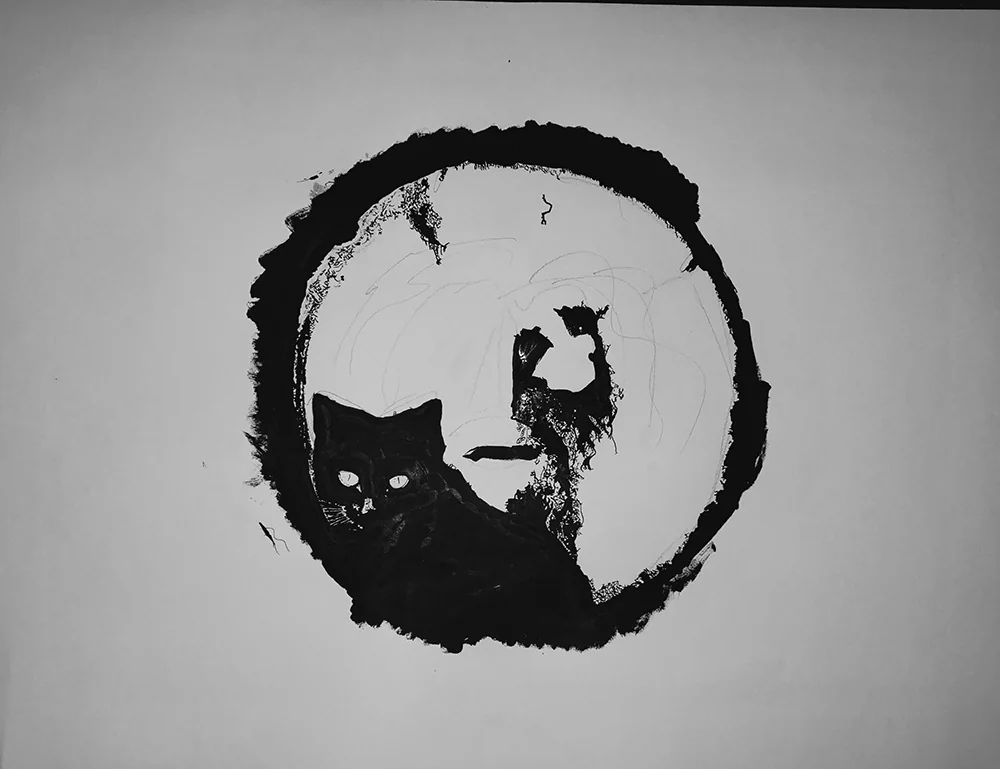
2 · The first dark marks begin to locate the ancient face.
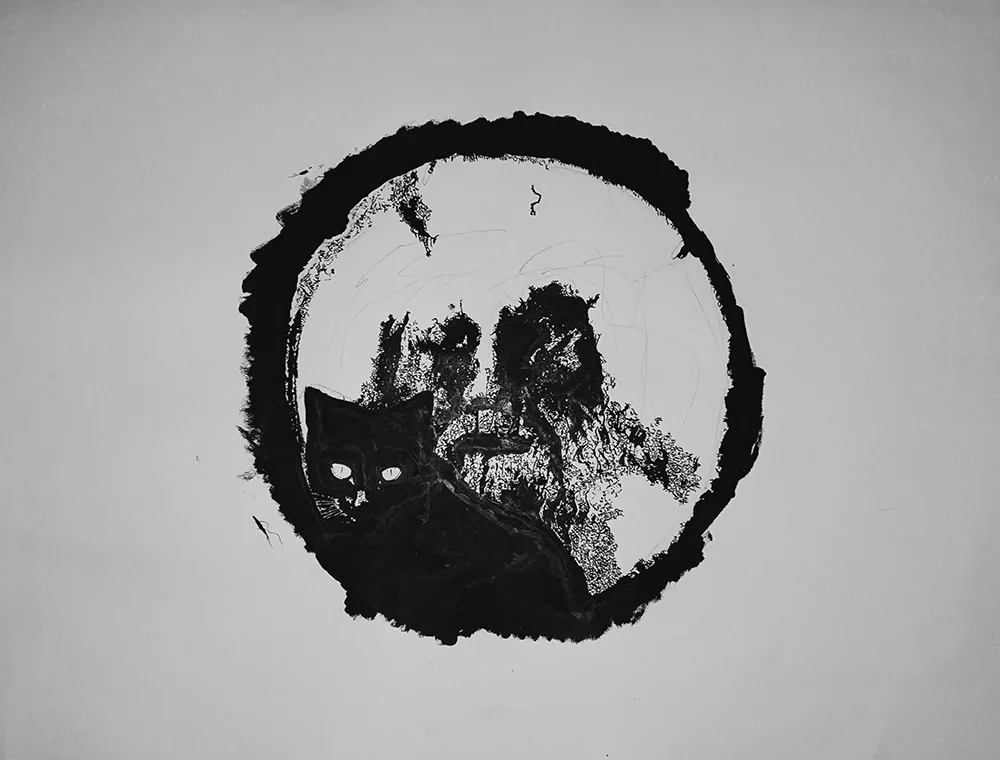
3 · Oceanus becomes legible while much of the disk remains untouched paper.
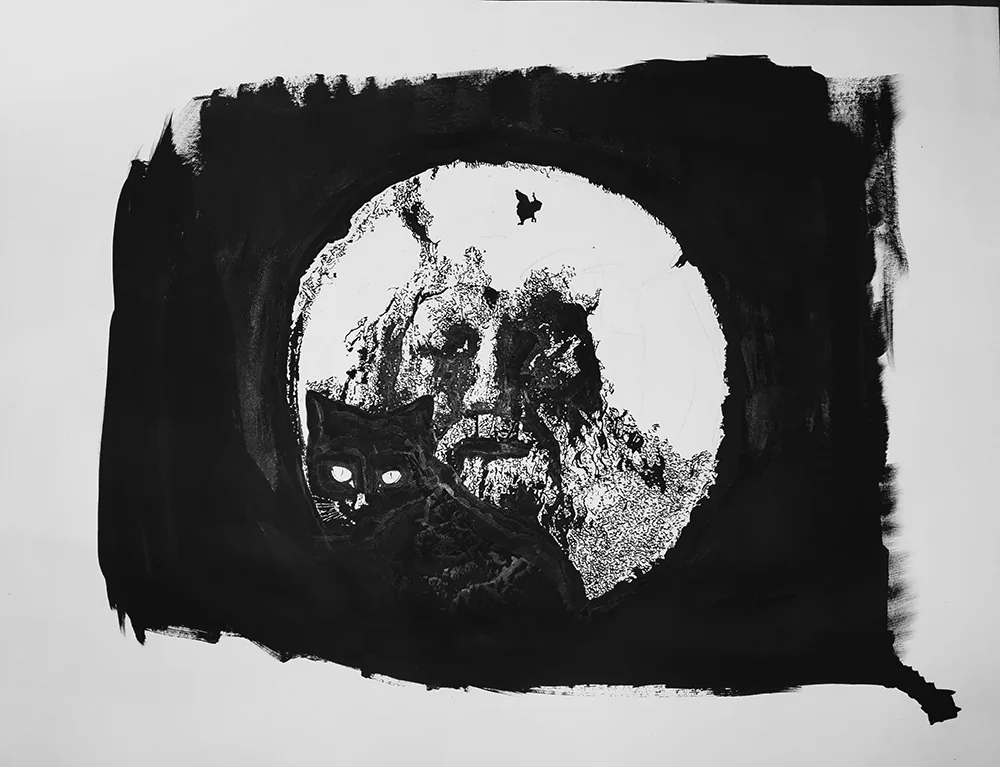
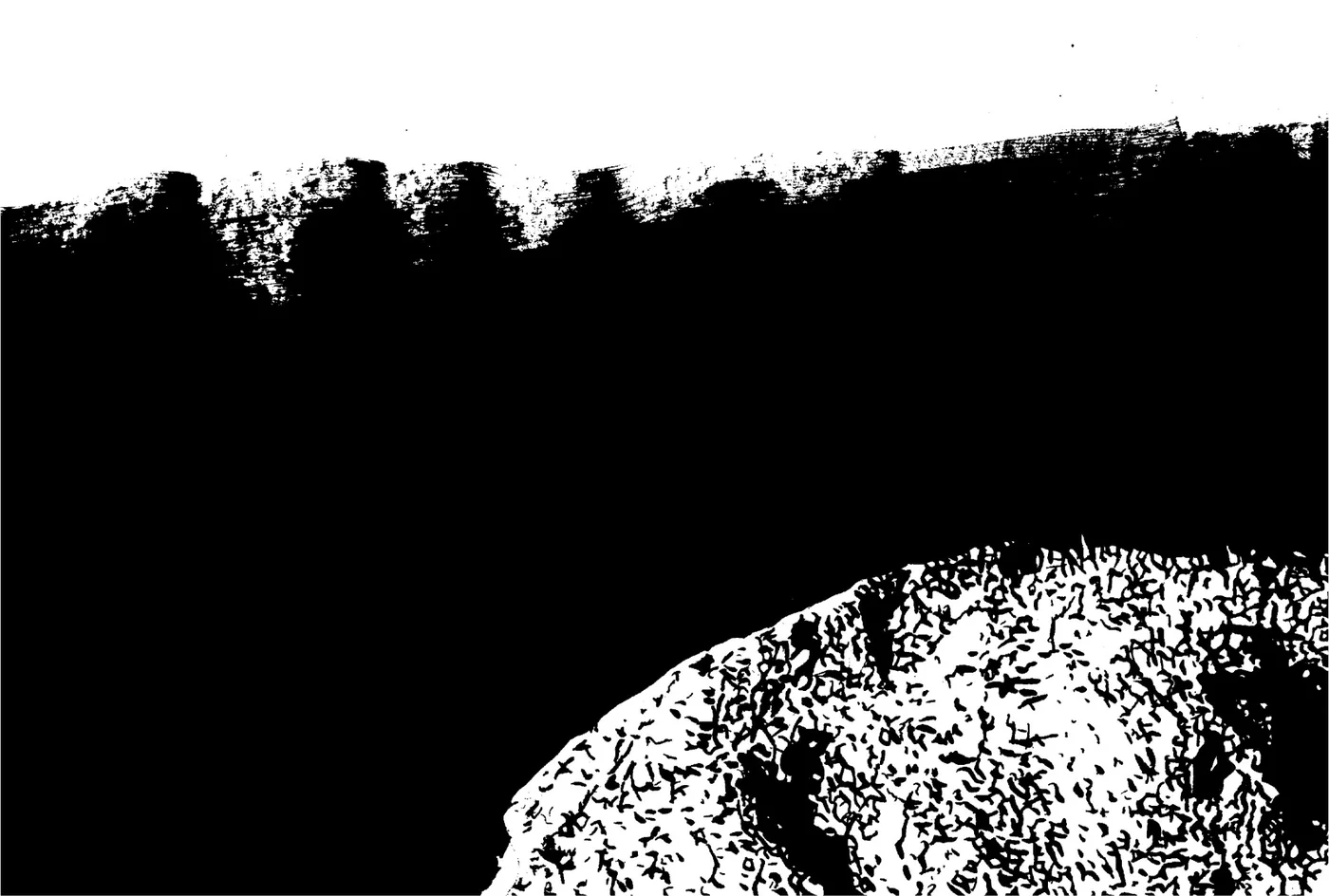
4 · The outer black field closes around the disk and cat.
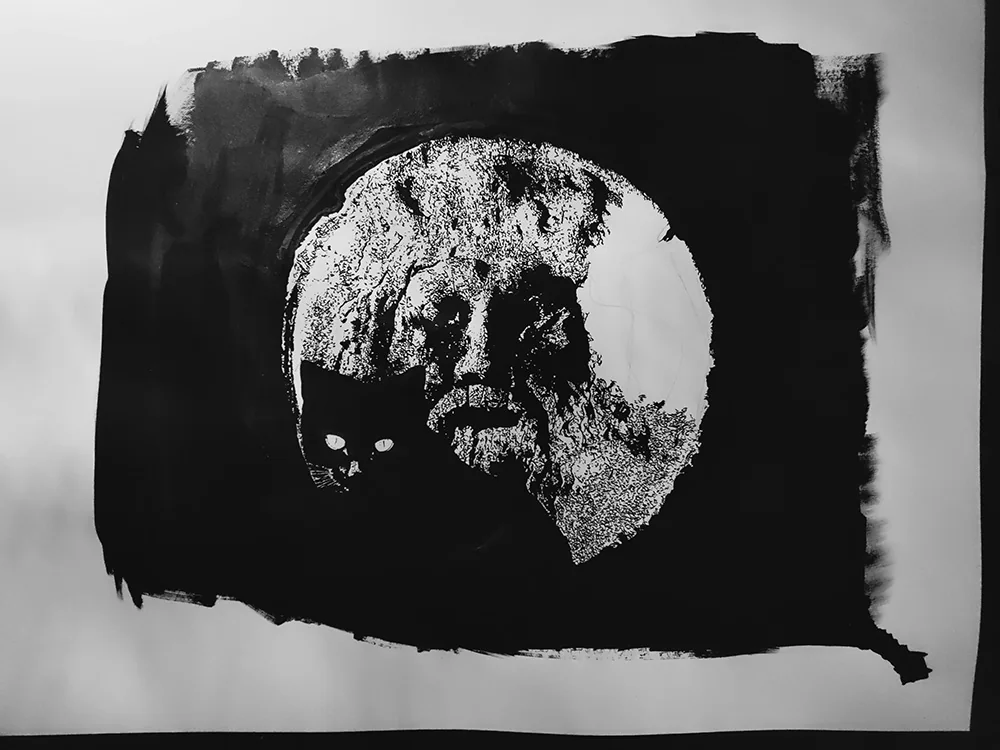
5 · Texture and tonal density bring the marble face into its final balance.
The black field leaves the page
Seen framed and at distance, the composition becomes even more deceptive. The broad black brushwork first reads as a single nocturnal mass; only then do the cat and the ancient face separate from it.
View exhibition history
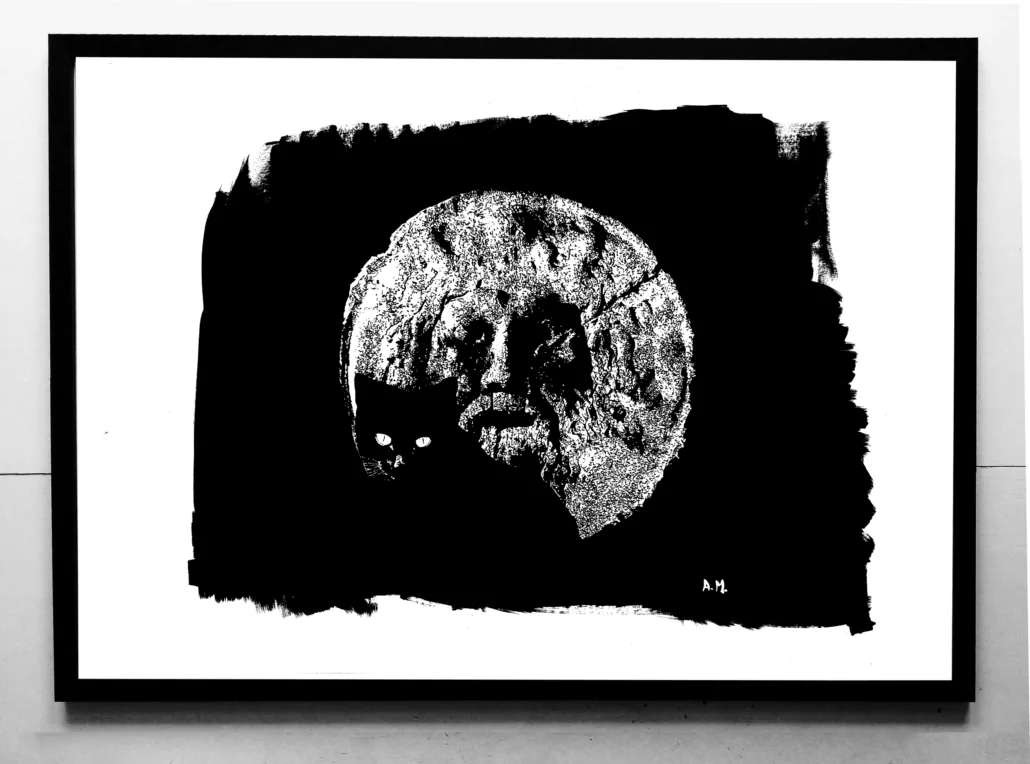
The black field leaves the page
Seen framed and at distance, the composition becomes even more deceptive. The broad black brushwork first reads as a single nocturnal mass; only then do the cat and the ancient face separate from it.
The work has been shown as part of the Cities of Lost Memory exhibition cycle.
The surviving exhibition photograph does not securely identify its venue.
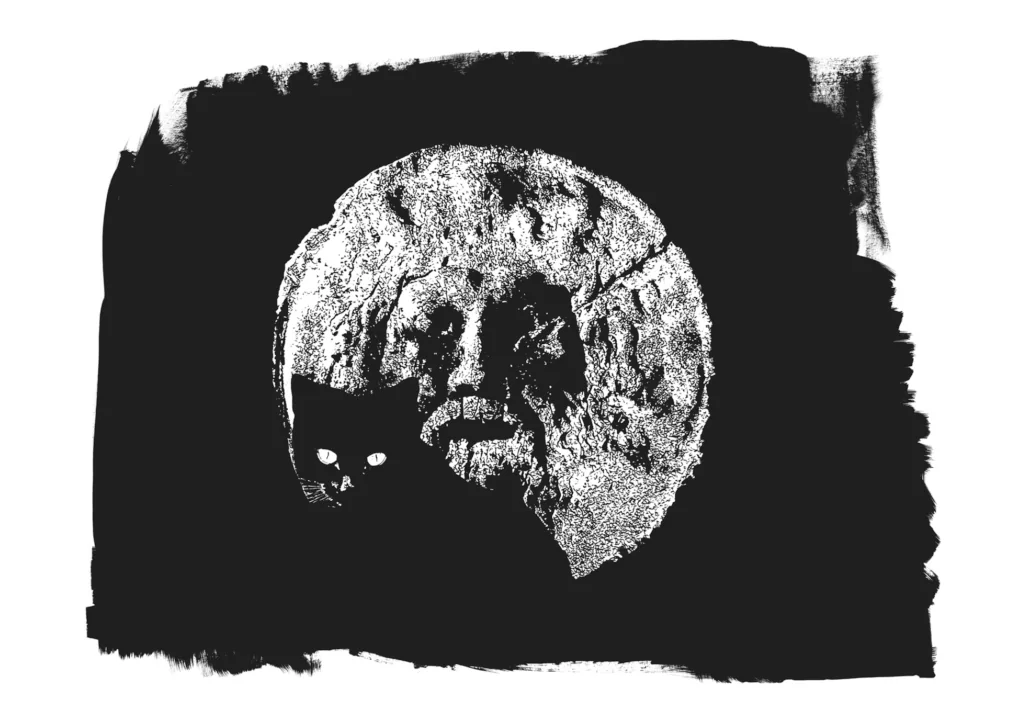
Superstition in stone
The image was translated into lithography in 2023 by master printer Bruno Robbe. The medium is particularly apt for a drawing built from dense blacks, scraped textures and the resistance of untouched white paper.
€250 · Brussels hand delivery by appointment · Elsewhere in Belgium & EU: €15 packaging/shipping · EU delivery only
Buy this lithographBrussels hand delivery · €250The afterlife of the Mouth of Truth
View sources & further reading
The afterlife of the Mouth of Truth
- Lost Memory Art — the artist’s account of the Bocca della Verità, its changing meanings and the conception of the drawing. Read online.
- Mirabilia Urbis Romae — the medieval guide tradition through which ancient Roman monuments were repeatedly reinterpreted for later visitors.
- Roman Holiday (William Wyler, 1953) — the film that turned the Mouth of Truth legend into one of Rome’s most internationally recognisable tourist rituals.