Mosul Will
Rise Again
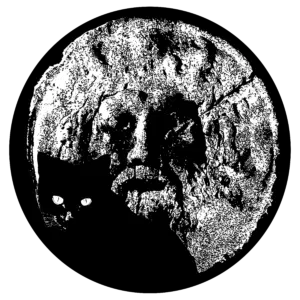
A monumental Assyrian face rises from a landscape of broken architecture. Behind it, fragments of Mosul’s religious and urban fabric stand among dense fields of black. The figure does not look back at an intact antiquity: it emerges through destruction.
The drawing is built around an inversion. Ruin fills the present, while one of the oldest visual traditions of northern Mesopotamia is made to stand upright again. The title is therefore not descriptive. It is a wager.
A five-metre hero from near Mosul.
The central figure was inspired by the colossal Assyrian hero from the palace of Sargon II at Dur-Sharrukin, modern Khorsabad, just outside Mosul. Now in the Louvre, the relief shows a frontal male figure overpowering a lion. The museum describes him as a royal image of overwhelming strength and notes that he has sometimes been identified with Gilgamesh.
Read more
A five-metre hero from near Mosul.
The central figure was inspired by the colossal Assyrian hero from the palace of Sargon II at Dur-Sharrukin, modern Khorsabad, just outside Mosul. Now in the Louvre, the relief shows a frontal male figure overpowering a lion. The museum describes him as a royal image of overwhelming strength and notes that he has sometimes been identified with Gilgamesh.
I did not reproduce the relief. I isolated the head and monumental beard and made the figure rise again inside the landscape from which this Assyrian image had once come.
That return matters. The ancient hero is not presented as a museum object illustrating a vanished civilisation. He is pushed back into northern Iraq and made contemporary again.
The ruins came first.
The surviving photographs show the image developing from left to right. The ruined skyline and the domed structure are established before the central head is completed. Large areas remain almost empty while the black ink slowly closes around them.
View process & sketches
The ruins came first.
The surviving photographs show the image developing from left to right. The ruined skyline and the domed structure are established before the central head is completed. Large areas remain almost empty while the black ink slowly closes around them.
The face appears relatively late. That sequence is important: the Assyrian figure is not a backdrop to the city. It is something that materialises out of the damaged ground.
Mosul between destruction and reconstruction
Daesh seized Mosul in June 2014. For three years, the city endured authoritarian rule, mass violence, displacement and the deliberate destruction of cultural and religious heritage. The devastation cannot be reduced to monuments: it was first a human catastrophe. But the attacks on buildings, manuscripts, museums and archaeological sites were also attacks on the layered identity of a city whose history had always been plural.
Read full historical context
Mosul between destruction and reconstruction
Daesh seized Mosul in June 2014. For three years, the city endured authoritarian rule, mass violence, displacement and the deliberate destruction of cultural and religious heritage. The devastation cannot be reduced to monuments: it was first a human catastrophe. But the attacks on buildings, manuscripts, museums and archaeological sites were also attacks on the layered identity of a city whose history had always been plural.
A city attacked through its memory
Among the most visible targets were the archaeological remains of ancient Nineveh and major monuments of Mosul itself. The Nergal Gate and other parts of Nineveh were damaged or destroyed, objects in the Mosul Museum were smashed, and religious sites belonging to different communities were attacked.
The Al-Nouri Mosque became one of the most charged symbols of the occupation. Daesh’s leader proclaimed his so-called caliphate there in 2014. As the group retreated during the battle for Mosul in June 2017, explosives destroyed the mosque and its celebrated leaning Al-Hadba minaret.
Khorsabad, Nineveh, Mosul
The Assyrian source in the foreground belongs to a much longer history. Sargon II founded Dur-Sharrukin — today Khorsabad — in the eighth century BC, close to modern Mosul. The palace reliefs excavated there in the nineteenth century entered European museums, including the Louvre. Nearby Nineveh became the capital under Sargon’s successors.
By bringing the Louvre hero back into a contemporary image of Mosul, the drawing collapses museum history, ancient Assyria and the violence of the twenty-first century into one surface.
The people who remained
Research conducted after the liberation documented how civilians survived under Daesh and through the final military campaign: shortages, insecurity, coercion, injury, displacement and loss. That lived history is why the work should not be read simply as a lament for destroyed architecture. The monuments matter because they belonged to a living city.
The future tense became a fact.
When I made the drawing in 2022, Mosul Will Rise Again was a statement of hope. UNESCO’s active reconstruction phase at the Al-Nouri Mosque was only beginning that summer.
Read more
The future tense became a fact.
When I made the drawing in 2022, Mosul Will Rise Again was a statement of hope. UNESCO’s active reconstruction phase at the Al-Nouri Mosque was only beginning that summer.
By January 2025, UNESCO reported the completion of its reconstruction of major heritage sites in cooperation with the Iraqi authorities and local communities. In September 2025, the Al-Nouri Mosque complex, the Al-Saa’a Convent and Al-Tahera Church were formally inaugurated after rehabilitation.
The city has not been returned to an untouched past, nor could it be. But the title can now be read differently: not as an imagined future, but as part of a reconstruction that actually happened.
The face is made of fragments.
The central head appears monumental from a distance, but close up it is almost unstable. The skin and beard are constructed from hundreds of small marks, interruptions and broken lines.
That texture matters. The figure is not restored to archaeological perfection. It rises as a body made from fragments — visually closer to rubble, excavation and reconstruction than to polished museum display.
The black eye sockets are especially severe. They make the hero less triumphant than watchful: something ancient has survived, but it has seen what happened.
Lithograph · 2024
A separate lithographic edition was produced from the original drawing in 2024 by Bruno Robbe.
50 × 35 cm
Rives BFK 270 g paper
Edition of 50
Signed and numbered
The lithograph is a distinct physical work and is not the 2022 original.
€250 · Brussels hand delivery by appointment · Elsewhere in Belgium & EU: €15 packaging/shipping · EU delivery only
Buy this lithographBrussels hand delivery · €250Exhibition history
View exhibition history
Exhibition history
- Full Circle, Brussels3 February – 25 April 2024 · original drawing
- Teloglion Fine Arts Foundation, Thessaloniki8 October – 10 November 2024 · original drawing
- Musée BIBLE+ORIENT, University of Fribourg25 March – 25 December 2025 · lithograph
Mosul, Khorsabad and reconstruction
View sources & further reading
Mosul, Khorsabad and reconstruction
- Musée du Louvre, “The Palace of Sargon II” — the colossal hero mastering a lion, sometimes identified as Gilgamesh, from Dur-Sharrukin / Khorsabad. Read online.
- UNESCO, “Al-Nouri Mosque” — history, destruction and reconstruction of the complex. Read online.
- UNESCO, “Revive the Spirit of Mosul: Heritage” — reconstruction completed in January 2025. Read online.
- UNESCO, “A milestone for Mosul: Iraq inaugurates iconic heritage sites rehabilitated by UNESCO”, September 2025. Read online.
- Lafta, R., Cetorelli, V. & Burnham, G., “Living in Mosul during the time of ISIS and the military liberation: results from a 40-cluster household survey”, Conflict and Health 12, 31 (2018).
- Cuneiform Digital Library Initiative, P346683, Old Babylonian tablet from Ur, c. 1900–1600 BC. Read online.