Finding
New Gods
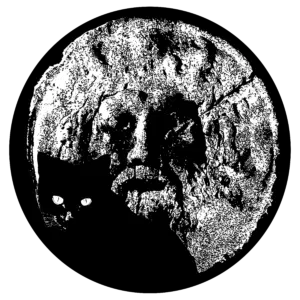
Skopje appears here as a city in which political memory has begun to assume the posture of belief.
Alexander the Great, Josip Broz Tito, the Stone Bridge and a fragment of the European circle of stars occupy the same black field. They do not belong to the same historical moment, yet each offers a different answer to the same question: what past should the city recognise as its own?
The title is deliberately ambiguous. The “new gods” are not religions in a literal sense. They are the heroes, rulers, monuments and political memories that public space places above us and asks us to look towards. In Skopje, those presences accumulate rather than replace one another.
Three claims on the city
The drawing is built around figures that point in different temporal directions: antiquity, Yugoslavia and contemporary Europe. The Stone Bridge holds them together physically, while the black ground makes them compete visually.
Before the city became a monument
The preparatory drawings show that the work did not begin as a catalogue of landmarks. It began with relationships: a bridge running across the sheet, Tito viewed from behind, Alexander pushed into the foreground and a handful of stars held apart in the upper field.
View process & sketches
Before the city became a monument
The preparatory drawings show that the work did not begin as a catalogue of landmarks. It began with relationships: a bridge running across the sheet, Tito viewed from behind, Alexander pushed into the foreground and a handful of stars held apart in the upper field.
The final drawing compresses those separate thoughts into one image. Architecture becomes a stage on which incompatible historical memories can coexist.
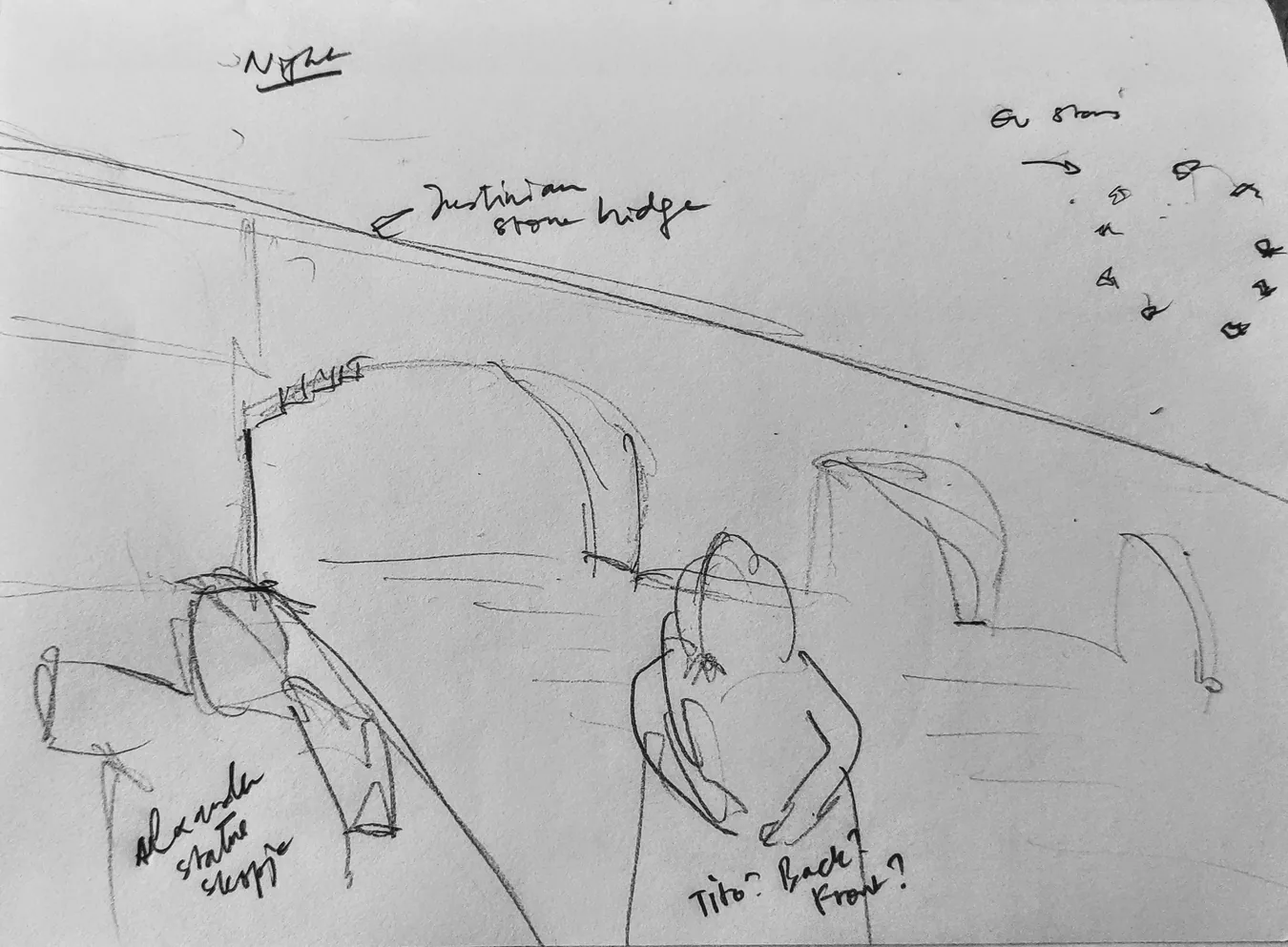
Early compositional study: the Stone Bridge, Tito and the placement of the European stars.
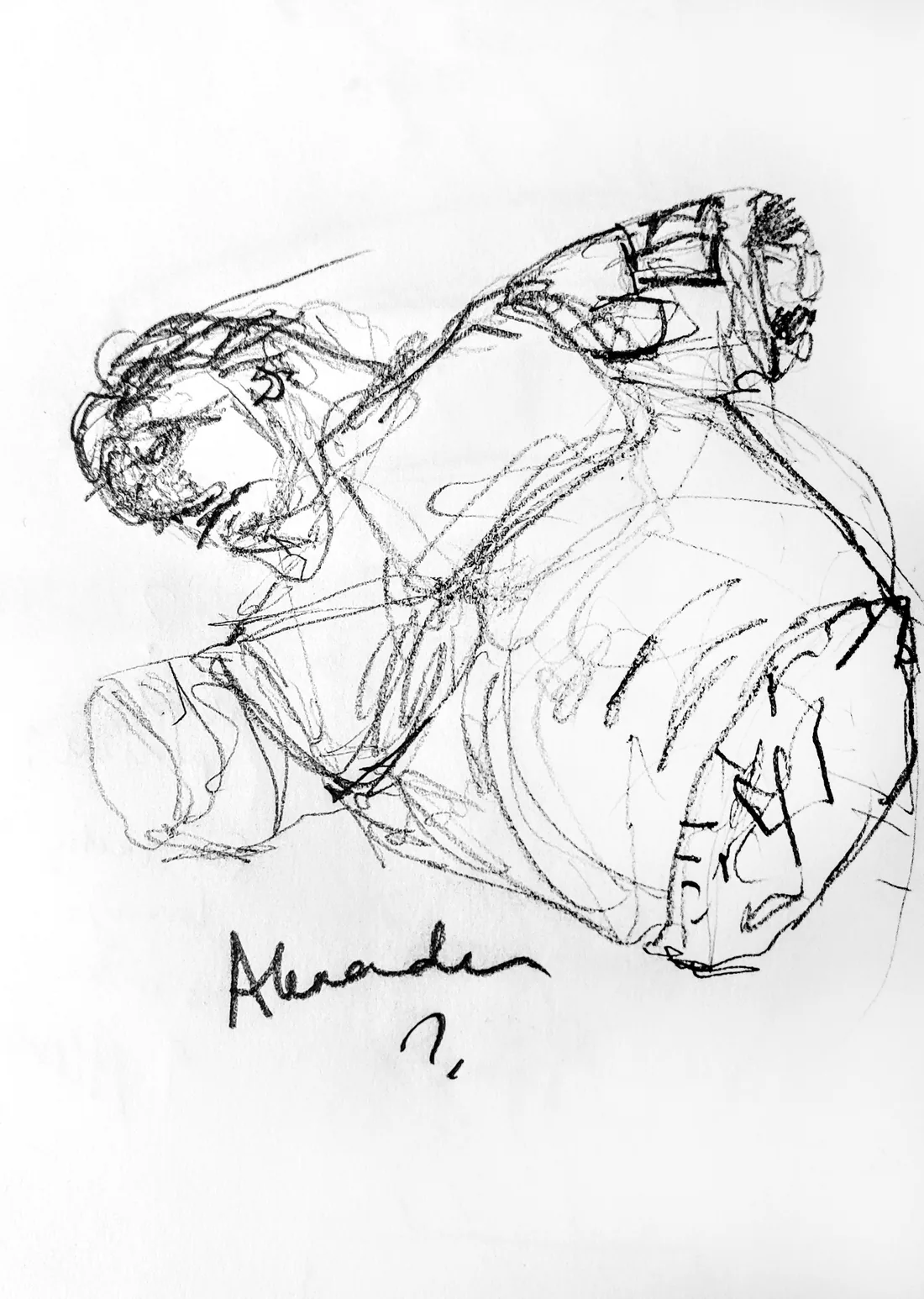
Study for the Alexander figure. The handwritten question remains visible in the working sheet.
Skopje and the invention of continuity
Skopje does not possess a single historical face. Roman and Byzantine precedents, more than five centuries of Ottoman rule, the Yugoslav period, the reconstruction after the catastrophic earthquake of 1963 and the post-independence city all remain legible in different parts of the capital. Finding New Gods is interested precisely in what happens when those layers are asked to form one coherent national story.
Read full historical context
Skopje and the invention of continuity
Skopje does not possess a single historical face. Roman and Byzantine precedents, more than five centuries of Ottoman rule, the Yugoslav period, the reconstruction after the catastrophic earthquake of 1963 and the post-independence city all remain legible in different parts of the capital. Finding New Gods is interested precisely in what happens when those layers are asked to form one coherent national story.
Skopje 2014 and “antiquisation”
The government-backed project known as Skopje 2014 was announced in 2010 and rapidly transformed the centre with new monuments, classical and baroque-style façades, museums, bridges and monumental statuary. Scholars and critics frequently describe one strand of this policy as “antiquisation”: the attempt to give modern Macedonian identity a more visible continuity with the ancient kingdom of Macedon.
The most conspicuous example is the enormous equestrian monument installed in Macedonia Square in 2011. Officially named Warrior on a Horse, it was universally understood as Alexander the Great. Its very ambiguity made it politically potent during the long dispute with Greece over the name “Macedonia” and over claims to the ancient past.
The Stone Bridge: a hinge between cities
The Stone Bridge crossing the Vardar is one of Skopje’s defining landmarks. The standing bridge is fundamentally an Ottoman monument of the fifteenth century, although archaeological evidence indicates an earlier bridge in the area during the age of Justinian. Today it links Macedonia Square with the Old Bazaar — two parts of the city whose architecture and historical associations are markedly different.
In the drawing, the bridge performs the same function conceptually. It connects Alexander and Tito without reconciling them. It is both passage and fault line.
Tito after Yugoslavia
Josip Broz Tito belongs to another historical order altogether. Socialist Yugoslavia formally disappeared in the 1990s, but Tito’s presence in Skopje has never simply vanished. His memory has been preserved, removed, contested and revived in monuments, institutions and in the history of the city’s reconstruction after the 1963 earthquake.
Here Tito is shown from behind. He is neither glorified nor caricatured. He looks across the river while the newer symbols rise around him. The posture turns him into a witness to a city whose public mythology continued to change after his death.
Crosses, stars and another future
Skopje’s monumental landscape is not limited to antiquity. The 66-metre Millennium Cross was erected on Mount Vodno in 2002 as a major Christian landmark visible above the capital. In the drawing, however, the religious cross is displaced by another sign high in the darkness: part of the European circle of stars.
That incomplete ring does not provide a solution. Europe appears as another horizon against which identity is negotiated — alongside the ancient past, Ottoman Skopje and the Yugoslav twentieth century.
After Prespa
The 2018 Prespa Agreement with Greece changed the country’s official name to the Republic of North Macedonia and also altered the interpretation of some of Skopje’s most controversial monuments. In 2019, plaques were added to monuments including the Alexander figure, clarifying their association with ancient Hellenic history and civilisation.
This later re-labelling is particularly relevant to Finding New Gods. Public monuments do not acquire one meaning at the moment they are erected. Their identities can be renamed, qualified and politically re-read — just as cities themselves are.
2002
The Millennium Cross is erected above Skopje on Mount Vodno.
2010
Skopje 2014 is publicly launched as a major remaking of the capital’s centre.
2011
The monumental Warrior on a Horse, widely identified as Alexander the Great, is inaugurated.
2018–19
The Prespa Agreement is implemented; the state becomes North Macedonia and interpretive plaques are added to ancient-themed monuments.
Exhibition history
View exhibition history
Exhibition history
- Full Circle, Brussels3 February – 25 April 2024 · included in the 21-work exhibition
- Teloglion Fine Arts Foundation, Thessaloniki8 October – 10 November 2024 · original drawing
- Musée BIBLE+ORIENT, University of Fribourg25 March – 25 December 2025 · lithograph
Lithograph · 2024
A hand-printed lithographic edition was produced from the 2022 drawing in 2024 by Bruno Robbe. It is a separate physical object from the original work.
€250 · Brussels hand delivery by appointment · Elsewhere in Belgium & EU: €15 packaging/shipping · EU delivery only
Buy this lithographBrussels hand delivery · €250Public memory in Skopje
View sources & further reading
Public memory in Skopje
- Anastas Vangeli, “Nation-building ancient Macedonian style: the origins and the effects of the so-called antiquization in Macedonia,” Nationalities Papers 39.1 (2011), 13–32. DOI.
- Andrew Graan, “Counterfeiting the Nation? Skopje 2014 and the Politics of Nation Branding in Macedonia,” Cultural Anthropology 28.1 (2013), 161–179. DOI.
- Skopje 2014 Uncovered, database entry for the “Equestrian Warrior” monument. Read online.
- HAEMUS Center for Scientific Research and Promotion of Culture, “Stone Bridge,” on the Ottoman monument and archaeological evidence for an earlier bridge. Read online.
- Ines Crvenkovska Risteska, “Tito Returns to Skopje: The Forgotten Memories of Josip Broz,” EthnoAnthropoZoom 20 (2020). DOI.