Tree of Life
The central menorah is immediately legible, but it no longer behaves as an isolated ritual object. Its branches keep going. They split, recombine, climb outward and become a tree. Crystal-like leaves appear. Birds settle into the structure until a diagram of light has become a habitat.
The transformation is deliberate. Geometry remains everywhere: triangles repeat along the branches, squares punctuate junctions, circles mark the seven lights and the descending axis. Yet the system does not produce sameness. It generates variation.
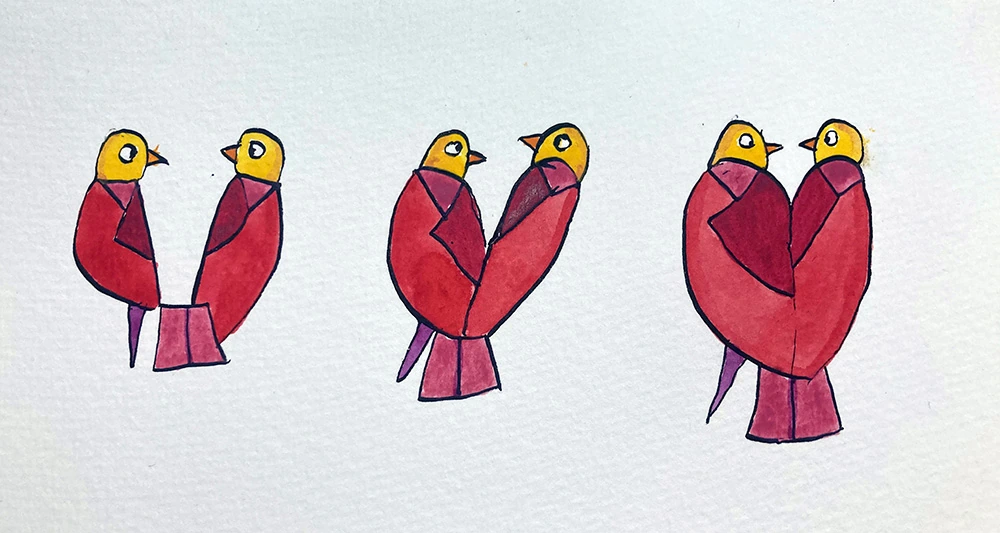
The birds are the first sign that solemnity will not control the image. Some are almost diagrams themselves; others develop extravagant crests, unexpected plumage or comic personalities. Two fold together into a heart. The work is mystical without becoming austere, and humorous without dissolving its symbolic structure.
Its optimism lies in that balance: order is not opposed to life. It is the framework from which life keeps inventing new forms.
A rule that produces difference
The drawing can be read almost mathematically. A small vocabulary of repeated forms establishes a visual grammar; within it, every bird becomes a variation.
Maimonides and the diagram
The historical point of departure is important, but it is not the subject of the drawing. Tree of Life does not attempt to reconstruct the Temple menorah. It begins instead with the extraordinary survival of a medieval diagram — and asks what can grow from it.
Read more
Maimonides and the diagram
The historical point of departure is important, but it is not the subject of the drawing. Tree of Life does not attempt to reconstruct the Temple menorah. It begins instead with the extraordinary survival of a medieval diagram — and asks what can grow from it.
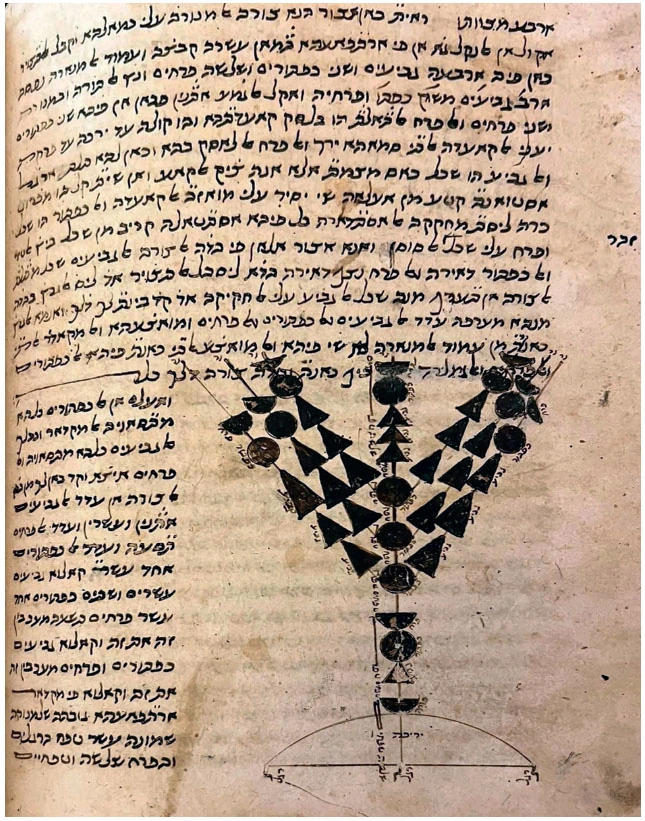
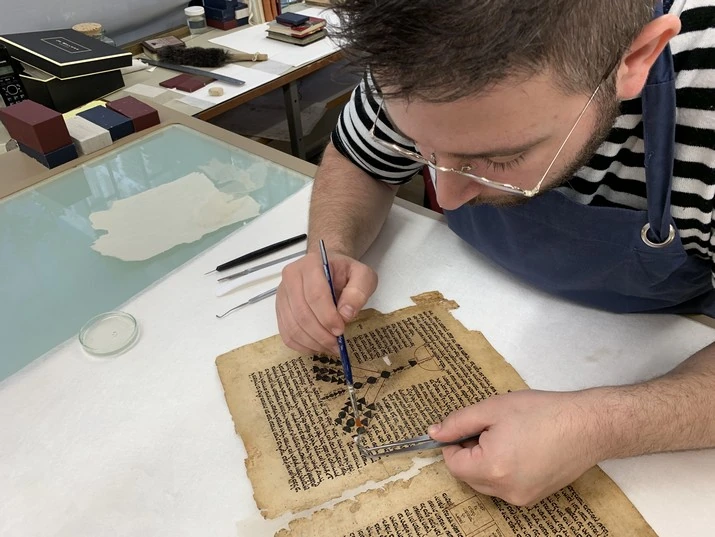
Oxford’s Bodleian Library preserves Maimonides’ autograph Commentary on the Mishnah, written in Judeo-Arabic and completed in 1168. On fol. 35b of MS. Pococke 295, beside his discussion of Menaḥot 3:7, appears the famous hand-drawn menorah with straight, diagonally rising branches — a form that has generated a long modern debate about the appearance of the Temple menorah.
That controversy is deliberately left at the edge of this work. What matters here is the visual intelligence of the diagram itself: an ordered stem, branching symmetrically into seven lights. Mitchell takes that compressed medieval scheme and subjects it to expansion. The branches cease to terminate. They become a tree.
The change is almost biological. A scholarly diagram designed to clarify form becomes a structure capable of producing leaves, birds, pairs, oddities and colour.
Inventing the birds
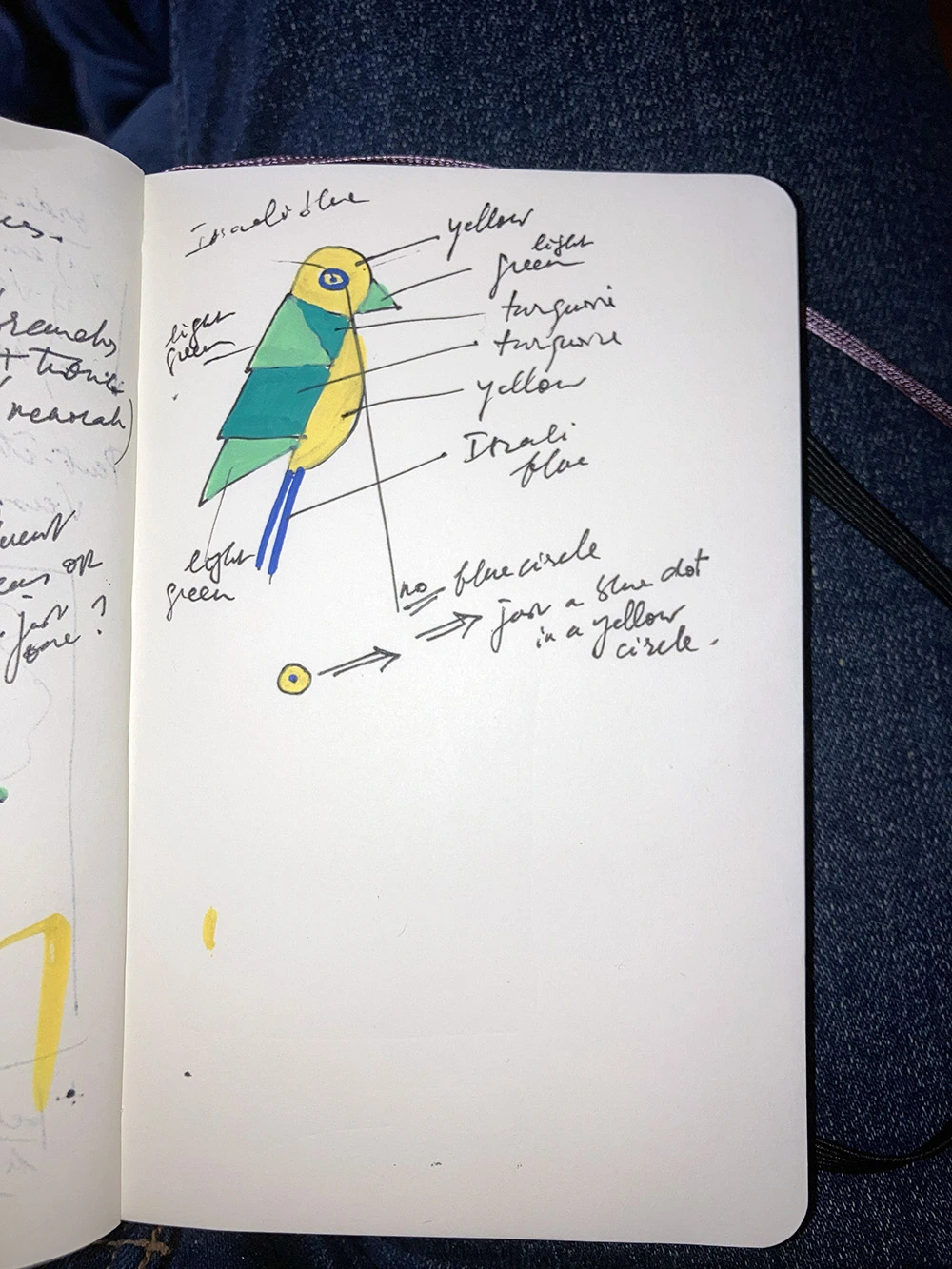
Before the large sheet filled with life, the birds were worked out separately. The preparatory pages reveal colour decisions, failed combinations, comic mutations and tiny acts of design.
View process & sketches
Inventing the birds
Before the large sheet filled with life, the birds were worked out separately. The preparatory pages reveal colour decisions, failed combinations, comic mutations and tiny acts of design.
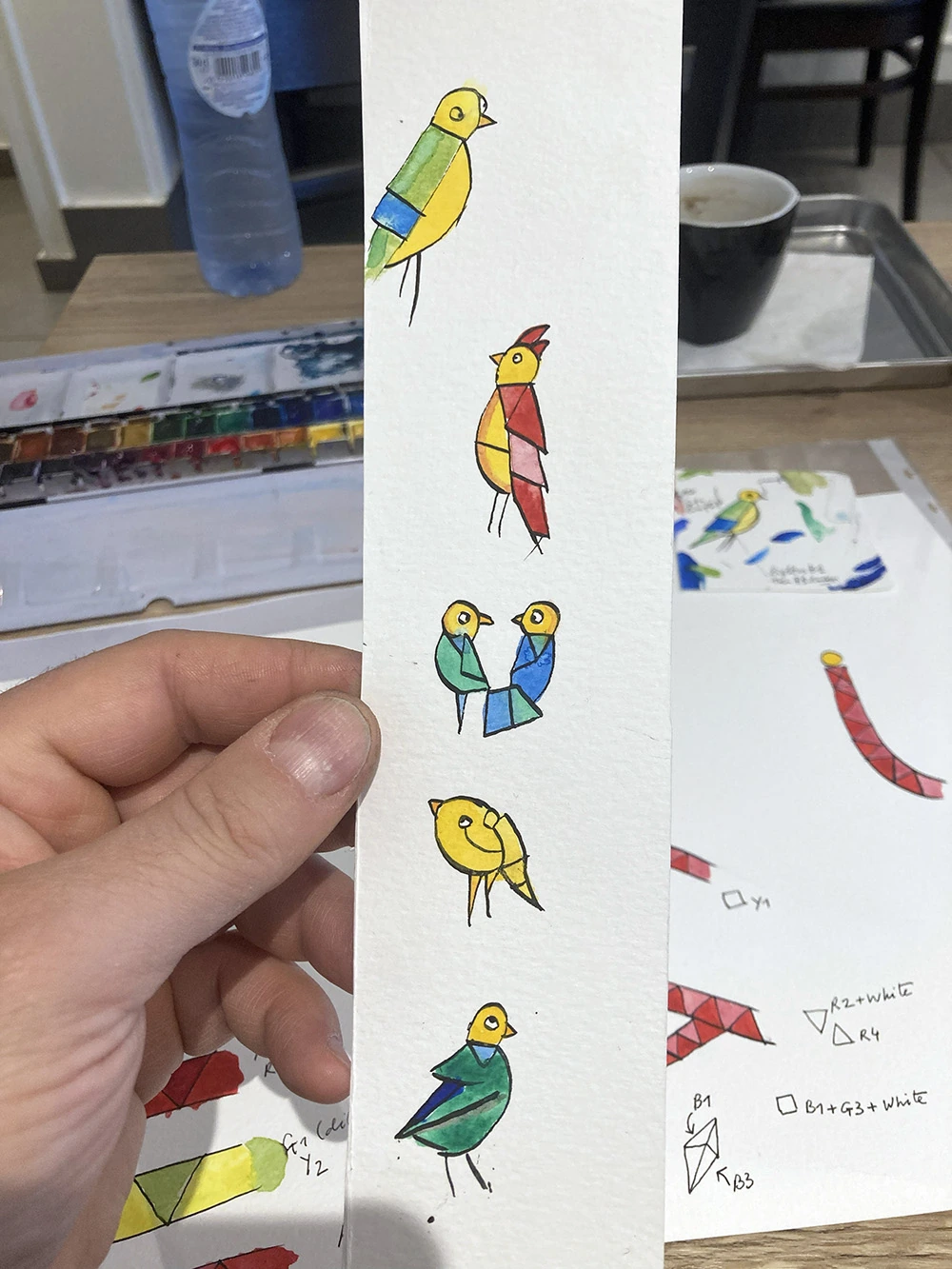
Colour entering the tree
The short studio film makes visible what the finished image conceals: the slowness of accumulation. Line comes first; colour is introduced in measured patches; a single bird may require its own miniature palette.
The physical sheet matters too. The grain of Canson Montval remains visible beneath the ink and watercolour, preventing the geometric forms from becoming mechanically perfect. The system is exact enough to hold together, but human enough to breathe.
Not survival by standing still
The menorah is a symbol of light. Here, however, there are no painted flames. Illumination has been displaced into colour, multiplication and life.
Read more
Not survival by standing still
The menorah is a symbol of light. Here, however, there are no painted flames. Illumination has been displaced into colour, multiplication and life.
One possible reading is a meditation on Jewish continuity. The image does not imagine endurance as the preservation of an unchanged form. The inherited structure remains visible, but it survives by generating difference: new branches, new combinations, new creatures.
The old geometry does not disappear; it becomes fertile.
That is where the humour matters. The playful birds prevent continuity from becoming monumental or mournful. The tree is crowded, sociable, slightly unruly and full of light. Tradition is not represented as a weight carried forward, but as a structure from which life keeps beginning again.
From seven lights to a world of creatures
A medieval diagram sits far behind the composition; mathematics regulates it; memory gives it depth. Yet the final image refuses to remain an argument about the past.
It turns outward. It grows.