Seed of Eternity
A tree records time without remembering it. Each ring is a year made visible, one season enclosed within another. Seed of Eternity begins with this familiar measure of time and turns it inward.
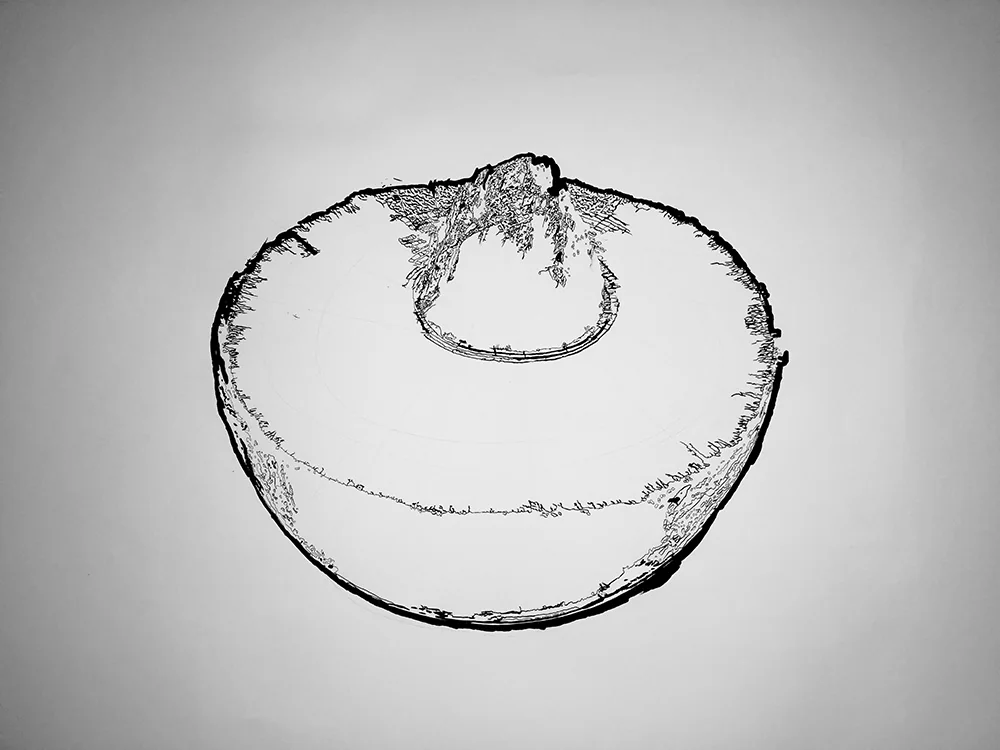
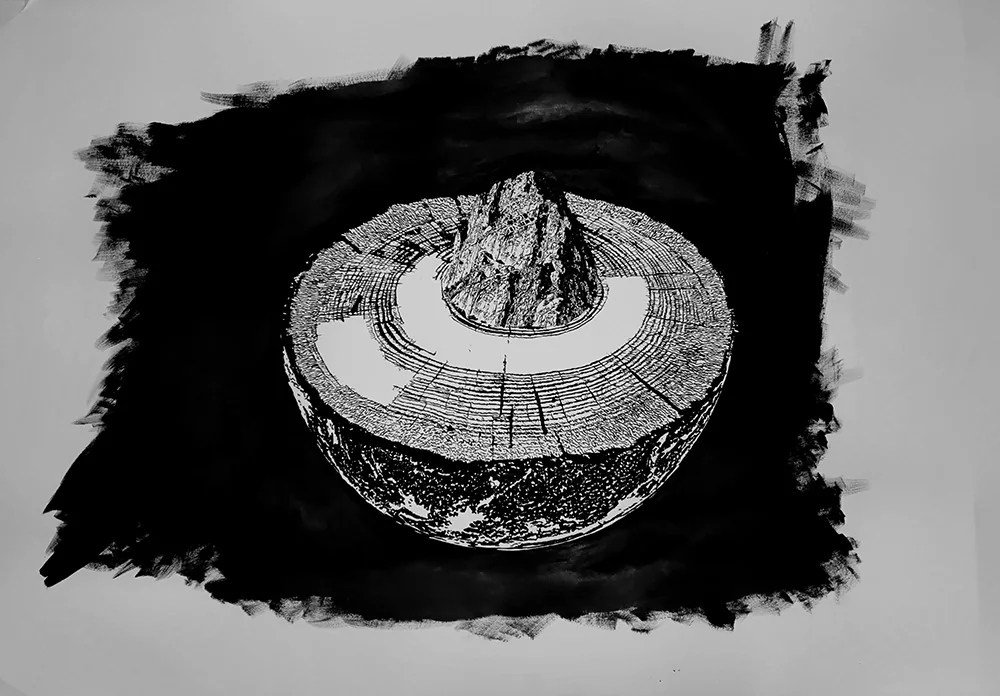
The cut trunk becomes a world. At its centre, stone rises from wood: the Tablets are not placed upon history, but imagined beneath it, at the point from which history itself seems to unfold.
The image is deliberately difficult to classify. It can be read as a tree stump, a planet cut open, a crater, a mountain encircled by time, or an altar-like form suspended in darkness. The ambiguity matters. This is not a reconstruction of Sinai, nor a historical scene. It is an attempt to give physical form to continuity.
Time made physical
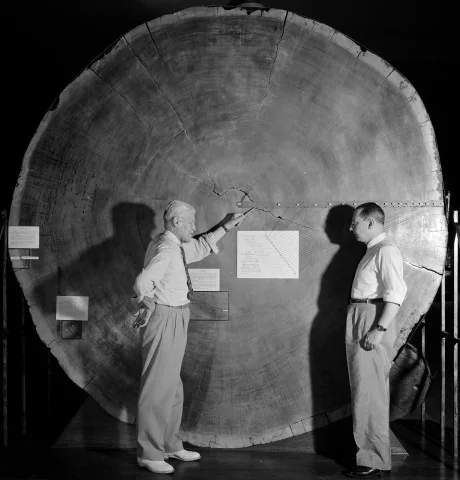
Dendrochronology reads time through accumulation. A tree does not replace one year with the next: it keeps them all. Growth occurs by adding another ring around everything that came before.
The drawing borrows that structure but reverses the scientific gaze. Dendrochronology moves through the rings in order to date the past. Seed of Eternity asks what might be found if one continued moving inward — beyond chronology, beyond individual generations, towards a centre that cannot itself be dated.
Wood, stone and a law older than the rings
The title contains a paradox. A felled trunk is an image of an ending; a seed is an image of beginning. Here the two occupy the same body.
At the core stand the Tablets of the Ten Commandments. They are not treated as an archaeological object and the drawing does not reconstruct the biblical episode. Instead they appear embedded within the organic structure itself — law imagined not as something added to human history, but as something beneath it.
Wood grows, ages, scars and eventually dies. Stone suggests another duration. Between them, the image sets biological time against the possibility of permanence: an organic world that changes around a centre conceived as enduring.
From centre to circumference
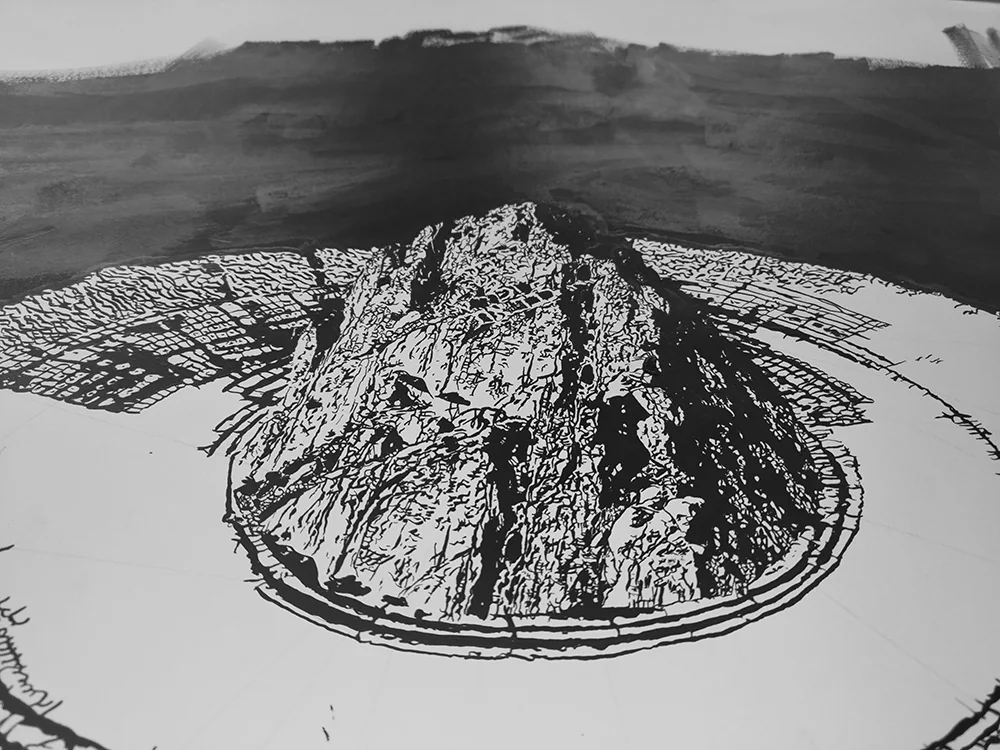
The surviving working photographs reveal an unusually close coincidence between subject and process. The image itself grows by accumulation.
View process & sketches
From centre to circumference
The surviving working photographs reveal an unusually close coincidence between subject and process. The image itself grows by accumulation.
Origin and reflection
The artist’s statement and a separate meditation by Avi Tawil offer two distinct registers: one describes the image; the other opens it into a more explicitly philosophical reflection.
Read more
Origin and reflection
The artist’s statement and a separate meditation by Avi Tawil offer two distinct registers: one describes the image; the other opens it into a more explicitly philosophical reflection.
Artist’s note
Seed of Eternity places the Ten Commandments at the heart of the earth, inscribed in stone as though they were the first roots of creation. The globe, cut open like a tree, reveals concentric rings of time — marking both the fragility and endurance of life.
These rings evoke growth, memory and the unfolding of generations, all circling back to a divine core. The work becomes both a meditation on origin and an invocation of continuity: the commandments as a seed that never withers, anchoring humanity to eternity.
Avi Tawil
Tawil reads the rocky centre as a divine ground and the rings as an existence that is simultaneously stable and always becoming. Past, present and future are not separate compartments: each is carried within the next.
The rock speaks of the limitless — the divine ground from which all life emerges. From this primal foundation, existence surges forth: first wild and untamed, then gently guided by laws that steady its growth like stakes in a garden. Unlike the shifting rules that mirror society’s needs, these laws are inscribed from the very beginning. They are the hidden currents that make flowers bloom, the silent intuition of the body to love, to give, to nurture a family.
This painting evokes the layered fabric of existence: eternal and unchanging, yet ceaselessly unfolding; rooted in nature’s order, yet ever renewing. Eternity is not only a distant horizon — it is revealed in every living detail of the present when we allow ourselves to connect with it. Within this harmony, discipline, courage, and character become the language through which we accept the moment and shape our destiny.
Here, time is not a passing measure but an otherworldly voice. The future beckons us forward, the present is shaped by each step we take, and the past stands as our enduring foundation. In every moment, eternity whispers — carrying both the strength of what has always been and the promise of what is yet to come.
The world returns to an object
After the image has been read as planet, crater, mountain and temporal diagram, the exhibition photograph restores its physical scale. It is once again paper, ink and a surface around which people gather.
View exhibition history
The world returns to an object
After the image has been read as planet, crater, mountain and temporal diagram, the exhibition photograph restores its physical scale. It is once again paper, ink and a surface around which people gather.
The change of viewpoint matters. Seen horizontally, the concentric form becomes almost topographical: something to lean over, inspect and circle with the eye. The mystical suggestion of the work is not diminished by its materiality; it depends on it.