Mystified
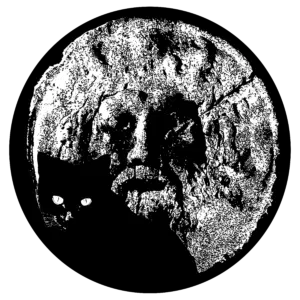
Mystified is a joke about certainty. A Minotaur sits and thinks beneath an enormous black thought-bubble. Inside it stands Knossos — not simply the Bronze Age palace, but the palace as the twentieth century taught us to imagine it.
The three shapes deliberately refuse to belong to the same historical world. The Minotaur comes from myth. The palace is archaeology filtered through reconstruction. The outline of the thought itself is instantly recognisable as a modern entertainment icon. The image asks what happens when the desire to make the past visible becomes so powerful that interpretation hardens into architecture.
A reconstruction inside a reconstruction
Everything in the drawing is unstable. We know the Minotaur as a creature of story, not excavation. We know the palace through material remains, but also through a century of photographs of Arthur Evans’s reconstructions. And we know the silhouette enclosing Knossos from an entirely different visual universe: mass entertainment, repetition and instant recognition.
Read more
A reconstruction inside a reconstruction
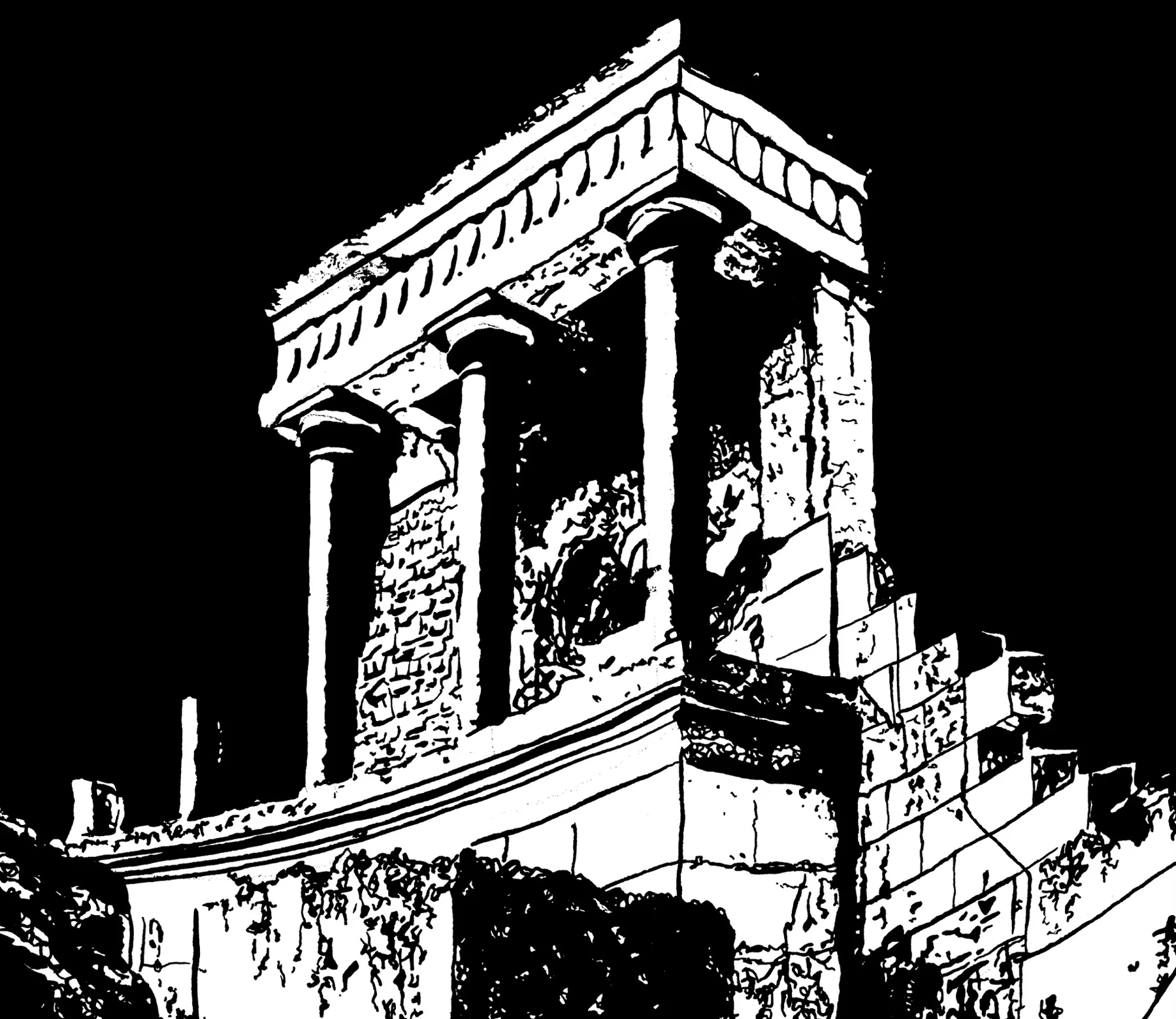
Everything in the drawing is unstable. We know the Minotaur as a creature of story, not excavation. We know the palace through material remains, but also through a century of photographs of Arthur Evans’s reconstructions. And we know the silhouette enclosing Knossos from an entirely different visual universe: mass entertainment, repetition and instant recognition.
The collision is deliberate. The black form does not say that Knossos is a theme park. It asks how easily a reconstruction can become an image stronger than the evidence that produced it. Once that image settles into collective memory, the public no longer sees a hypothesis. It sees “the past”.
When interpretation became concrete
Arthur Evans began excavating at Knossos in 1900. His achievement was immense: the palace complex, archives and wall paintings transformed the study of Bronze Age Crete, and his work helped create the modern concept of “Minoan” civilisation. But excavation was only part of his project. Evans wanted visitors to experience architecture rather than confront a field of broken masonry.
Read more
When interpretation became concrete
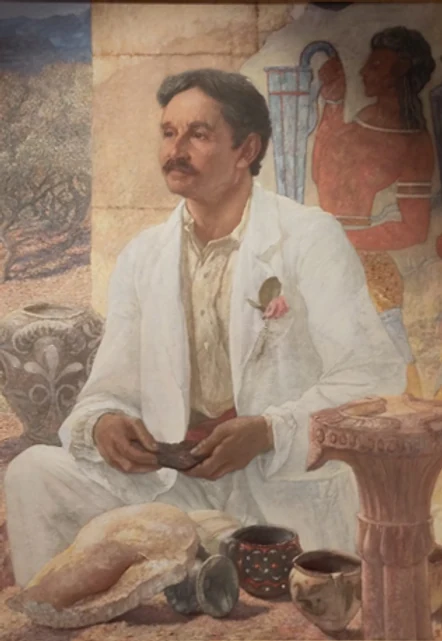
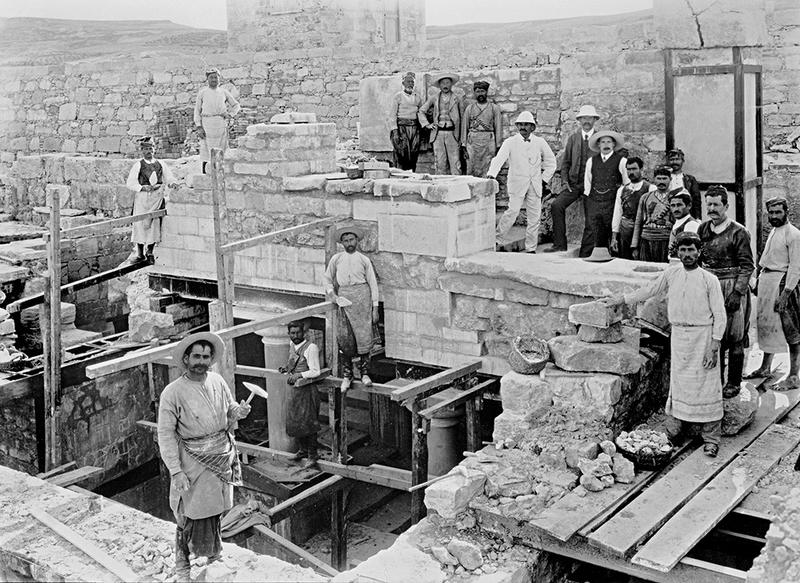
Arthur Evans began excavating at Knossos in 1900. His achievement was immense: the palace complex, archives and wall paintings transformed the study of Bronze Age Crete, and his work helped create the modern concept of “Minoan” civilisation. But excavation was only part of his project. Evans wanted visitors to experience architecture rather than confront a field of broken masonry.
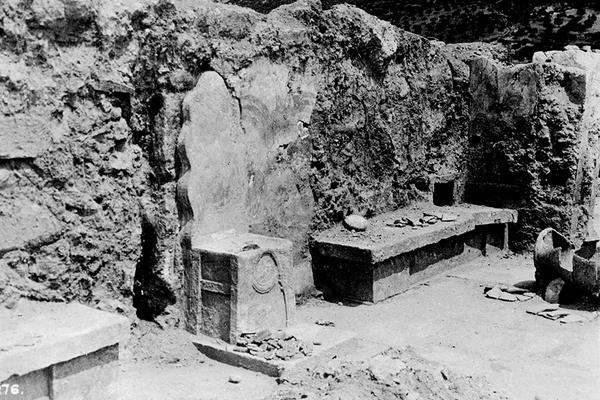
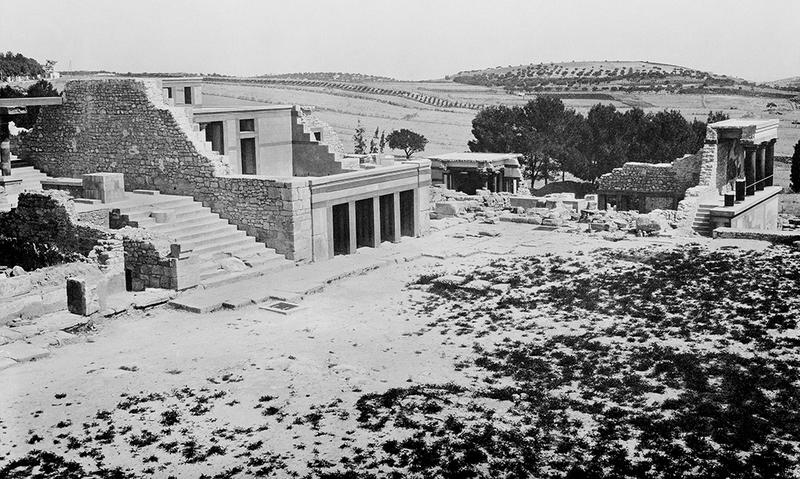
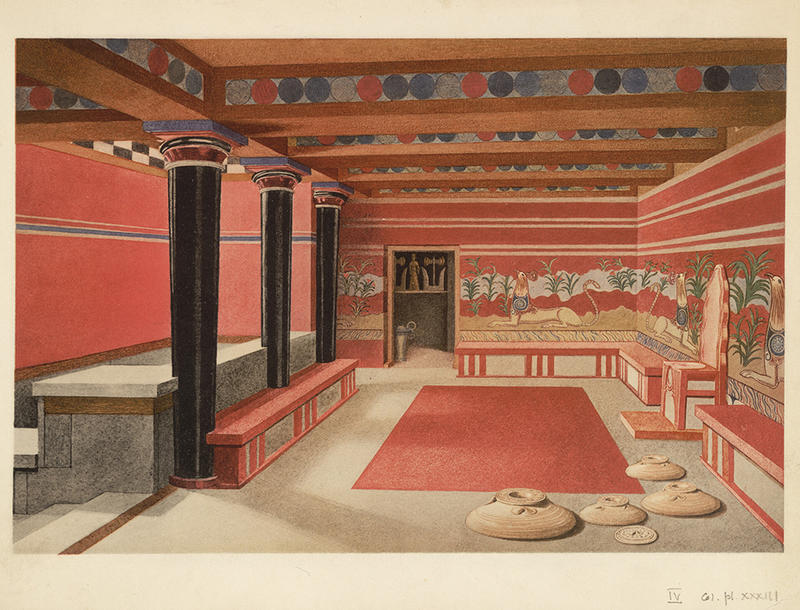
That ambition produced one of archaeology’s most famous experiments in reconstitution. Earlier protective measures gave way, particularly after the First World War, to extensive architectural rebuilding in reinforced concrete. Upper storeys, columns, stairways and painted spaces were recreated; reproductions of frescoes were placed within the new architecture. The work made Knossos spectacularly legible. It also fixed disputed interpretations into forms that looked permanent.
The problem is not simply that some reconstructions were wrong. Archaeological interpretation always changes. The deeper problem is material: once a conjecture is built at full scale, in concrete, it acquires the authority of a monument. Later scholarship can revise the argument, but the visitor still walks through the older argument.
The compulsion to fill the gap
Early archaeological restoration often treated absence as a problem to be solved. A broken wall invited completion; a fragment of fresco invited the missing composition; a surviving column invited the room around it. The impulse was understandable. Excavation produces disconnected evidence, while both scholars and visitors want spaces they can inhabit mentally.
Read more
The compulsion to fill the gap
Early archaeological restoration often treated absence as a problem to be solved. A broken wall invited completion; a fragment of fresco invited the missing composition; a surviving column invited the room around it. The impulse was understandable. Excavation produces disconnected evidence, while both scholars and visitors want spaces they can inhabit mentally.
But filling the gap can also conceal where evidence ends and imagination begins. At Knossos, visual completion was especially seductive because Evans already possessed a powerful model of the civilisation he believed he had discovered: elegant, courtly, colourful and distinctively “Minoan”. Restoration could therefore become circular. The reconstruction illustrated the interpretation, and the finished reconstruction then appeared to confirm it.
The modern virtue of the void
Contemporary conservation is generally more suspicious of completion. Interventions are expected, where possible, to be legible, limited and reversible. Missing elements may remain missing. A visitor is often asked to confront the archaeological void: foundations without roofs, walls that stop abruptly, fragments that refuse to become whole.
Read more
The modern virtue of the void
Contemporary conservation is generally more suspicious of completion. Interventions are expected, where possible, to be legible, limited and reversible. Missing elements may remain missing. A visitor is often asked to confront the archaeological void: foundations without roofs, walls that stop abruptly, fragments that refuse to become whole.
This can feel austere beside Knossos. The older restorer tried to give the ruin back its body; the modern conservator is more willing to preserve its wounds. That restraint protects the evidence for future interpretation, but it also changes the emotional encounter with antiquity. The past becomes less theatrical and, perhaps, more honest.
Knossos complicates any easy moral judgement. Evans’s interventions protected important structures and gave generations of visitors an extraordinary sense of scale and space. Yet the reinforced concrete itself aged, cracked and corroded, so that modern conservators have had to conserve the restoration as well as the antiquity beneath it.

Visibility
Reconstruction can make ancient architecture understandable at a glance.
Authority
Once built at full scale, a scholarly hypothesis can look more certain than the evidence warrants.
Reversibility
Modern conservation increasingly values interventions that future scholars can identify, question and, when necessary, undo.
Three layers of invention
Mystified deliberately stacks three different kinds of cultural fabrication. None of them is condemned simply for being invented. Myth makes meaning. Archaeological reconstruction can make space intelligible. Popular imagery creates forms that can be recognised in a fraction of a second. The danger begins when one category borrows the authority of another without admitting the exchange.
Read more
Three layers of invention
Mystified deliberately stacks three different kinds of cultural fabrication. None of them is condemned simply for being invented. Myth makes meaning. Archaeological reconstruction can make space intelligible. Popular imagery creates forms that can be recognised in a fraction of a second. The danger begins when one category borrows the authority of another without admitting the exchange.
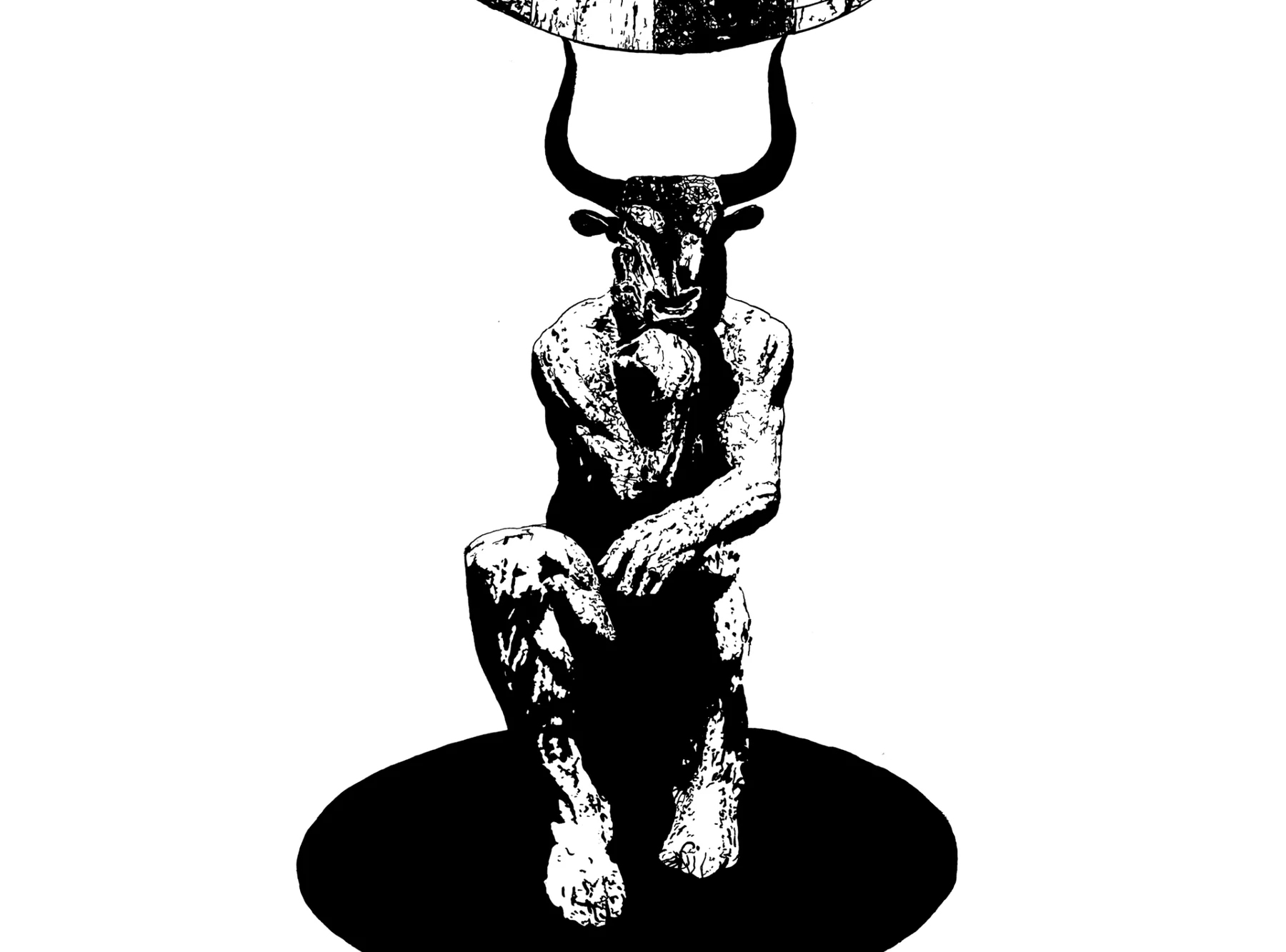
The Minotaur
A creature everyone knows to be mythical becomes the drawing’s sceptic: he is the one left wondering what later ages have made of his world.
Knossos
The palace appears through the visual language of reconstruction. What looks ancient is partly a twentieth-century proposition about antiquity.
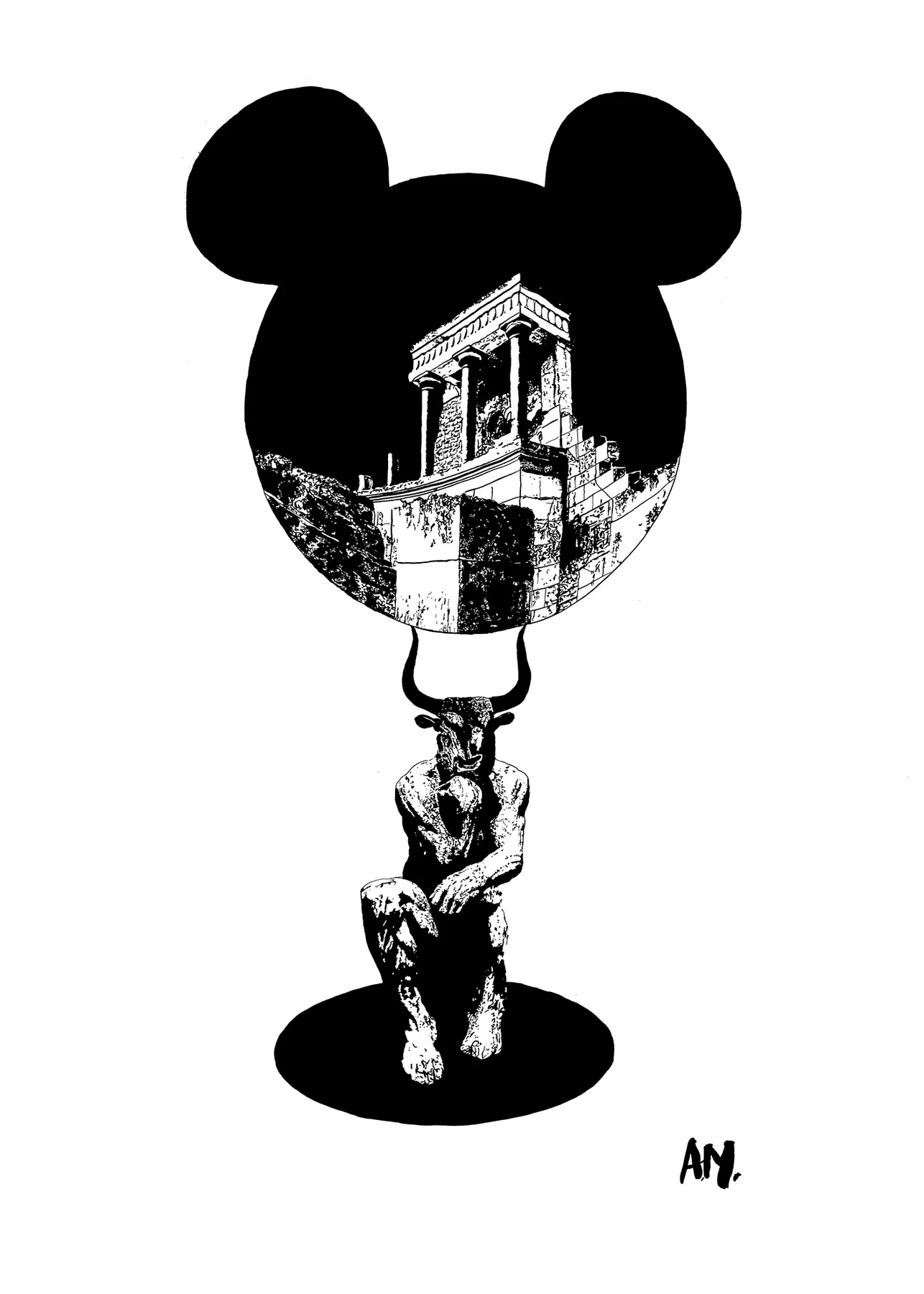
The silhouette
The familiar ears turn archaeological reconstruction into an image of instant consumption: memorable, seductive and almost impossible to unsee.
How much past should we rebuild?
Leave too little and an archaeological site can become unreadable except to specialists. Rebuild too much and interpretation begins to masquerade as evidence. Knossos is compelling precisely because it refuses to let that dilemma remain theoretical.
The drawing does not propose a solution. Its humour depends on the impossibility of one. We want the ancient world to become visible, complete and inhabited again; at the same time, we want every surviving trace to remain intellectually honest. Mystified leaves the Minotaur — and the viewer — caught between those desires.
Knossos, reconstruction and authenticity
View sources & further reading
Knossos, reconstruction and authenticity
- Lost Memory Art, “Mystified” — the artist’s original statement on authenticity, interpretation and the ethics of reconstruction. Read online.
- Smarthistory, Senta German, “Restoration versus conservation: the Palace at Knossos (Crete)” — a balanced account of Evans’s reconstructions, their benefits, inaccuracies and later conservation problems. Read online.
- Ashmolean Museum, Andrew Shapland, “Rebuilding the Palace of Minos at Knossos” — archival photographs of the excavation and successive restorations, including the Throne Room and Grand Staircase used above. Read online.
- Cambridge University Press, Arthur Evans, The Palace of Minos — Evans’s monumental publication of the excavations and his programme of structural reconstitution. Read online.
- Annual of the British School at Athens, “The Power of Images: Re-examining the Wall Paintings from the Throne Room at Knossos” — a study of successive post-excavation reconstructions and the interpretative history of the painted programme. Read online.
The comparative images combine archival material from the Ashmolean Museum’s Sir Arthur Evans Archive with a Creative Commons photograph from Wikimedia Commons. They are used here to clarify the visual genealogy and conservation argument of the work.